AI Agent Developer in Armenia: Which Projects Actually Make Sense
A practical framework for deciding when agentic AI is worth building
Workflow ownership, tool permissions, RAG context, approval boundaries and production logs
How this long-tail guide supports the broad Armenia AI specialist landing page
AI agent developer Armenia, agentic AI systems, tool calling and human approval workflows
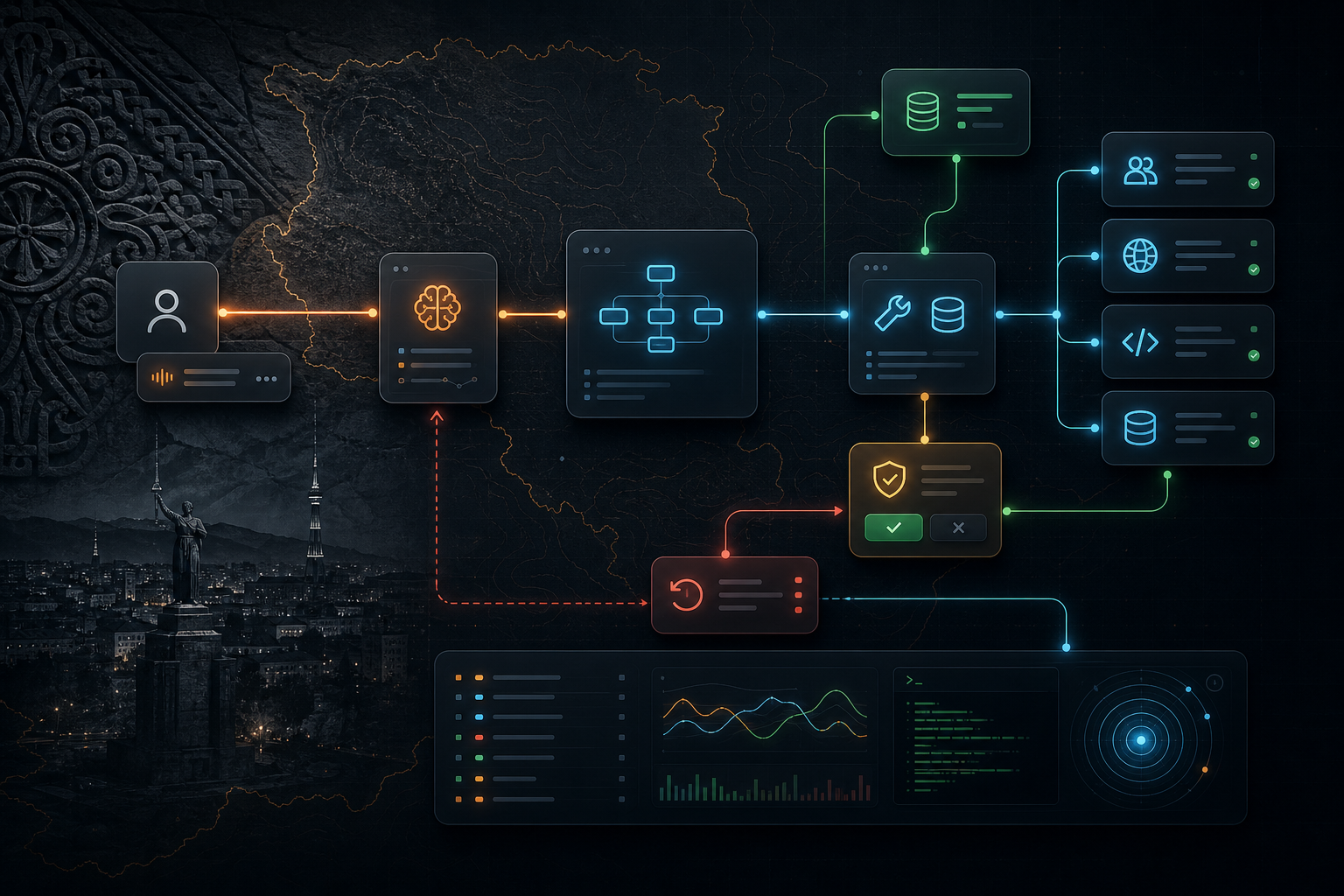
$ evaluate ai_agent_developer --market armenia
> inspect: workflow / tools / context / approvals / state
> route: audit / controlled_agent_pilot / production_agent_system
> output: project_fit_before_autonomy_claimsHiring an AI agent developer in Armenia is not the same as asking someone to add a chatbot to a website. An agent project becomes useful only when the system can understand a business request, choose a controlled next step, call tools safely, use the right context, ask for approval when needed, and leave enough trace for a human team to audit the result.
That is why the first question is not "can we build an agent?" The better question is: which business decision or repeated operation deserves an agent workflow instead of a simpler automation, RAG assistant, n8n workflow, internal tool, or classic software feature?
This article is a long-tail guide for companies evaluating an AI agent developer in Armenia. The broad commercial search intent belongs to the dedicated AI specialist in Armenia landing page. This page is narrower: it helps founders and operations teams decide whether an agent-style system is the right format for a real project.
When an AI agent is the right shape
An AI agent makes sense when the task has several possible paths and the next action depends on context. A simple prompt is enough for rewriting text. A RAG assistant is often enough for answering from documents. A classic integration is better when every step is deterministic. An AI agent becomes useful when the workflow needs conditional reasoning, tool use and controlled state across more than one step.
In practice, that usually means one of these situations:
- a support request must be classified, checked against knowledge, routed and drafted;
- a sales lead must be enriched, compared with CRM history and prepared for human review;
- an internal request must gather data from several systems before proposing a decision;
- a document workflow must extract fields, compare policies and request approval;
- an operations task must decide between multiple tools, but cannot act without audit logs.
The agent should not be treated as an independent employee. It is an orchestration layer around existing tools, rules, data and approvals.
Local comparison table
The fastest way to avoid overbuilding is to compare the project format before choosing a developer.
| Project need | Better first format | When to consider an AI agent |
|---|---|---|
| Answer questions from company documents | RAG assistant | The answer also needs tool calls, ticket routing or follow-up actions |
| Move data between CRM, forms and messengers | n8n or API workflow | The route changes based on ambiguous text, policy or context |
| Draft emails or summaries | LLM feature | The system must choose context, inspect history and prepare next actions |
| Build a customer-facing assistant | Controlled chatbot or RAG | The assistant must create cases, schedule steps or escalate with rules |
| Review operational exceptions | Internal tool plus AI triage | The system needs multi-step investigation before human approval |
This comparison matters in Armenia because many companies are still connecting CRM, messengers, spreadsheets and internal tools. If those systems are not mapped, an "agent" label can hide basic integration debt.
Selection criteria for an AI agent developer
A serious AI agent developer should be able to discuss boundaries before models. Useful criteria include:
- Can they name the workflow owner, user roles and final decision maker?
- Can they separate model suggestions from system actions?
- Can they design tool permissions, validation and approval gates?
- Can they explain what state the agent stores between steps?
- Can they test failure cases, missing data and contradictory instructions?
- Can they connect the agent to CRM, RAG, APIs, logs and monitoring without making the model the source of truth?
The strongest signal is not a demo where the model appears autonomous. The stronger signal is a design that shows what the model is forbidden to do.
A practical scoring method
Use a simple score before paying for development:
| Criterion | Good signal | Risk signal |
|---|---|---|
| Workflow fit | Repeated task with clear owner and exception path | Vague "agent for everything" request |
| Data readiness | Known systems, fields, documents and permissions | Important context lives only in people's heads |
| Tool safety | APIs have scoped permissions and validation | Agent can write to live systems directly |
| Human approval | Sensitive actions require review | Approval is added only after something goes wrong |
| Evaluation | Real examples and failure cases exist | Success is judged by a few impressive demos |
| Maintenance | Logs, prompts, tool schemas and ownership are documented | Nobody owns changes after launch |
If the score is weak, start with an AI audit or a smaller automation pilot. That is usually cheaper than building an agent that must be rebuilt after the first real workflow review.
What the working process should look like
The first phase should be an audit, not code. The developer maps the business process, users, systems, data sources, tools, permissions and failure modes. For a company in Armenia, this often includes CRM records, WhatsApp or Telegram communication, forms, spreadsheets, document storage and internal rules.
The second phase is a narrow pilot. The pilot should not try to automate the whole company. A good first slice might classify inbound requests, retrieve relevant context, draft a suggested response and create a task for review. That already tests routing, context, prompts, tool calls and approval without giving the agent uncontrolled authority.
The third phase is hardening. That means structured outputs, validation, idempotent actions, retries, logs, monitoring, cost controls, permission limits and rollback notes. Production AI agent work is closer to systems engineering than to prompt entertainment.
Example from practice
One practical pattern from aicoding.am work is the browser-first messaging runtime behind AmoBit Inbox. The project itself is not presented as a public autonomous agent. Its value for agent work is architectural: conversations, contacts, media access and workspace boundaries are handled by a controlled application layer instead of leaving state inside a model conversation.
That matters because AI-assisted routing, drafts or summaries need a reliable source of truth. Before an agent can help an operator, the system needs protected media access, conversation state, workspace isolation and auditable backend data. In other words, the agent layer is only useful when the operational substrate is already controlled.
See the proof layer in case studies and the broader service map in services.
Red flags
Be careful when a proposal says the agent will "decide everything", "replace a department" or "learn your business automatically" without naming data sources, permissions, approval points and failure handling. Those claims are usually too broad to verify.
Other red flags:
- no distinction between agent, chatbot, RAG and workflow automation;
- no plan for human approval before writes to CRM, payments, legal records or customer communication;
- no test set from real examples;
- no logs or monitoring plan;
- no rollback path when the agent takes a wrong branch;
- no maintenance owner after launch.
An AI agent can support operations. It should not become an invisible place where business rules disappear.
Practical next step
If the project is still unclear, start with a short AI audit. Prepare one repeated workflow, current tools, example inputs, desired outputs, decisions the AI must not make, and the first safe action that could be proposed to a human.
For aicoding.am, the useful starting point is usually a small project brief: workflow, systems, data, approvals, risks and the smallest pilot that would prove value. That keeps the article intent separate from the broad AI specialist Armenia landing page while giving companies a concrete way to evaluate an AI agent developer.
Where This Applies
AI agent audit, controlled pilot and production-safe tool orchestration
This article is useful when a company in Armenia needs to decide whether a repeated process deserves an AI agent, a RAG assistant, an n8n workflow or a simpler integration.
- Founders comparing an AI agent developer, AI automation specialist, studio or internal engineer.
- Operations teams preparing tool permissions, approval gates, CRM context and exception paths.
- Companies that need criteria-based selection instead of autonomous-agent promises.
agent_readiness = workflow_owner
  + tool_permissions
  + context_policy
  + approval_boundary
  + state_contract
  + eval_cases
  + observability;
if (agent_can_write_live_data) require("human_approval");
if (process_is_not_mapped) start("audit_before_agent");