AI Automation ROI Calculator: Time, Cost and Risk
Estimate a controlled pilot with ranges and assumptions, not a promised savings percentage
Time baseline, TCO, risk reserve, budget controls and a measurable 30-day decision
Original ROI-RANGE-7 model with a copyable three-scenario calculator and acceptance gate
AI automation ROI calculator, AI automation ROI, AI back office automation, AI automation cost, AI implementation TCO, automation pilot budget, AI business automation and ROI-RANGE-7
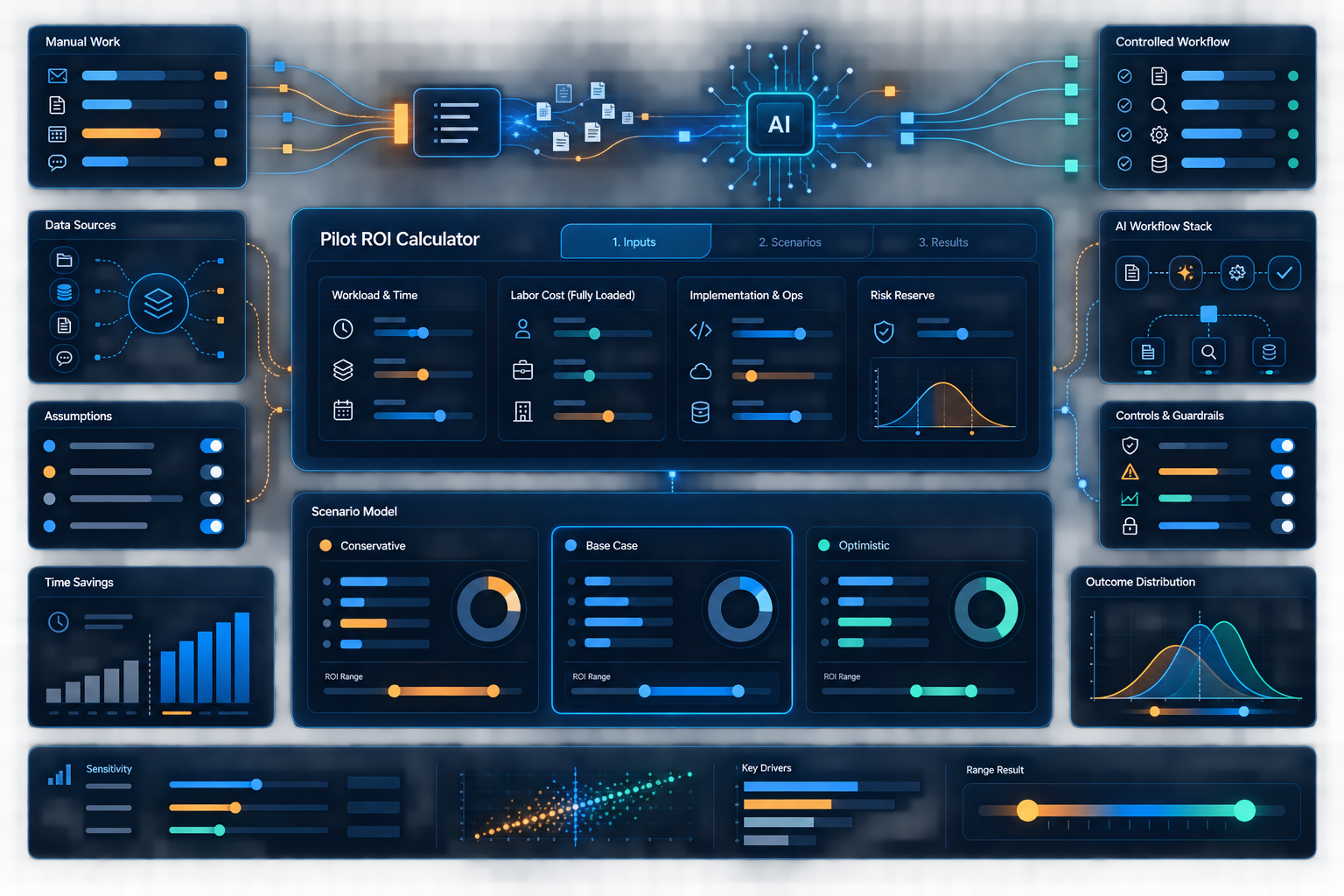
$ estimate roi --contract ROI-RANGE-7
> map: process / owner / baseline / exclusions
> measure: volume / minutes / quality / handoffs
> model: low / expected / high / currency-date
> cost: discovery / build / operations / reserve
> gate: authority / acceptance / recovery
> decide: pilot / stop / revise / read-back
AI automation ROI is a decision range, not a promised percentage
An AI automation ROI calculator should help a team decide whether a specific process deserves a pilot. It should not manufacture a savings claim from a demo, a vendor day rate, or an optimistic number of hours. The useful question is: *under which documented assumptions could a controlled workflow return more value than it costs, and what evidence would change the decision?*
Broad AI automation planning belongs to the AI automation service page. This article is a narrower, reusable long-tail tool: a copyable model for time, cost, risk and total cost of ownership (TCO). It supports, rather than replaces, the commercial local-intent landing page at AI specialist Armenia.
The calculator: inputs before outputs
Use one row per workflow: invoice intake, support triage, reporting preparation, onboarding checklist, or another bounded repeatable task. Do not mix different owners, policies and outcomes into one number.
annual_gross_value = volume × minutes_saved_per_case ÷ 60 × loaded_hourly_cost
annual_net_value   = annual_gross_value - annual_operating_cost - annual_risk_reserve
ROI                = (annual_net_value - implementation_cost) ÷ implementation_cost
payback_months     = implementation_cost ÷ max(annual_net_value ÷ 12, 1)
The formula is deliberately plain. It makes the assumptions reviewable instead of turning the model into a black box. It is an estimation framework, not financial, tax, legal or accounting advice.
| Input | What to record | Do not assume |
|---|---|---|
| Volume | completed cases in a representative period | every incoming item is suitable |
| Time | measured manual minutes, including review and rework | the fastest observed case is typical |
| Cost | agreed loaded hourly cost or a documented range | salary alone is the delivery cost |
| Quality | baseline errors, queue age and exception rate | model output is automatically correct |
| Build cost | discovery, design, integration, tests and release | prototype effort equals production effort |
| Operating cost | hosting, model/API usage, monitoring, support and change work | the workflow has zero running cost |
| Risk reserve | owned exception handling, recovery and compliance review | unknowns have no cost |
Use currency explicitly, date the sheet, state whether figures are monthly or annual, and record who owns every source. A range is more honest than a false decimal point.
Three planning scenarios
The following scenarios are illustrative model shapes, not market prices or a promise of savings. Replace every input with local evidence before choosing a budget.
| Scenario | Suitable boundary | Value model | Cost profile | Decision signal |
|---|---|---|---|---|
| Small | one team, one source, human approval remains | time freed from a repeatable preparation step | discovery, one integration, review queue and monitoring | test whether adoption and exception handling are viable |
| Medium | several users, versioned policy and two systems | time plus fewer avoidable handoffs, measured separately | integration hardening, access control, observability and support | compare a bounded pilot with current manual queue metrics |
| Complex | multiple systems, material exceptions or regulated context | only evidenced operational value; do not price avoided risk as guaranteed return | security, change management, testing, recovery and named owners | require a staged business case and explicit authority boundaries |
For each scenario, maintain low, expected and high inputs. A low case can use conservative time saved, a high operating-cost estimate and a larger exception reserve. The expected case must not be a disguised best case. If the result changes from viable to non-viable with a small input change, the next work is measurement, not implementation.
The costs a simple development quote misses
The build invoice is only one part of TCO. A decision-ready estimate separates one-time work from recurring work and shows the owner of each line.
- Discovery and process mapping. Measure the current path, exclusions, source quality, manual handoffs and success condition.
- Workflow and integration design. Define event contracts, permitted fields, source systems, destination write boundary and idempotency.
- Controls and review. Add policy checks, human authority, audit receipt, exception routing and recovery.
- Validation. Prepare representative test cases, failure cases, acceptance criteria and a release decision.
- Operations. Budget for hosting, model usage, access review, alerting, observability, support and policy/data changes.
- Change work. Train users, revise instructions, retain fallback capability and reassess the model after the pilot.
Do not treat reduced manual minutes as cash released unless the organization can actually redeploy capacity or avoid a confirmed future cost. In many teams the first value is shorter queue age, clearer ownership and fewer rework loops. Those outcomes matter, but they need their own metric rather than being silently converted into money.
A copyable 30-day estimation sheet
Build a small table with the columns below. Keep the original source or measurement note beside every value.
| Field | Low | Expected | High | Evidence / owner |
|---|---|---|---|---|
| Cases per month | queue report / process owner | |||
| Manual minutes per case | time sample / operator | |||
| Minutes saved after review | pilot observation | |||
| Loaded cost per hour | finance or management assumption | |||
| One-time implementation cost | scope estimate / delivery owner | |||
| Monthly operating cost | platform and support owner | |||
| Monthly risk reserve | exception owner | |||
| Quality or service constraint | baseline and acceptance gate |
Then calculate the result for each column and add two non-financial gates: “Who may approve the workflow?” and “What happens when the destination cannot be verified?” A calculator without a recovery owner is not complete enough to justify automation.
Budget controls for a controlled pilot
Start with a 30-day pilot only after agreeing its boundary: one named process, a small allowed input set, one measurable manual handoff, a policy version and a reviewer. AI may prepare a classification, summary or draft; deterministic code and authorised people retain decisions that create material commitments.
Review the model weekly. Compare actual volume, manual minutes, exception rate, correction rate, operating cost and destination read-back with the assumptions. Stop or redesign if source quality is poor, exceptions grow, policy is unclear, or the workflow cannot prove its final state. This keeps a pilot from becoming an unmeasured subscription plus an unowned queue.
For implementation patterns, see AI automation architecture and the case studies. Bring the completed input table—not only a desired outcome—for a range-based estimate of TCO, budget and a controlled next step.
A useful ROI conclusion
Good ROI work narrows uncertainty. It does not promise that every task should be automated or that AI replaces a team. A defensible estimate shows the assumptions, gives conservative ranges, assigns each operating and risk cost to an owner, and identifies the evidence required for a rollout decision. That is the point of the calculator: a decision a team can inspect, revise and safely act on.
require(process.owner && baseline.source && assumptions.currencyDate);
require(costs.build && costs.operations && risk.reserve && scenarios.length === 3);
pilot = reviewer.authorized && metrics.measurable && recovery.owner && destination.readBack;