AI Automation vs Classical RPA: Where Does the Boundary Lie?
A criteria-based comparison of deterministic execution and bounded inference
Applicability, speed, TCO, risk, control and maintenance
Original BOUND-6 weighted matrix with three typical scenarios
AI automation vs RPA, hybrid workflows, architecture selection and operational control
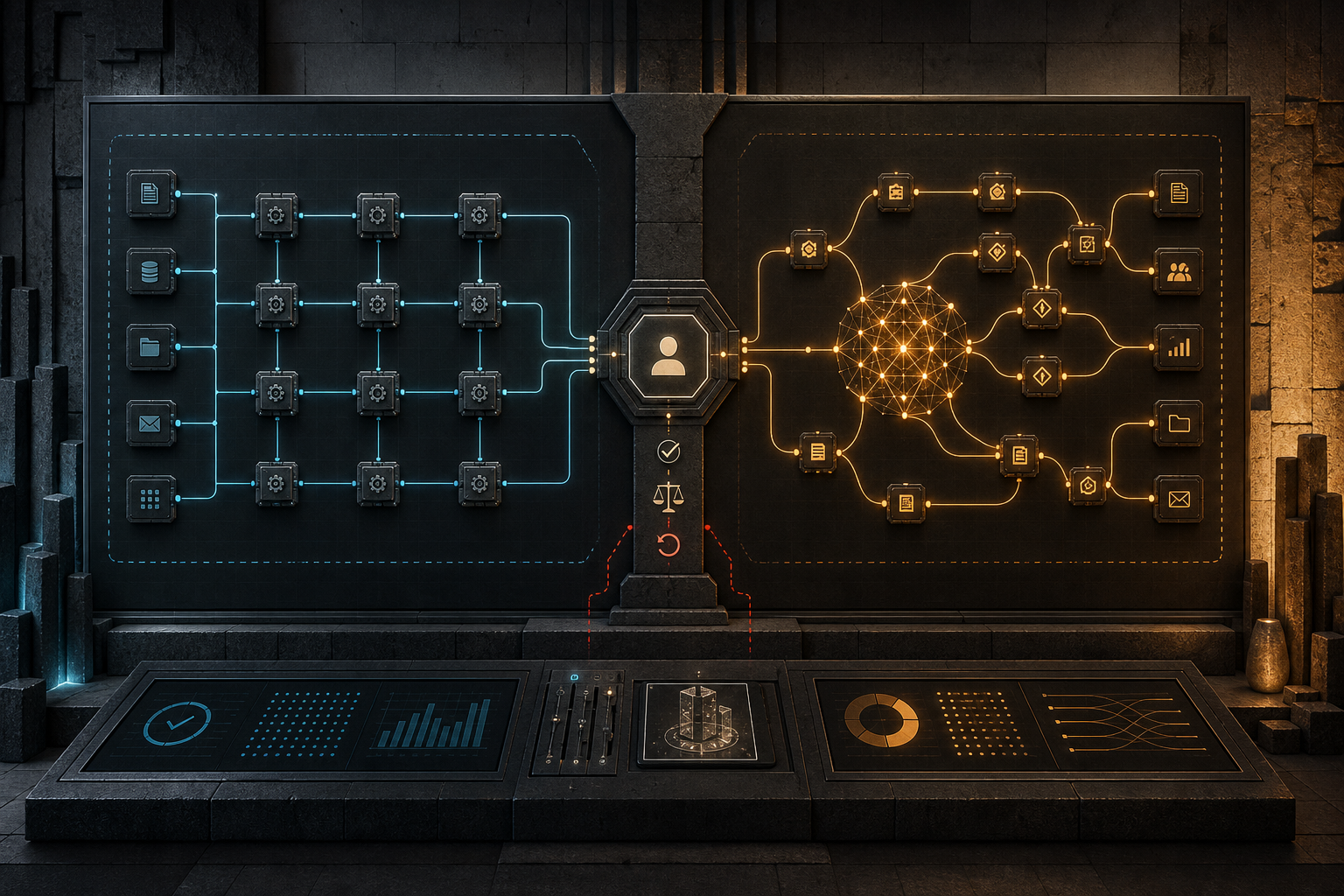
$ compare automation --rpa --ai
> map: stability / input / judgment / change
> weigh: control / operating economics
> route: rpa / ai / hybrid / redesign
> verify: pilot / exceptions / rollback / owner
AI automation and robotic process automation solve different kinds of uncertainty. RPA is strongest when the path is known, inputs are structured and the same action must be repeated exactly. AI automation is useful when the system must interpret language, images or variable context before it can choose a bounded next step. Many production workflows need both: AI proposes a classification or draft, while deterministic rules, RPA and human approval control what happens next.
This is not a contest between an old and a new technology. It is an architecture decision. Start from the process, score the uncertainty and consequences, and choose the simplest mechanism that can meet the acceptance criteria. The broader commercial intent for implementation belongs to the AI automation service and AI specialist in Armenia pages; this guide answers the narrower selection question.
What exactly are we comparing?
Classical RPA reproduces explicit interactions with software: open a screen, read a defined field, copy a value, click a known control, download a report or move a record. It can also call APIs and execute rules, but its defining advantage is deterministic repetition over a stable contract.
AI automation introduces probabilistic interpretation. A model can classify a free-form request, extract fields from inconsistent documents, summarize a conversation, compare evidence or draft a response. The output must still be constrained by schemas, permissions, evaluation and human review where consequences matter.
Workflow automation is the orchestration layer around both. It connects triggers, APIs, queues, approvals, retries, logs and systems of record. A useful design often looks like this:
- A deterministic trigger receives a document or message.
- AI extracts or classifies information into a strict schema.
- Rules validate required fields and confidence conditions.
- A person reviews ambiguous or consequential cases.
- RPA or an API performs the approved update.
- Monitoring records the result, exception and rollback path.
The boundary is therefore not “bots versus models.” It is deterministic execution versus bounded inference, joined by an operational control plane.
The six criteria that decide the architecture
Use the original BOUND-6 method before selecting a vendor or tool. Score each option from 1 to 5, where 1 means a poor fit and 5 means a strong fit. Then apply weights based on the actual process. The weights must total 100; they are decision assumptions, not market statistics.
| Criterion | Question | RPA tends to fit when | AI tends to fit when |
|---|---|---|---|
| Process stability | Does the sequence stay the same? | Screens, fields and rules are stable | The route changes with meaning or context |
| Input entropy | How structured is the input? | Values arrive in fixed fields | Language, images or layouts vary |
| Judgment need | Is interpretation required? | Rules cover the decision | Classification or synthesis is necessary |
| Change rate | How often does the environment change? | Changes are rare and scheduled | Variability is expected and tested |
| Control burden | How severe is a wrong action? | Exact steps and audit logs dominate | Inference is bounded by review and validation |
| Operating economics | What creates ongoing cost? | Volume is stable and exceptions are low | Manual interpretation is the bottleneck |
This comparison is only useful after a current-state map exists. If ownership, baseline, exception routes or acceptance criteria are missing, return to the process-first automation guide before scoring technologies.
Strengths and weaknesses of RPA
RPA is a good choice when a worker repeatedly transfers data between stable systems that lack a practical API. It is transparent: the team can describe the exact sequence, verify every field and reproduce the failure. It can also be easier to approve in tightly controlled environments because the robot follows predefined steps.
Its weakness is brittleness at the interface boundary. A renamed field, new modal, changed screen position, unexpected document layout or additional authentication step may stop the robot. Maintenance cost grows when many variants and exception branches accumulate. Adding a model does not automatically repair that problem; sometimes the right answer is an API integration or process redesign.
Choose RPA when:
- the input and target fields are structured;
- the path can be written as explicit rules;
- exact repetition matters more than interpretation;
- UI automation is unavoidable and the interface is reasonably stable;
- exceptions can be routed to a named operator;
- logs, credentials and rollback are designed from the start.
Do not choose RPA merely because a human currently uses a mouse. First ask whether the step can be removed, moved to an API or simplified in the source system.
Strengths and weaknesses of AI automation
AI automation is useful when variation is inherent in the work: customers describe the same issue differently, invoices use different layouts, product requests contain incomplete context, or an operator must compare several text sources. A model can reduce the amount of manual interpretation before a deterministic action.
The weakness is that inference is not a fixed rule. The system needs representative cases, an evaluation rubric, schema validation, a fallback, data permissions, cost and latency budgets, and a clear boundary for human approval. A convincing demo on five examples is not evidence of production reliability.
Choose AI-assisted automation when:
- unstructured content is the real bottleneck;
- the desired output can be defined and evaluated;
- wrong outputs can be contained before consequential action;
- representative examples include ordinary and difficult cases;
- the workflow can fall back to rules or human review;
- a team owns monitoring, corrections and model changes.
Do not use a model for arithmetic, exact identity checks, permission decisions or deterministic transformations when rules can solve them reliably.
Why the hybrid architecture is often practical
Hybrid does not mean placing AI everywhere. It means giving each component a narrow contract. AI handles a bounded interpretation step; rules and RPA handle verified execution. The system of record remains authoritative.
For example, an incoming invoice can pass through document extraction, schema validation and duplicate checks. AI may identify fields from an unfamiliar layout. Rules verify tax identifiers, totals and required values. A person reviews a mismatch. Only then does RPA enter the approved values into a legacy desktop system. Each layer has a different failure mode and a different test.
Hybrid architecture adds coordination cost, so it is not automatically the winner. If a stable RPA flow already meets the need, adding AI creates unnecessary evaluation and operational work. If the process is mostly judgment and the final action is already exposed through an API, RPA may add no value.
Original weighted matrix: three typical scenarios
The following matrices demonstrate the BOUND-6 method. Scores are reasoned example assumptions, not benchmarks. Replace them with evidence from your interfaces, cases, error costs and maintenance history.
Scenario 1: invoices with variable layouts into a legacy desktop system
| Criterion | Weight | RPA | AI | Hybrid |
|---|---|---|---|---|
| Process stability | 25 | 5 | 2 | 5 |
| Input entropy | 15 | 2 | 5 | 5 |
| Judgment need | 10 | 2 | 5 | 4 |
| Change rate | 10 | 3 | 4 | 4 |
| Control burden | 25 | 5 | 2 | 4 |
| Operating economics | 15 | 4 | 2 | 3 |
| Weighted result | 100 | 3.90 | 2.95 | 4.25 |
The hybrid route leads because AI can extract variable layouts while validation, review and RPA keep the write deterministic. If all suppliers use one stable template, RPA or direct import may become simpler.
Scenario 2: support request triage and response drafting
| Criterion | Weight | RPA | AI | Hybrid |
|---|---|---|---|---|
| Process stability | 10 | 2 | 3 | 4 |
| Input entropy | 25 | 1 | 5 | 5 |
| Judgment need | 25 | 1 | 5 | 5 |
| Change rate | 15 | 2 | 5 | 4 |
| Control burden | 15 | 4 | 2 | 4 |
| Operating economics | 10 | 3 | 3 | 3 |
| Weighted result | 100 | 1.90 | 4.15 | 4.40 |
AI fits the language problem, but the hybrid route keeps routing rules, permissions and approval outside the model. Fully automatic sending should be a separate decision from classification or drafting.
Scenario 3: stable transfer between two legacy desktop systems
| Criterion | Weight | RPA | AI | Hybrid |
|---|---|---|---|---|
| Process stability | 30 | 5 | 2 | 4 |
| Input entropy | 5 | 4 | 3 | 4 |
| Judgment need | 5 | 2 | 4 | 4 |
| Change rate | 10 | 3 | 3 | 4 |
| Control burden | 30 | 5 | 2 | 4 |
| Operating economics | 20 | 4 | 2 | 3 |
| Weighted result | 100 | 4.40 | 2.25 | 3.80 |
Here classical RPA wins. The workflow is stable, structured and control-heavy; AI adds uncertainty without solving a meaningful bottleneck.
Total cost of ownership: compare the operating system, not licenses
Tool pricing is only one line. Compare discovery, implementation, credentials, integration, testing, exception handling, evaluation, monitoring, incident response, vendor changes and staff time. RPA maintenance often concentrates around interface changes. AI maintenance concentrates around data drift, evaluation, prompt/model changes, latency and output review. Hybrid systems inherit both sets of responsibilities, though each can be narrower.
A useful TCO review asks:
- How many variants and exceptions exist today?
- What changes monthly: screens, documents, rules or customer language?
- Who owns failed cases and how quickly must they be resolved?
- What evidence is required for audit or customer appeal?
- Can the system replay safely after failure?
- What happens if the RPA platform or model provider changes?
Do not convert uncertain assumptions into a precise ROI claim. Record the baseline, pilot one bounded slice and compare accepted outcomes, correction effort and operating cost.
A practical selection sequence
- Map the current workflow. Record trigger, input, decision, action, exception, owner and outcome.
- Remove unnecessary steps. Prefer process cleanup and direct APIs before screen automation.
- Locate uncertainty. Separate deterministic actions from interpretation.
- Score BOUND-6. Apply scenario-specific weights and document every score assumption.
- Design the control boundary. Keep permissions, validation, approvals and rollback outside probabilistic output.
- Pilot one reversible slice. Use shadow or draft mode before automatic writes.
- Measure operations. Track accepted results, corrections, exceptions, latency and ownership load.
- Choose stop, narrow, harden or expand. Do not expand simply because the demo worked.
The case-study hub shows the kind of integration and operational proof that should accompany an automation claim. The adjacent guide on processes that should not be automated with AI helps define the stop boundary.
Final decision rule
Choose RPA when the path is stable, structured and deterministic. Choose AI automation when interpretation of variable content is the actual bottleneck and the output can be evaluated and contained. Choose a hybrid design when AI must interpret but deterministic systems must validate and act. Choose neither when the process has no owner, no baseline, unclear permissions or no safe recovery path.
The most maintainable architecture is usually the least complex one that satisfies the real acceptance criteria. If the boundary remains unclear, request an independent architecture recommendation through the AI automation service page rather than committing to a platform first.
require(processOwner && baseline && acceptanceCriteria);
score = weightedFit(stability, inputEntropy, judgment, changeRate, control, tco);
route = uncertainty === 0 ? "rpa" : consequential ? "hybrid_review" : "bounded_ai";