AI Consultant in Armenia: When You Need an Audit Before Development
A practical guide for teams deciding whether to audit, clean data, prototype or build
Workflow value, data readiness, integration risk, evaluation, human control and pilot scope
How to support the broad Armenia AI landing page with long-tail audit criteria
AI consultant Armenia, AI audit Armenia, AI developer Armenia and production AI evaluation
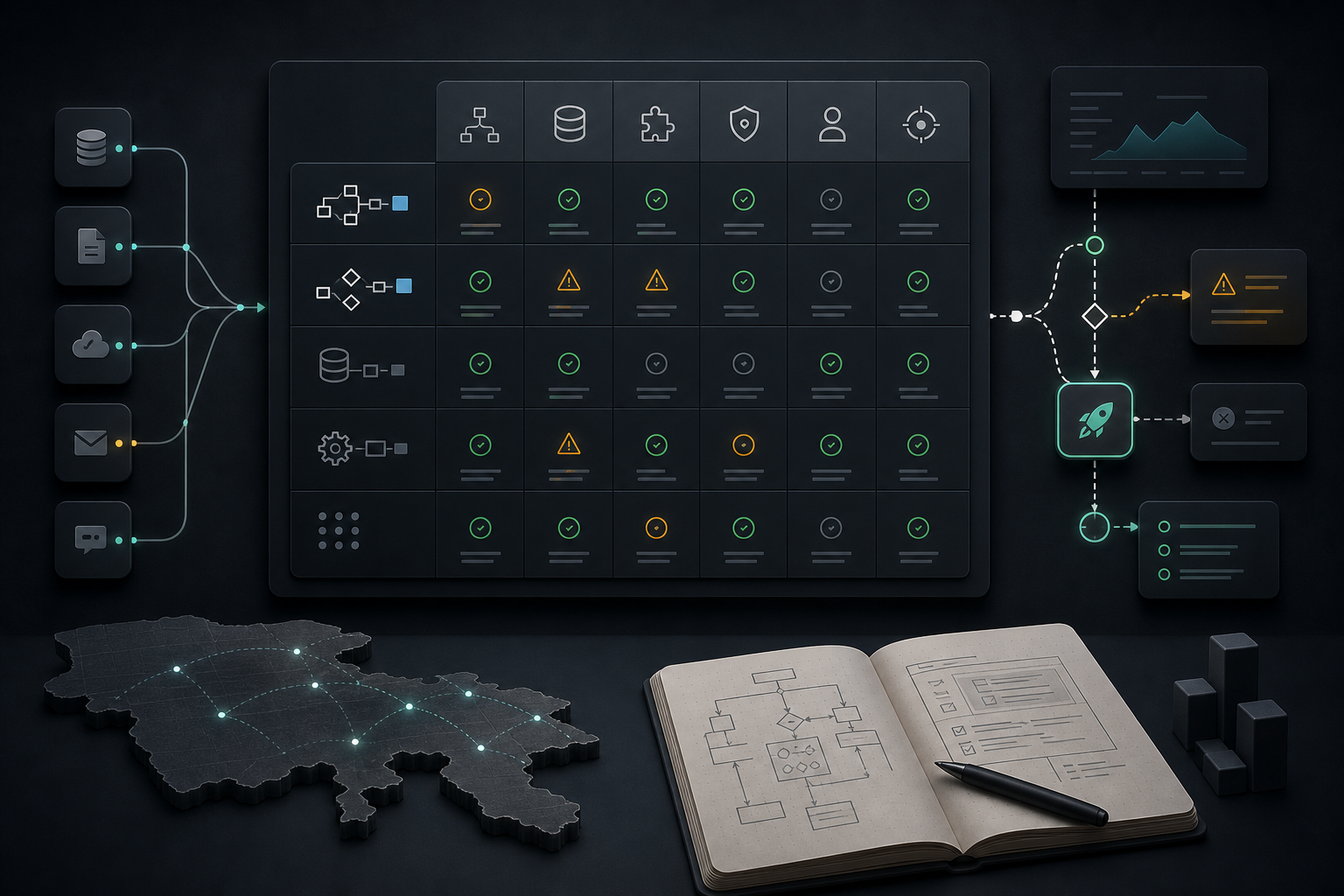
$ audit ai_workflow --market armenia
> inspect: workflow / data / integrations / evaluation / human_control
> route: no_build / cleanup / prototype / production_pilot
> output: decision_before_development, not generic chatbot demoWhy an AI consultant can be the right first step
The search query "AI consultant in Armenia" usually appears before a company knows exactly what to build. The team may have documents, CRM data, repeated manual decisions, support messages, sales workflows or internal reports, but the right implementation path is still unclear.
Broad commercial intent still belongs to the AI developer and AI specialist in Armenia landing page. This article is narrower: it explains when an AI audit should come before development, how to evaluate an AI consultant, and what evidence should exist before a company commits to a build.
The practical question is not "can this be automated with AI". A better question is "which part of this workflow is valuable, safe, measurable and ready enough for a first production slice".
Consultant, developer or studio
An AI consultant is useful when the decision itself is still risky. A developer is useful when the scope is already clear enough to implement. A studio is useful when the project needs discovery, product UI, backend work, integrations, testing, deployment and post-launch ownership in one delivery loop.
| Situation | Better first step | Why |
|---|---|---|
| The team has many AI ideas but no priority | AI audit | The first task is to choose the workflow, not the model |
| Data sources are messy or spread across tools | AI audit | Data readiness affects cost, quality and risk |
| The workflow writes to CRM, sends messages or changes status | Audit plus risk review | Human approval, logging and rollback need to be designed first |
| The scope is clear and low-risk | Narrow pilot | Development can start if acceptance criteria are explicit |
| AI will become a permanent capability | Audit, first slice, then ownership plan | The company needs documentation, tests and handoff, not just a demo |
The wrong pattern is to start with a generic chatbot because it is fast to demo. A chatbot may be enough for exploration, but business value usually comes from a controlled workflow: retrieve the right data, classify a request, draft an answer, route a task, update a record or help an operator decide.
A local audit method
Use a small scoring method before writing code. It does not need to be complex, but it must force the team to compare business value with operational risk.
| Criterion | Weight | What to inspect | Audit output |
|---|---|---|---|
| Workflow value | 22% | Frequency, time saved, decision cost and business owner | Ranked workflow shortlist |
| Data readiness | 18% | Source quality, permissions, freshness and update rhythm | Source inventory and cleanup notes |
| Integration risk | 17% | CRM, ERP, website, messenger, spreadsheet, API or n8n surface | Integration map and risk notes |
| Evaluation path | 16% | Good examples, bad examples, acceptance criteria and failure cases | Test set and review rules |
| Human control | 12% | Approval points, sensitive actions and fallback | Human-in-the-loop contract |
| Delivery fit | 10% | Build complexity, deployment path and support owner | Pilot shape and handoff plan |
| Commercial fit | 5% | Budget, speed and opportunity cost | Go / no-go / postpone recommendation |
If a workflow scores high on value but low on data readiness, start with cleanup or a retrieval audit. If it scores high on risk and low on human control, do not automate the action yet. If value, data and evaluation are strong, a narrow pilot can be justified.
What the working process should look like
A useful AI consultation is not a vague strategy call. It should produce artifacts that a team can use even if it chooses another vendor later.
The process should start with one workflow, not the whole company. The consultant should ask who performs the task, where inputs come from, which tools are touched, which mistakes are unacceptable, what a human must approve, and how the first version will be measured.
Then the audit should separate four layers:
- business workflow: users, decisions, approvals and expected result;
- data layer: documents, CRM fields, permissions, freshness and ownership;
- AI layer: retrieval, classification, drafting, tool use, evaluation and fallback;
- delivery layer: repository, deployment, monitoring, logs and maintenance.
The output should be concrete: a workflow map, source inventory, risk register, acceptance criteria, recommended first slice and a reasoned choice between no-build, audit extension, prototype, production pilot or larger delivery.
Red flags when choosing an AI consultant
Strong consultants slow down the wrong build. Weak consultants speed it up.
Red flags:
- promising "full AI transformation" before seeing the workflow;
- treating model choice as the main decision before inspecting data;
- ignoring privacy, permissions, logs and human approval;
- selling a chatbot when the real problem is routing, retrieval or integration;
- giving a fixed estimate without assumptions and exclusions;
- using "best" or "top" language without methodology or proof.
Strong signals:
- they recommend a smaller first slice when the requested scope is too broad;
- they can explain why some tasks should not use AI yet;
- they discuss bad cases and evaluation before launch;
- they connect AI decisions to real tools such as CRM, APIs, messengers, n8n, databases or internal dashboards;
- they leave documentation that another engineer can read.
Confirmable practice example
The aicoding.am case studies are useful proof checks because they show operational systems rather than generic AI claims. Narciss CRM demonstrates production software discipline around orders, inventory, CRM, POS, delivery and integrations. AmoBit Inbox demonstrates a controlled messaging runtime with protected media, workspace boundaries and backend source of truth.
Those examples matter for AI consulting because an AI workflow rarely lives inside a model call. The hard part is often around data contracts, operator behavior, integration boundaries, monitoring, deployment and ownership after launch.
When evaluating an AI consultant in Armenia, ask for proof at that level. A screenshot can show taste. A workflow map, source inventory, evaluation table and deployment boundary show whether the consultant understands production risk.
Questions to ask before development
1. Which workflow should we audit first, and why?
2. Which data sources are ready, stale or risky?
3. Which decisions must stay human-approved?
4. What would make this project not worth building yet?
5. What is the smallest useful production slice?
6. Which examples should be in the evaluation set?
7. Which systems will the AI read from or write to?
8. What will we own after the audit: map, brief, tests, code or deployment notes?
Good answers should name tradeoffs. If every answer is "yes, we can build it", the consultation is not doing its job.
Practical next step
Prepare a one-page brief with workflow, users, data sources, tools, risks, approval points and the smallest useful outcome. Then decide whether the next step is audit, cleanup, prototype or production-safe pilot.
If you need a local AI audit in Armenia, start with the project brief. If you need the broader service context, use the AI specialist in Armenia page.
Where This Applies
AI audit, workflow triage and first production-safe pilot planning
This article is useful when a company in Armenia has AI ideas, but the safest first step is still a decision process rather than immediate development.
- Founders deciding whether an AI project is ready for build.
- Operations teams with messy documents, CRM fields, messages or approval workflows.
- Companies that need local AI context without inflated transformation promises.
audit_score = workflow_value * 0.22
  + data_readiness * 0.18
  + integration_risk_control * 0.17
  + evaluation_path * 0.16
  + human_control * 0.12
  + delivery_fit * 0.10
  + commercial_fit * 0.05;
if (data_readiness < 0.5) recommend("cleanup_before_build");
if (risk > control) recommend("audit_or_human_review_first");