AI CRM Enrichment: Data, Sources and Quality Control
Let AI assist interpretation while source evidence and policy retain authority
Field contracts, source hierarchy, identity checks, review and verified CRM writes
Original ENRICH-6 operating model with a bounded acceptance gate
AI CRM enrichment, CRM data quality, sales automation, source validation, identity resolution, human review and verified CRM updates
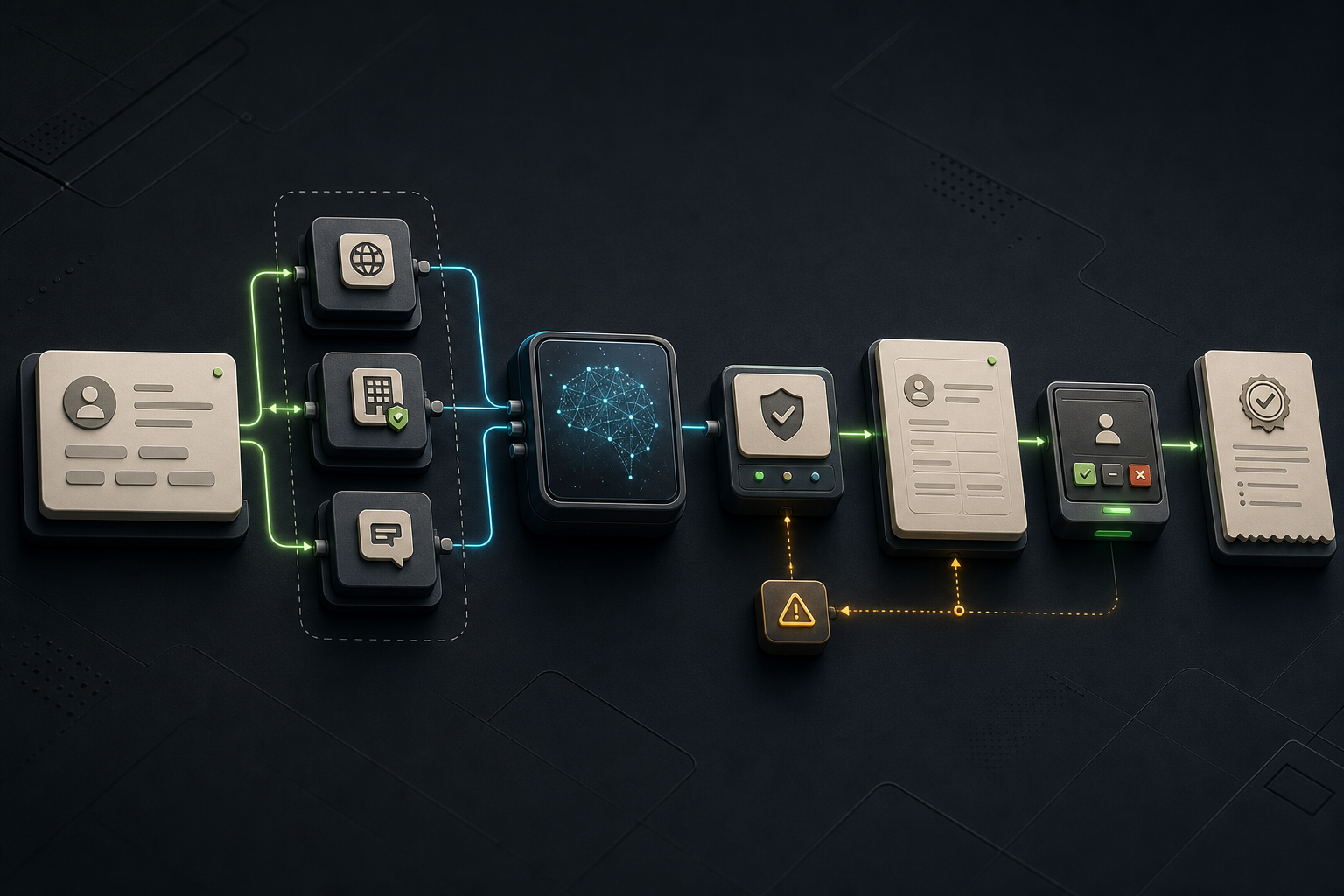
$ enrich crm --contract ENRICH-6
> preserve: record / source / consent
> propose: field / evidence / uncertainty
> validate: policy / match / authority
> write: idempotent CRM update
> verify: read-back / receipt / correctionCRM enrichment is not a request to make every contact record look more complete. It is a controlled decision process: preserve what arrived, connect permitted sources, distinguish evidence from inference and write only fields the team can later explain, correct or remove.
This article covers the long-tail implementation question. For a broader AI automation scope, discovery and delivery discussion, start with the AI specialist Armenia service page.
1. Start with a field contract, not a model prompt
An enrichment workflow needs a narrow purpose before it needs an AI model. Pick one record type and a limited set of fields, for example: normalize a company name, identify a public company domain, classify an inbound request, or flag a missing owner. Do not combine identity resolution, qualification, personal-data collection and automatic outreach in a single first release.
For every target field, document:
- the allowed source and whether its use is permitted by your policy and agreements;
- the source timestamp, source URL or source record ID where applicable;
- the expected type, allowed values and confidence boundary;
- whether the value is observed, derived deterministically or an AI-assisted suggestion;
- the write authority, reviewer and expiry/recheck rule.
A field such as industry = SaaS is not equivalent to a verifiable company classification. If the source is ambiguous, the correct outcome can be needs_review, unknown or no update. An empty field is often safer than a plausible but untraceable value.
A compact input and output example
Use a stable intake record rather than a loose collection of browser results:
{
  "eventId": "crm-import-2026-08-05-0142",
  "recordId": "lead_1042",
  "companyName": "Northline Studio",
  "website": "https://northline.example",
  "requestedFields": ["normalized_name", "domain", "segment"],
  "policyVersion": "CRM-ENRICH-1",
  "sourceConsent": "approved"
}
The workflow should produce a constrained proposal, not an unbounded profile:
{
  "recordId": "lead_1042",
  "proposed": {"normalized_name": "Northline Studio", "domain": "northline.example"},
  "evidence": [{"field": "domain", "source": "submitted_website"}],
  "unresolved": ["segment"],
  "route": "review",
  "policyVersion": "CRM-ENRICH-1"
}
The unresolved segment is useful output. It prevents a workflow from turning a weak guess into a sales decision.
2. Design the workflow around source hierarchy and record identity
Source quality is not just an API availability issue. A CRM may contain a submitted form, a sales note, an account record and a third-party data response that disagree. Define a precedence order for each field. For example, a verified customer-provided domain can take priority over an inferred web match, while a sales owner may override an automated classification after review.
Separate three questions that are often collapsed:
- Is this the same company or person as an existing record?
- Is a source allowed to fill this particular field?
- Is the evidence sufficient to apply the update automatically?
Matching on email alone can fail when a person changes jobs; matching only on a company name can merge unrelated businesses. Route uncertain matches to a collision queue. An enrichment workflow should never silently overwrite a record because a model found a similarly named entity.
Give every run a stable event ID and derive an idempotency key from the CRM record, requested fields and policy version. This lets retries recover from a delayed API response without applying the same update twice. Preserve the original value, proposed value, source references and final disposition as separate facts.
For the wider verified-action pattern, see AI automation architecture: from event to verified action. The enrichment-specific boundary is simple: a source-backed proposal becomes a CRM value only after policy, duplicate handling and a confirmed read-back.
3. Put AI behind deterministic validation
AI can help parse unstructured notes, compare alternative source fragments or recommend a normalized label. It should not silently invent a company attribute, decide legal data permissions or overwrite customer-owned truth.
Use deterministic checks around the model:
- validate the schema, enumerations and field length;
- reject outputs without evidence references;
- block values from unapproved sources or stale source windows;
- compare identity keys before an update;
- require a named owner for ambiguous or consequential changes;
- write through one CRM adapter that performs read-back.
Keep the model response constrained to fields the workflow can validate. If the model has low confidence or incomplete evidence, route the record to review instead of trying a second prompt until it returns an affirmative answer. A retry is a transport tool, not a mechanism for forcing certainty.
This same separation protects sales and support operations: model output may prioritize work, but routing policy, permission checks and people retain authority over assignment, outreach and data changes.
4. Test acceptance cases before switching on writes
Create an evaluation set from representative records, including incomplete forms, legacy duplicates, recently changed employer domains, multilingual notes, invalid websites, conflicting sources and deliberate near-matches. Do not measure success using only records chosen because they already enrich cleanly.
Useful acceptance questions include:
- Does every auto-filled field retain an inspectable source reference?
- Does the workflow preserve the original CRM value and write reason?
- Does a missing or conflicting source lead to review rather than fabricated completeness?
- Do duplicate and collision cases avoid creating or merging records automatically?
- Does a retry produce one final state and one traceable receipt?
- Can an operator correct an enrichment without editing hidden prompt state?
- Does the fallback path work when a source provider or CRM API is unavailable?
Record the results by field and route, not as a single universal accuracy claim. The acceptable error rate and review burden depend on the field, the downstream action and the team’s risk tolerance. A field used for internal reporting may have a different gate from a field that changes ownership or customer communication.
5. Operate enrichment as a data-quality system
Once the first bounded workflow is live, observe source failures, unresolved fields, collisions, reversals, human corrections and CRM write receipts. These are operating signals, not performance promises. They show where the contract, source hierarchy or review capacity needs revision.
Version the policy when you add a field, change a source or revise a matching rule. Re-run the affected acceptance set before expanding automatic updates. When a source is unavailable, preserve the record and create a review task or retryable pending state; do not backfill with a model guess.
Schedule rechecks only where the business meaning needs it. Company size, ownership and product position can change; an inbound consent or customer-selected category must not be replaced casually. Retention, access control and removal requests belong in the same operational design as the prompt and integration.
ENRICH-6 acceptance gate
require(event.id && record.id && policy.version);
require(proposal.schemaValid && evidence.allowed && match.resolved);
write = authority.approved && crm.readBack && audit.receipt;
The gate does not promise cleaner data or higher conversion. It makes the path to a CRM update inspectable: the source is known, the proposal is bounded, an owner exists for uncertainty and the system of record confirms the result.
A practical first pilot
Choose one record class, two or three fields and one clearly permitted source hierarchy. Start with proposals or a review queue. Link the original input, source evidence, policy version, reviewer decision and CRM read-back to one event ID. Review corrections with the sales or operations owner on a fixed cadence, then decide whether the narrow workflow should remain review-only, gain a limited automatic path or be retired.
That is the useful role for AI CRM enrichment: it reduces repetitive interpretation while the company keeps control of truth, permissions and customer-facing consequences. If you need to scope such a controlled pilot, discuss an AI automation project brief after mapping the specific workflow and data boundaries.
require(event.id && record.id && policy.version);
require(proposal.schemaValid && evidence.allowed && match.resolved);
write = authority.approved && crm.readBack && audit.receipt;