AI Developer in Yerevan: Local Expertise and Remote Delivery
A practical evaluation guide for companies choosing AI delivery in Yerevan
Local context, remote production discipline, workflow scoring, red flags and a next-step route
How to support the broad Armenia AI landing page with long-tail selection criteria
AI developer Yerevan, AI specialist Armenia, remote delivery and production AI evaluation
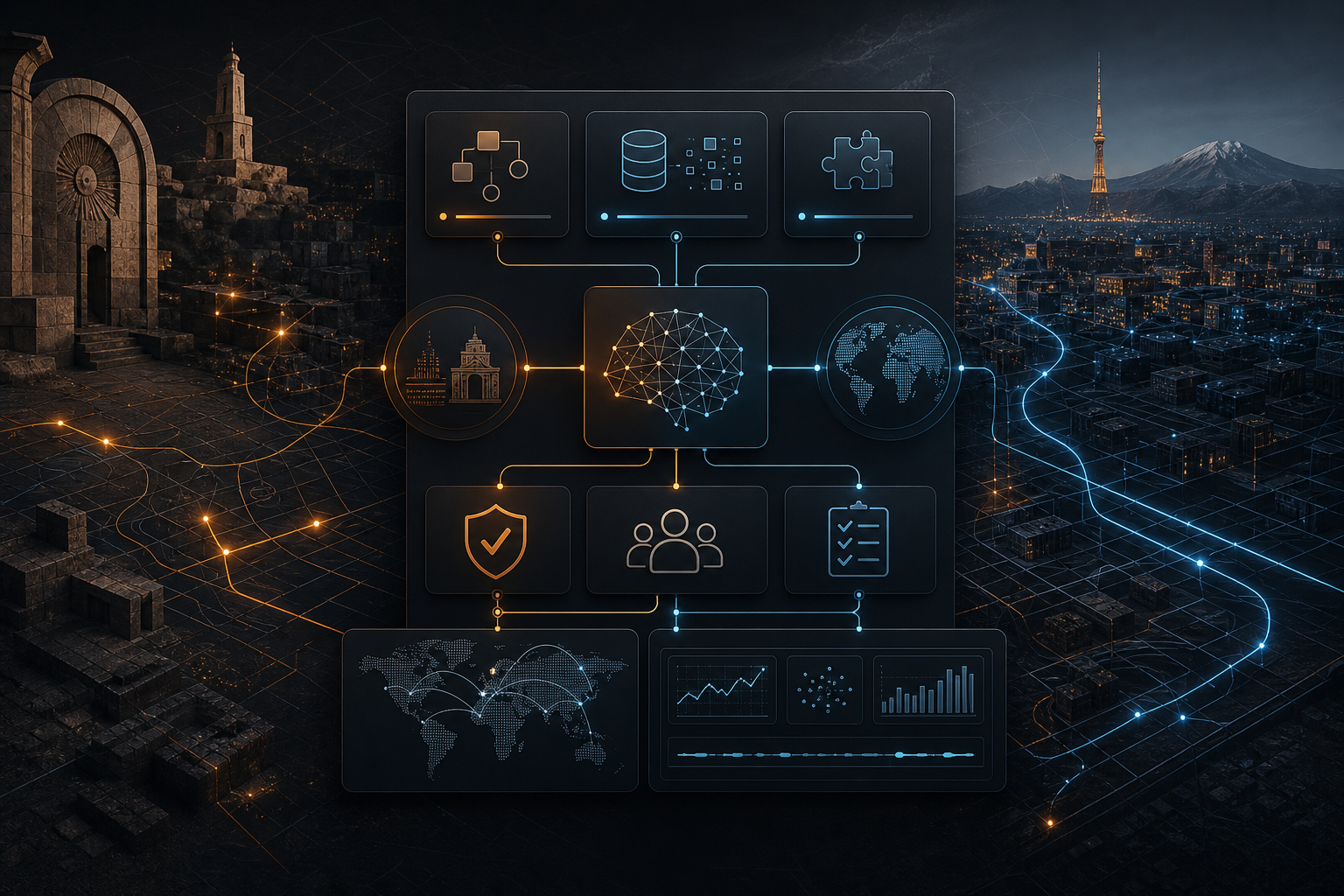
$ evaluate ai_developer --city yerevan
> local_signal: workflow context, stakeholder language, market reality
> remote_delivery: repo, review, build, deploy, monitoring
> criteria: workflow / data / integration / evaluation / ownership
> output: audit or narrow pilot, not broad AI transformationContext: the useful question is not only location
When a company searches for an AI developer in Yerevan, the practical need is usually broader than "find someone nearby". The company needs a person or studio that understands the local business context, can communicate with teams in Armenia, and can still deliver with remote engineering discipline: scoped work, source control, deployment checks, evaluation and support after launch.
The broad commercial page for this topic is AI Developer and AI Specialist in Armenia. This article is narrower. It explains how to evaluate Yerevan-local AI expertise, when remote delivery is enough, and what criteria separate production AI work from generic consulting.
For Armenian companies, the delivery context is often mixed: local operations in Yerevan, Russian or Armenian-speaking users, English technical documentation, international APIs, CRM or ERP systems, spreadsheets, messengers and existing websites. The AI developer has to design around that reality before choosing an LLM, agent framework or automation tool.
Local relevance versus delivery model
| Criterion | Local Yerevan value | Remote delivery value | What to verify |
|---|---|---|---|
| Business context | Faster understanding of local operations, language mix and team habits | Access to wider engineering practices and async delivery | Can the developer map the real workflow, not just discuss models? |
| Communication | Easier discovery sessions and stakeholder alignment | Written specs, tickets and reviewable decisions | Are decisions documented clearly enough to survive handoff? |
| Data and integrations | Awareness of local CRM, messengers, exports and operational shortcuts | API-first integration, repeatable deployment and logs | Is there a source-of-truth plan for data and permissions? |
| Quality control | Easier business review with local examples | Automated checks, evaluation sets and rollback discipline | Are failure cases tested before launch? |
| Support | Practical follow-up in the same market context | Maintainable code, deployment notes and monitoring | Who owns prompts, logs, documents and incidents after release? |
The best setup is not automatically "local only" or "remote only". For AI systems, the stronger question is whether local discovery and remote-grade delivery are both present.
Evaluation method for an AI developer in Yerevan
A practical evaluation can use five gates. If one gate is missing, the project can still be discussed, but the risk should be explicit.
- Workflow gate: the developer can describe the business process, inputs, users, decisions and unacceptable errors.
- Data gate: the developer asks where approved knowledge lives, who can access it, how it changes and what must not enter model context.
- Integration gate: the developer can connect CRM, website, messenger, document storage, APIs or n8n without turning the model into the system of record.
- Evaluation gate: the developer defines test cases, expected outputs, escalation cases and launch blockers before production.
- Ownership gate: the developer names who maintains prompts, documents, logs, deployment and incidents after the first release.
This method supports the broader AI specialist Armenia page instead of replacing it. The landing page owns the broad commercial intent. This article owns the long-tail question: how to evaluate a Yerevan-local AI developer and delivery format.
What the working process should look like
The process should begin with a discovery audit, not a demo. The AI developer should ask for a narrow workflow, real examples, current tools, source documents, user roles, approval points and the error that would be unacceptable for the business.
A healthy first phase usually produces:
- a workflow map with users, systems, inputs and decisions;
- a data and permissions note for documents, CRM fields, files and API access;
- a shortlist of implementation patterns: RAG, AI automation, agent, internal tool or process cleanup;
- a risk table with human review, fallback and logging requirements;
- a small pilot scope that can be evaluated before deeper investment.
The local part matters during discovery: terminology, workflow habits and stakeholder expectations are easier to clarify when the developer understands the Yerevan and Armenia business context. The remote part matters during implementation: source control, issue tracking, review, build checks, deployment and monitoring should not depend on informal chat memory.
Red flags
Be careful if the developer starts with a model name before understanding the workflow. The model is rarely the whole system. Most business AI work needs data boundaries, integration rules, human approval and maintenance.
Other red flags:
- promises of "autonomous AI" without approval rules or audit logs;
- a demo chatbot that has no source update process;
- no plan for CRM writes, retries, permissions or rollback;
- no examples of production systems, only screenshots;
- no evaluation set or failure-mode discussion;
- vague ownership after launch.
The issue is not that prototypes are bad. Prototypes are useful. The issue is treating a prototype as production before the workflow, data, integrations and support contract are clear.
Original proof: a local comparison matrix
Use this matrix before signing a larger AI project.
| Score area | 0 points | 1 point | 2 points |
|---|---|---|---|
| Workflow clarity | Task is a slogan | Workflow is described verbally | Workflow has inputs, users, decisions and failure cases |
| Source quality | No approved source | Documents exist but are messy | Source owner, versioning and access are defined |
| Integration readiness | Manual copy-paste only | One API or export exists | CRM/API/webhook/storage path is mapped |
| AI control | Model answers freely | Draft-only human review | Approval, fallback, logs and escalation are designed |
| Delivery discipline | Demo only | Repository and build exist | Tests, deploy notes, rollback and support owner exist |
For most first projects, a score below 6 means the next step should be audit or process cleanup. A score from 6 to 8 can support a narrow pilot. A score above 8 can justify building the first production slice, still with human review for risky actions.
Practice example from existing systems
The public case studies show why this matters. Narciss CRM is not an AI demo; it is an operating system where orders, inventory, delivery, POS, messengers and analytics connect into one workflow. AmoBit Inbox is also not just a chat interface; it needs workspace boundaries, protected media and a backend source of truth.
Those examples are relevant to AI work because production AI has the same integration problem. A useful AI layer has to fit inside orders, messages, documents, permissions, logs and human decisions. Without that layer, a model can produce text but the business still has to manage the real workflow manually.
Practical next step
If you are evaluating an AI developer in Yerevan, prepare one workflow before the first call: what starts it, who uses it, what systems are involved, which decision is risky and what a successful pilot would prove.
Then choose the smallest useful next step: an AI audit, a RAG pilot, an AI automation draft workflow, an internal tool prototype or process cleanup before AI. For a structured start, use the project brief, review the broader AI specialist in Armenia page, or compare proof through case studies.
Where This Applies
Discovery audit, local/remote delivery choice and first production-safe AI pilot
This article is useful when a team in Armenia needs local AI context but also expects remote-grade engineering delivery, review and support.
- Founders comparing local AI developers, studios and remote delivery partners.
- Operations teams preparing an AI audit before RAG, automation or an internal tool.
- Companies that need Yerevan context without accepting demo-only implementation.
score = workflow + data + integration + controls + delivery;
if (score < 6) start_with_audit();
if (score >= 6 && score <= 8) scope_narrow_pilot();
if (score > 8) build_first_production_slice();
require_human_review_for_risky_actions();