How Much AI Development Costs in Armenia in 2026
A practical budget model for audit, pilot and production AI work in Armenia
Discovery, data preparation, integrations, evaluation, deployment, monitoring and maintenance
How to support the broad Armenia AI landing page with long-tail cost criteria
AI development cost Armenia, AI development pricing Armenia, AI developer Armenia and production AI evaluation
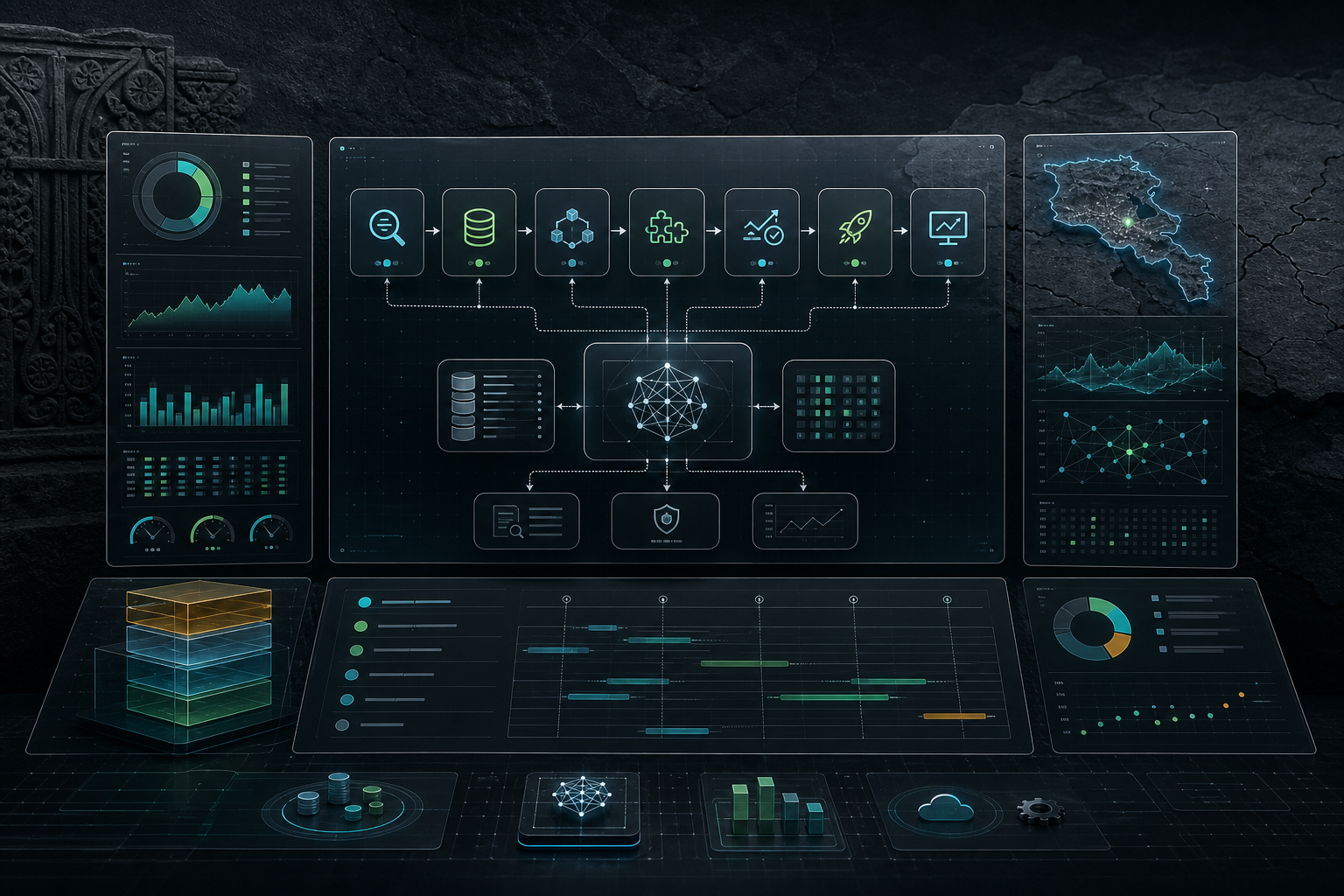
$ audit ai_project_cost --market armenia
> inspect: scope / data / integrations / evaluation / maintenance
> route: audit / pilot / production / maintenance
> output: range_before_commitment, not fake fixed quoteWhy a single price is usually misleading
The query "AI development cost Armenia" sounds like it should return one clear number. In practice, the useful answer is a cost model. AI work can mean a short audit, a retrieval prototype, a production RAG system, an internal AI tool, n8n automation, CRM integration, an agent workflow or a maintained product surface.
The broad commercial intent still belongs to the AI specialist in Armenia landing page. This article is narrower: it explains how to estimate AI development cost in Armenia, which variables move the budget, what hidden costs appear after the demo, and how to ask for a range without pretending that a real project can be priced before discovery.
Use the ranges below as planning bands, not as a public rate card. Currency, model prices, hosting costs, data quality and integration scope can change. A responsible estimate should include assumptions, exclusions and the date of the estimate.
What the budget is made of
AI development cost is not only "model plus developer time". The model call is often a small part of the total cost. The larger cost usually sits around data, workflow design, evaluation, integration and operations.
| Cost layer | What it includes | Why it changes the estimate |
|---|---|---|
| Discovery and audit | workflow map, data inventory, user roles, risk review, success criteria | unclear scope creates rework later |
| Data preparation | document cleanup, CRM field review, permissions, freshness, normalization | weak data makes RAG and agents unreliable |
| Prototype | first prompt flow, retrieval slice, UI or automation proof | useful for learning, but not production ownership |
| Integrations | CRM, ERP, website, messenger, spreadsheet, API, n8n or backend tools | every external system adds auth, edge cases and failure handling |
| Evaluation | good cases, bad cases, regression checks, human review rules | production AI needs repeatable quality checks |
| Product surface | admin UI, operator console, dashboard, logs, review queue | teams need control, not only a hidden model call |
| Deployment and monitoring | hosting, secrets, logging, retries, alerts, rollback path | AI workflows fail in operational ways, not only code ways |
| Maintenance | prompt updates, model changes, data refresh, support and iteration | systems drift when business rules and data change |
If an estimate skips evaluation, monitoring and maintenance, it is usually a demo estimate, not a production estimate.
Three practical budget scenarios
The cleanest way to discuss cost is to name the scenario first. These bands are illustrative planning shapes for companies comparing AI work in Armenia in 2026. They are not guaranteed prices and should be recalculated for each project.
| Scenario | Typical scope | Main deliverable | Budget logic |
|---|---|---|---|
| Audit / estimate | one workflow, data inventory, risk review, pilot recommendation | map, assumptions, scorecard, next-slice estimate | best when the team does not yet know what to build |
| Prototype / pilot | one narrow RAG, automation or assistant workflow | working slice with acceptance checks and known exclusions | best when value is plausible but scope needs proof |
| Production system | integrations, UI, evaluation, deploy, monitoring and handoff | maintained AI workflow or internal product surface | best when the company needs live usage, ownership and support |
For a small company, the biggest mistake is often jumping from idea to production scope. Start with the cheapest step that reduces uncertainty. If the workflow, data and risks are unclear, an audit saves more than it costs. If those are already known, a pilot can answer whether the model and process are useful enough. If the pilot is already proven, the production budget should include monitoring, support and future changes.
A copyable cost model
Use this table to discuss a range with an AI developer, consultant or studio. Replace the example values with project-specific assumptions.
| Line item | Low assumption | Higher assumption | Notes |
|---|---|---|---|
| Discovery sessions | 1-2 sessions | 3-5 sessions | more stakeholders increase alignment work |
| Workflow mapping | 1 workflow | 2-4 connected workflows | connected workflows need boundary decisions |
| Data sources | 1 clean source | several messy sources | permissions and freshness matter |
| Retrieval / prompt logic | simple prompt flow | RAG, tools, reranking or agent steps | complexity should match business value |
| Integrations | no write access | CRM/API/messenger writes | writes require approvals, logs and rollback |
| Evaluation set | 20-40 cases | 100+ cases and regression checks | quality must be measurable |
| UI / operator controls | minimal review screen | dashboard, queue, filters, audit trail | control surface can be a large share of work |
| Deployment | single environment | staging, production, monitoring | production ownership starts here |
| Maintenance | handoff only | monthly improvements and support | model, data and rules drift |
The formula is simple:
project_cost =
  discovery
  + data_preparation
  + prototype_or_build
  + integrations
  + evaluation
  + product_controls
  + deployment
  + maintenance_reserve
The more important formula is the decision rule:
if data_readiness is low:
  estimate cleanup before build
if workflow_risk is high:
  include human approval, logs and rollback
if evaluation_path is unclear:
  do not price production as if quality is solved
Hidden costs that appear after the demo
Many AI demos look cheap because they skip the parts that make the system usable every week.
Hidden costs usually come from:
- cleaning documents, CRM fields or spreadsheets before retrieval;
- deciding who owns approvals and exceptions;
- handling failed API calls, duplicate events and retries;
- protecting private data and credentials;
- adding logs so operators can understand what happened;
- building a review queue instead of fully automatic actions;
- creating acceptance cases for good and bad model behavior;
- updating prompts, instructions and data sources after launch.
This is why "simple chatbot" and "production assistant" are not the same project. A chatbot can answer from a small knowledge base. A production assistant may need permissions, retrieval filters, CRM writes, escalation paths, evaluation, monitoring and support.
How to get a correct estimate
A useful estimate should start from a brief, not from a model name. Before asking for cost, prepare:
- The workflow you want to improve.
- The users and roles involved.
- The data sources the AI can read.
- The systems it may write to.
- The decisions that must stay human-approved.
- Examples of correct and incorrect outputs.
- The first result that would justify continuing.
- Constraints around privacy, hosting, language and budget.
Then ask for an estimate in ranges:
| Question | Good answer should include |
|---|---|
| What is included in the first phase? | deliverables, assumptions and exclusions |
| What can break the estimate? | data quality, integration access, missing examples, approval rules |
| What is not production-ready yet? | quality, security, monitoring, ownership or UX gaps |
| What will we own after the phase? | code, docs, test set, workflow map, deployment notes or handoff |
| What should not be automated yet? | risky actions, unclear decisions or low-value workflow parts |
If a vendor gives one fixed number before seeing the workflow and data, treat it as a sales shortcut. It may still be useful for a demo, but not for production planning.
How to control the budget
Control comes from reducing uncertainty in the right order.
Start with one workflow. Do not estimate "AI for the company" as one project. Choose a repeated task with a clear owner, visible inputs, known decisions and a measurable outcome.
Separate the first phase from the final system. The first phase should answer a specific question: is the data ready, is retrieval good enough, can operators trust the draft, can the integration be controlled, or is the business value real?
Keep human control where mistakes are expensive. Human approval is not a failure of automation. It is often the cheapest guardrail for CRM updates, customer messages, financial actions, legal-sensitive text or operational decisions.
Use a small evaluation set early. Even 30 real examples can expose whether the scope is ready. Without examples, the estimate includes guesswork.
Budget maintenance explicitly. AI systems need updates when data, prompts, model behavior, workflows or business rules change. A project without maintenance can still be valid, but the handoff should be honest.
Practical next step
If you need an estimate for AI development in Armenia, prepare a one-page brief with workflow, data sources, integrations, risk level, examples and the first useful outcome. Then request a range for audit, pilot and production versions separately.
For broader service context, use the AI specialist in Armenia page. For proof of production discipline, review the case studies. To start with a concrete brief, use the project intake.
Where This Applies
AI cost estimation, TCO planning and first production-safe pilot scoping
This article is useful when a company in Armenia needs a realistic AI development estimate before choosing between audit, pilot and production scope.
- Founders comparing audit, prototype and production-system budgets.
- Operations teams estimating data cleanup, integrations, evaluation and maintenance.
- Companies that need a range with assumptions instead of a fake fixed quote.
project_cost = discovery
  + data_preparation
  + prototype_or_build
  + integrations
  + evaluation
  + product_controls
  + deployment
  + maintenance_reserve;
if (data_readiness < 0.5) estimate("cleanup_before_build");
if (evaluation_path === "unclear") avoid("fake_production_quote");