AI Employee Onboarding Automation: Knowledge Base and Control
Turn a new-hire event into a reviewable onboarding plan, not automatic access
Source contracts, permission-scoped knowledge, role rules and verified destination read-back
Original ONBOARD-7 workflow with input/output example and acceptance criteria
AI employee onboarding automation, AI knowledge base, onboarding workflow, role-based access, HR automation, human approval and verified read-back
$ onboard employee --contract ONBOARD-7
> receive: event / receipt / source-version
> resolve: role / manager / audience
> retrieve: allowed knowledge / citations / gaps
> validate: checklist / policy / entitlement
> route: named owner / expiry / exception
> commit: idempotent task / read-back / recoveryWhy employee onboarding needs a controlled AI workflow
Employee onboarding is often framed as a content problem: put policies into a chatbot, generate a checklist and let a new hire ask questions. The real operating problem is broader. A new person needs the right information, access requests, required acknowledgements and a named owner for exceptions — at the right time and for the right role. A fluent answer cannot prove that an access request was approved, that a policy is current, or that a mandatory step was completed.
The broad service question belongs on the AI automation service page. This guide answers one narrower question: how to design a controlled onboarding pilot that combines an AI knowledge-base assistant with a reviewable workflow. It does not promise autonomous provisioning, compliance completion or a measured return before a team has an agreed baseline.
Start with one role family, one business unit and one bounded first-week journey. The pilot can prepare a personalised checklist, retrieve approved guidance and open a reviewable access request. It should not grant permissions, change payroll or declare a person trained. Keeping that boundary explicit makes the pilot reversible and lets the team inspect whether the system improved the process rather than merely producing more text.
Preconditions: data, owners and a source contract
Before choosing a model, define the onboarding event contract. Each event should carry an immutable onboarding ID, employee or contractor scope, role, manager, start-date state, source system, received time and a correlation ID. Record which facts were supplied by HR, which were verified by an owner and which were inferred or still unknown. A new-hire record is not permission to expose every company document to an assistant.
The knowledge base needs equal discipline. Every retrievable item should have a stable ID, owner, audience or permission scope, effective date, version, source link and review status. Deprecated guidance needs an explicit end state; inaccessible documents must not become answer context merely because they share a folder. If an answer has no allowed, current source, the correct output is an uncertainty state and a named route — not an invented policy.
Useful readiness questions include:
- Is there one authoritative source for role, manager, start status and employment type?
- Which access requests are merely prepared by the workflow, and which require a human approver?
- Can the organisation identify the owner and effective version of each required policy or checklist item?
- What should happen when a new hire asks outside their entitlement or the knowledge source is stale?
- Can each destination system return an authoritative receipt after a permitted write?
If these answers are missing, improve the operating contract first. AI cannot reconcile conflicting HR records or turn an unowned wiki into reliable onboarding guidance.
The ONBOARD-7 workflow
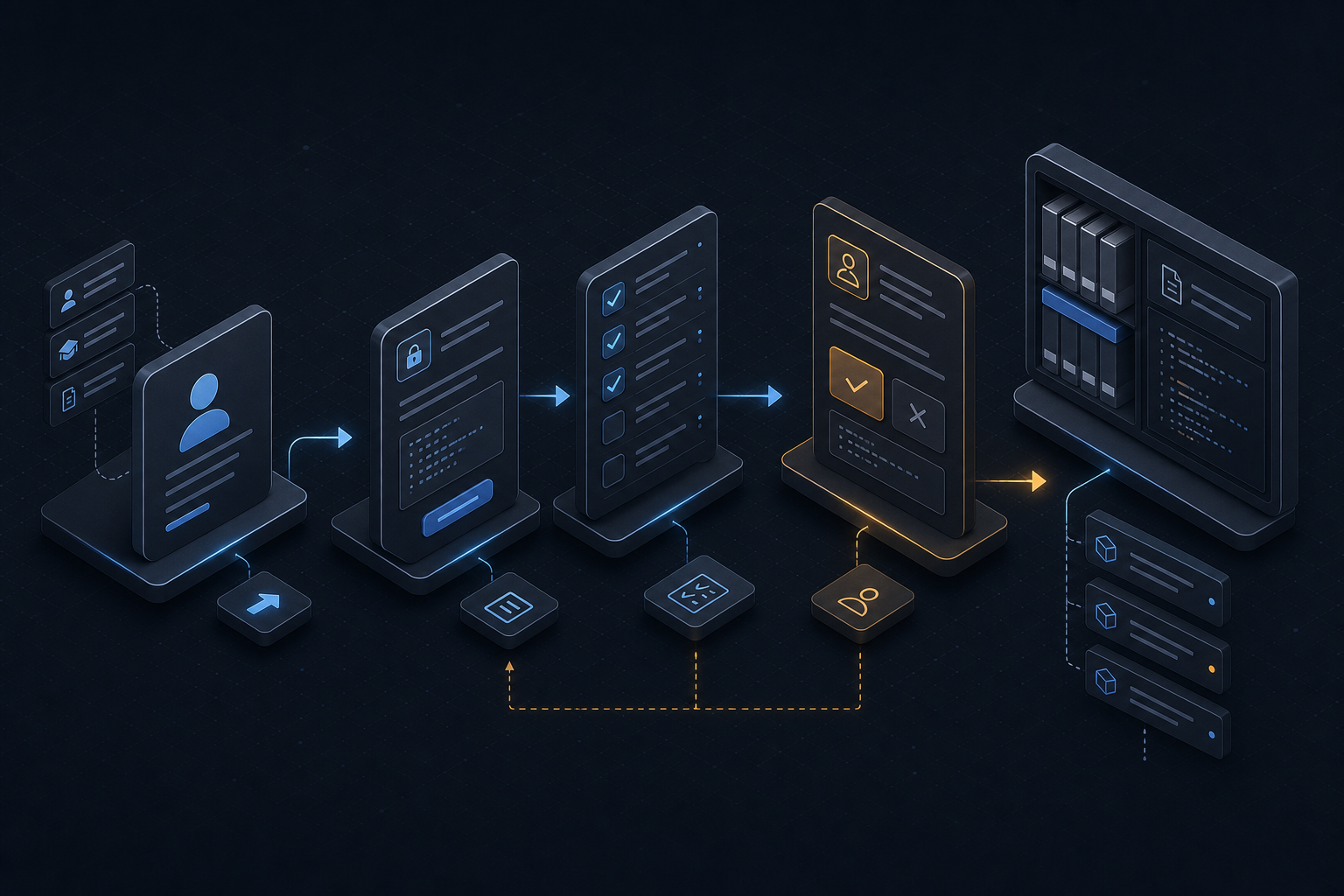
ONBOARD-7 is a small workflow for a controlled first onboarding slice. It separates AI retrieval and proposals from identity, approval and consequential actions.
- Receive. Accept a verified onboarding event and preserve its receipt, source version and permitted scope. Deduplicate repeated delivery with the source ID or an idempotency key.
- Resolve. Confirm role, manager, start-date state and audience. Missing or conflicting identity data becomes an owned exception.
- Retrieve. Select only current, allowed knowledge-base sources. Return citations, document versions and gaps with every AI-assisted answer or checklist suggestion.
- Propose. Produce a typed checklist: required learning, meetings, access requests and open questions. The proposal distinguishes source-backed items from items requiring a manager decision.
- Validate. Check checklist schema, role rules, prerequisite order, policy versions, permission boundaries and duplicate requests deterministically.
- Review and route. A named manager, IT or People owner accepts, corrects or rejects items that create access, commitments or exceptions. Route each approved request with expiry and an audit reason.
- Commit and verify. Create only the permitted task, request or acknowledgement. Read the state back from the authoritative destination and retain a receipt; unresolved timeouts enter a recovery queue.
The control path is deliberately modest:
verified onboarding event -> permitted knowledge evidence -> typed plan -> owner decision -> verified destination stateA successful model reply is not evidence that a laptop request, system account or mandatory acknowledgement exists. The destination read-back is the evidence for the action that the workflow was allowed to take.
Example input and output
Assume HR creates an event for a support specialist starting next Monday. The manager is known, but the employment type is still pending and the person has not been approved for production customer data. A safe workflow could return:
{
  "onboardingId": "ob_2048",
  "role": "support-specialist",
  "sourceVersion": "hr-event-v3",
  "proposal": {
    "knowledge": [
      { "id": "support-handbook", "version": "2026-06", "purpose": "first-week guide" }
    ],
    "checklist": ["manager welcome", "support handbook", "sandbox training"],
    "accessRequests": [{ "system": "support-sandbox", "requiresApproval": true }],
    "unknowns": ["employment type", "production-data entitlement"]
  },
  "route": "manager and IT review; do not grant production access"
}
The output is intentionally a proposal. It does not claim that access is granted, that the handbook is legally complete, or that the person finished training. The manager can correct the role, IT can approve the sandbox request and the workflow can preserve both decisions with their source versions.
Integrations and contracts
A practical implementation usually links an HR source, identity or directory service, knowledge-base index, task or learning destination, approval channel and audit store. The named software matters less than the contracts. The HR connector needs a stable event ID and state transitions. The knowledge connector must enforce document permissions and surface freshness. The approval connector needs an accountable owner, expiry and decision reason. Every writable destination should support idempotency or an equivalent duplicate-safe lookup.
Treat dependencies as fallible. A timeout after creating an access request is ambiguous: retrying blindly may duplicate a ticket, while marking success can hide a missing task. Query the destination by its idempotency key, record the authoritative result and route ambiguity to recovery. Likewise, do not let a model infer that “marketing analyst” is entitled to a restricted drive because a public job description mentions reports. Entitlement comes from the organisation's current rule set and authorised reviewer.
Version prompts, retrieval configuration, role rules and source documents independently. A revised handbook should change the cited version without silently changing access policy. A new role checklist should be tested against representative events before it becomes the default. Keep a manual route available so onboarding continues if retrieval, an integration or a policy check fails.
Acceptance criteria before launch
Test a pilot with representative historical or synthetic events: an ordinary new hire, a contractor, a delayed start, a role change, duplicate delivery, missing manager, stale handbook, conflicting role data, denied access, reviewer timeout and a destination failure. Include the languages and document formats that the actual workflow accepts. Do not treat a polished demo with one happy-path profile as a production evaluation.
The acceptance criteria should be inspectable:
- Every run retains an onboarding receipt, source version, correlation ID and applicable role-rule version.
- Every generated answer or checklist item has allowed, current knowledge evidence or is marked as unknown.
- The workflow never exposes a document outside the recipient's scope.
- Required prerequisites and owner approvals are checked before a consequential request is committed.
- Repeated delivery creates at most one destination task or request per idempotency key.
- The destination state is read back and linked to the proposal and decision evidence.
- Failed or ambiguous actions have a visible, named recovery owner.
- Managers can correct a checklist and the correction reason is retained without rewriting the original event.
Operational signals can include source-citation coverage, review and correction reasons, unresolved exception age, duplicate prevention, destination read-back coverage and completion of genuinely required tasks. These are process signals. They are not evidence of ROI, compliance or employee satisfaction unless the organisation defines and measures those outcomes separately.
Operating and improving the pilot
Launch with a small cohort and a scheduled review. Inspect both accepted proposals and exceptions; otherwise the team learns only where the system obviously stopped. Classify corrections in a controlled taxonomy such as "missing HR field", "stale knowledge source", "role-rule mismatch", "permission boundary" or "workflow design gap." That evidence tells the team whether to improve the source data, rules or integration rather than repeatedly tuning a prompt without a diagnosis.
Expand only after the existing slice is understandable: owners can explain decisions, knowledge sources are versioned, exceptions have recovery paths and destination writes reconcile. The next slice might add another role family or a learning-system integration, but it should retain the same proof gates. For a controlled onboarding pilot, discuss workflow and integration boundaries with aicoding.am's AI automation practice or review relevant delivery evidence in the case studies.
Conclusion
AI can make onboarding more navigable without becoming an access authority or policy owner. A useful first system preserves the event, retrieves only permitted current knowledge, proposes a typed plan, keeps consequential choices with named people and verifies destination state. That is a practical foundation for an onboarding workflow that a team can operate and improve.
require(event.id && event.receipt && event.sourceVersion && roleRule.version);
require(knowledge.allowed && proposal.schemaValid && proposal.citations.length);
commit = reviewer.authorized && destination.readBack && recovery.owner;