AI in Financial Operations: Permitted Scenarios and Required Guardrails
Let AI prepare evidence and exceptions; keep finance authority explicit and testable
Bounded proposals, deterministic checks, named review and verified destination read-back
Original FIN-GUARD-6 operating model with a use-case matrix and 30-day pilot gate
AI in financial operations, AI finance automation, back-office AI, finance AI guardrails, reconciliation preparation, invoice processing, human review and FIN-GUARD-6
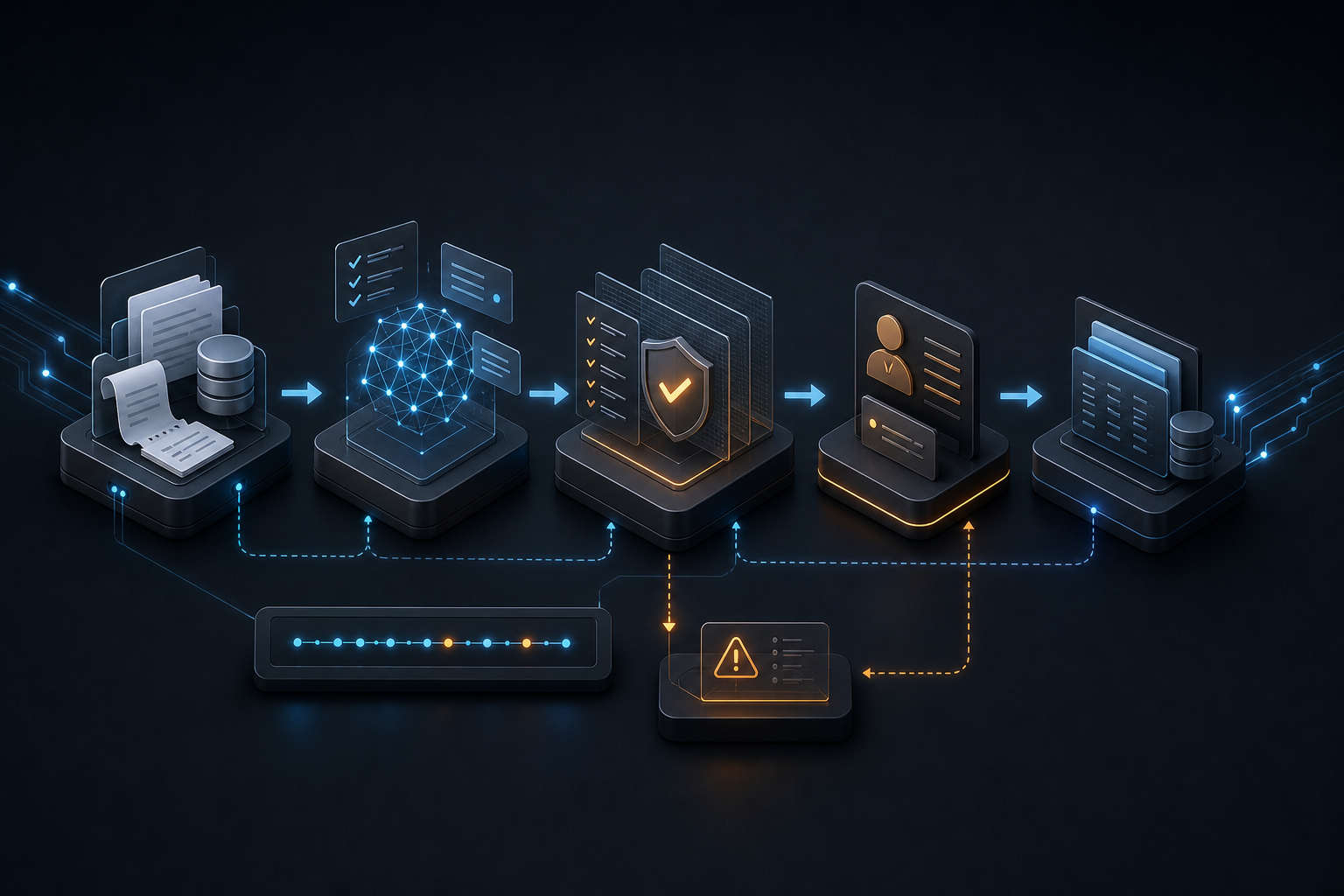
$ finance-pilot --contract FIN-GUARD-6
> receive: source / receipt / access-scope
> propose: bounded classification / exception
> validate: amount / identity / policy / duplicate
> route: named reviewer / expiry / rationale
> commit: permitted action / read-back / recovery
AI in finance operations: useful assistance needs a narrow boundary
Finance operations contain repetitive evidence work: matching documents, preparing close packs, routing exceptions and explaining why a record needs attention. AI can make this work easier, but it must not become an unobserved accounting authority. A fluent answer is not a reconciled balance, an approved payment or a compliance decision.
The broad service question belongs on the AI automation service page. This guide answers a narrower implementation question: which finance-operations tasks are appropriate for a controlled AI pilot, what must stay deterministic or human-owned, and how to test the boundary before expanding it. It is not financial, tax, legal or compliance advice.
Start with one named process, one owner and one measurable manual handoff. The first pilot should prepare or route work, never silently post entries, release funds, change vendor data or make a regulatory decision.
The FIN-GUARD-6 operating model
FIN-GUARD-6 places an AI proposal between source evidence and a controlled work queue. The accounting system, approval policy and authorised person remain the systems of record.
- Receive evidence. Retain document IDs, source system, extract time, permission scope and an immutable run receipt.
- Classify narrowly. Let the model identify a document type, possible exception or proposed queue only from permitted fields and a versioned taxonomy.
- Validate deterministically. Check schema, duplicate keys, totals, currency, supplier references, period state and policy thresholds with ordinary code or rules.
- Route uncertainty. A missing match, low-confidence extraction, policy conflict or material amount creates an exception for a named owner.
- Approve explicitly. An authorised reviewer accepts, edits or rejects a proposed action. The approval records policy version, rationale and expiry.
- Commit and read back. A permitted connector performs the approved action idempotently, then independently verifies the resulting state and retains recovery evidence.
approved source -> bounded AI proposal -> deterministic checks -> named reviewer -> idempotent action -> verified read-backThis division is deliberate. AI may summarize a discrepancy or group similar exceptions; it does not establish a ledger truth, authorize a payment or decide whether a transaction is compliant.
A practical use-case matrix
Use the matrix to select a pilot. “Priority” means a candidate for a bounded discovery or prototype, not a claim about business value without local measurements.
| Process | AI may help with | Must stay controlled | Pilot priority |
|---|---|---|---|
| Invoice intake | extract candidate fields and identify missing evidence | duplicate check, totals, supplier match and posting approval | High |
| Reconciliation preparation | group unmatched items and draft an exception note | matching rule, tolerance, close decision and adjustment | High |
| Expense review preparation | classify receipts and identify incomplete packs | policy interpretation, reimbursement approval and payment | Medium |
| Close-pack drafting | assemble approved metrics and explain source-linked variance | calculation, consolidation, sign-off and external assertions | Medium |
| Collections work queue | summarize permitted account context and draft next-step options | customer contact, terms changes and legal escalation | Medium |
| Cash or payment operations | detect incomplete approval evidence | beneficiary changes, payment release and bank instructions | Exception-only |
| Fraud or compliance alerts | prioritize a review queue with evidence references | final classification, report filing and account restriction | Exception-only |
The last two rows are useful only as evidence-preparation workflows. They need separate governance, authority and domain review before any operational action.
Data, integrations and permissions
Reliable finance automation begins with a source inventory, not a model choice. For each input, document the source owner, data fields, retention rule, refresh expectation, access role and acceptable destination. Typical inputs can include an accounting platform, approved invoice store, expense tool, ERP master data, CRM only when genuinely relevant, and a document archive. Do not create a general-purpose connector that can query or mutate every finance record.
Use least privilege and a small evidence packet. If a reviewer needs only a supplier reference, amount band, document status and exception code, do not pass a full bank detail, salary record or unrelated customer history to the model. Redact or tokenize sensitive fields where practical. Log which data version formed the proposal, but avoid logging raw sensitive content merely to make a trace look complete.
An integration is not complete when it returns HTTP 200. The team must test source freshness, schema drift, timeout behaviour, duplicate delivery, permission denial, a rejected destination write and a read-back that does not match the intended action.
Guardrails that make the pilot inspectable
The required guardrails are small and concrete:
- Versioned policy and taxonomy. The proposal cites the rule set it used; an old rule cannot silently decide a new case.
- Deterministic amount and identity checks. Totals, currencies, supplier IDs, period state and duplicate keys are checked outside model text.
- No autonomous sensitive action. Payment release, beneficiary changes, journal posting, legal conclusions and regulatory reporting require explicit authorised review.
- Exception-first routing. Missing evidence, ambiguity and failed validation are visible queue states, not confidence text hidden in a summary.
- Idempotency and recovery. Every permitted write uses an operation key, records a receipt and has a controlled repair path.
- Access and retention boundaries. Evidence is limited to the task, retained according to an approved policy and available only to authorised roles.
These guardrails do not certify compliance. They make a proposed workflow testable with the organisation's finance, security, legal and compliance owners.
A simple pilot ROI model without invented results
Do not begin with a vendor benchmark or a promised savings number. Measure the current process for a short representative period, then use ranges that the process owner can challenge.
monthly_manual_hours = cases_per_month × median_minutes_per_case / 60
recoverable_hours = monthly_manual_hours × observed_assisted_share
pilot_cost = build_and_review_hours × internal_hour_cost + approved_tool_cost
decision_signal = recoverable_hours, exception_rate, correction_rate, verified_read_back_rate
observed_assisted_share is not “model accuracy.” It is the fraction of cases that pass the agreed controls and still require less manual preparation. Keep rejected cases and reviewer corrections in the measurement. A pilot can be worth continuing because it creates a cleaner exception queue even if it does not yet reduce total time.
A 30-day controlled pilot
Week 1: select one process, owner, source set and forbidden actions. Capture a baseline sample and write the data, policy and output contracts.
Week 2: build the smallest evidence-to-proposal path. Add deterministic validation, redaction, exceptions and a reviewer queue before adding automation of any destination.
Week 3: test representative fixtures: duplicate invoice, partial document, changed supplier field, wrong currency, late source, policy-version change, denied permission, failed delivery and ambiguous read-back. Review every false suggestion and every rejected action.
Week 4: run a shadow or review-only mode. Compare the proposal with the existing process, record corrections and decide whether one permitted, reversible destination action is justified. Retain a manual path and a stop condition.
The evidence to keep is simple: source receipt, proposal version, validation outcome, reviewer decision, destination receipt, read-back result and recovery owner. That record is more useful than a dashboard claiming that an AI agent “handled finance.”
Choose the process before the tool
The safest first finance AI pilot makes evidence easier to inspect and exceptions easier to own. It does not replace accounting controls or professional judgment. Teams can start with the AI automation service guide, see broader engineering scope on AI specialist Armenia, review implementation evidence in the case studies, or prepare one process for an architecture review through the project brief.
require(source.receipt && policy.version && proposal.schemaValid);
require(checks.amount && checks.identity && checks.duplicate && checks.period);
commit = reviewer.authorized && action.permitted && destination.readBack && recovery.owner;