AI Procurement Request Automation: Classification, Approval and Audit
Turn procurement intake into a reviewable proposal, not an autonomous spend decision
Source contracts, classification evidence, approval policy and verified destination read-back
Original PROCURE-7 workflow with example input, output and acceptance criteria
AI procurement automation, purchase request classification, approval routing, procurement audit trail, AI back office automation and human review
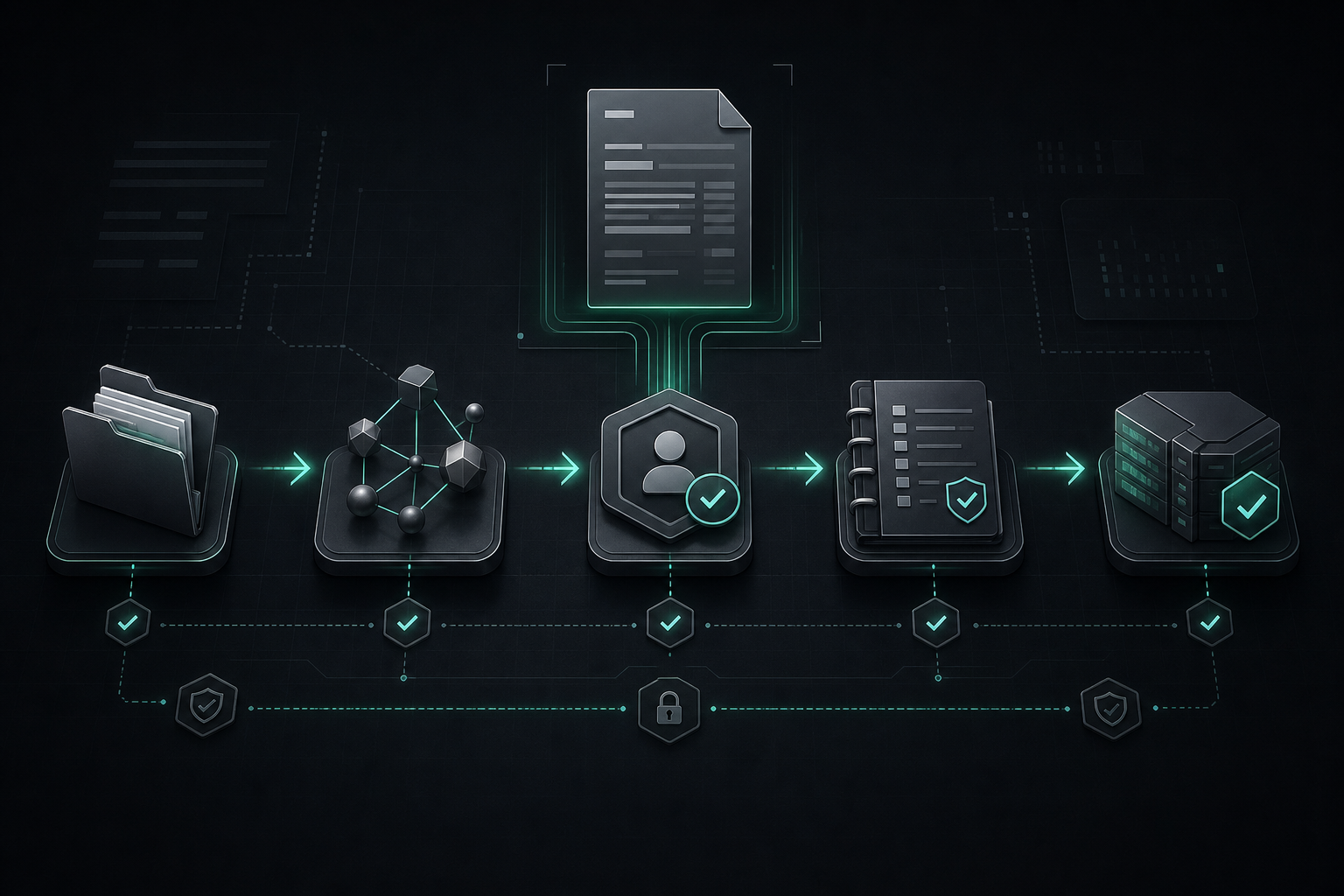
$ process procurement-request --contract PROCURE-7
> receive: request / receipt / source-version
> classify: category / evidence / uncertainty
> validate: taxonomy / policy / reference-data
> route: named reviewer / expiry / exception
> commit: idempotent task / read-back / recoveryWhy procurement requests need a controlled workflow
AI automation for procurement is often described as a faster way to read requests and send them to the right approver. That description hides the operating problem. A purchase request can contain incomplete scope, a supplier reference, a cost centre, an urgency claim, an attachment and a request for an exception. It may arrive from a form, email, shared inbox or internal system. The valuable outcome is not a fluent summary. It is a reviewable proposal that can be accepted, corrected or stopped without losing the original request.
The broad service question belongs on the AI automation service page. This article stays narrow: how to classify a procurement request, route approval and retain audit evidence for one controlled pilot. The same design can support procurement, finance and operations teams, but it should not silently approve spend, create a purchase order or promise ROI.
Start by choosing one bounded request type, one target workflow and one accountable owner. For example, a team may pilot non-catalogue requests below a documented threshold. The workflow may prepare a classification and route an approval task; the approver remains responsible for the decision. This boundary makes the first release measurable and reversible.
Preconditions and input data
Before a model is selected, define the request contract. Give each inbound item an immutable request ID, tenant or business-unit scope, received timestamp, source channel, source version and retention reference. Preserve the submitted text and attachments or their approved references. A later reviewer must be able to see what the system actually received, not a reconstructed prompt.
The minimum useful inputs are usually the requester, legal entity or cost centre, requested item or service, stated purpose, amount and currency when supplied, supplier clues, required-by date, category taxonomy and approval-policy version. Not every field has to be complete. The contract must distinguish an absent value from a value inferred by the model. An unknown cost centre is an exception, not a blank that should be guessed.
Reference data needs its own ownership. Category lists, cost centres, budget states, approver groups, suppliers and policy thresholds change. The workflow should read an approved current snapshot and record the version used. Free text from a request must never update that reference data. If the source is stale, unavailable or ambiguous, the safe outcome is a named review queue.
Useful readiness questions are:
- Can the team identify the source request and attachment version after the fact?
- Is there a maintained category and approver taxonomy with an owner?
- Which fields are required for a routing proposal, and which remain optional?
- Which request classes must always stop for human review?
- Can the destination system return an authoritative receipt after a write?
If these answers do not exist, fix the process contract first. AI cannot turn missing approval authority into reliable approval data.
Designing the PROCURE-7 workflow
PROCURE-7 is a step-by-step workflow for a controlled procurement pilot. It separates a probabilistic classification proposal from policy and the consequential action.
- Receive. Deduplicate the request using the source ID or a content-safe idempotency key. Store a receipt, source version and permitted attachment references.
- Normalize. Extract only allowed text and fields. Redact or withhold data that the classification task does not need.
- Classify. Return a typed proposal: category, request type, candidate cost centre, urgency label, confidence or uncertainty, evidence spans and missing fields. The model may propose; it does not set the final accounting or approval state.
- Validate. Check the schema, required fields, taxonomy membership, policy version and match to current reference data. Validate currency and amounts deterministically where those values are in scope.
- Route. Apply deterministic approval rules. Requests with missing, conflicting or high-impact information go to a named reviewer rather than a default approver.
- Review. Show the original evidence, proposal, policy decision, reviewer identity, decision reason and expiry. A reviewer can accept, correct or reject the proposal.
- Commit and verify. Create an idempotent draft, approval task or permitted downstream record. Read it back from the authoritative destination and save the receipt, or open a recovery item.
The workflow can be represented as a small contract rather than a promise of autonomous procurement:
request -> bounded proposal -> deterministic policy -> named decision -> verified destination stateThis sequence prevents a common failure: treating a successful model response or green workflow run as proof that the approval record is correct. Only the destination read-back is evidence that the permitted action exists.
Integrations and contracts
An implementation normally connects an intake source, identity and master-data references, an approval destination and an audit store. The exact software is less important than the contracts between it. The intake connector should provide stable identifiers and receipts. The reference-data connector should make freshness, ownership and failure visible. The approval connector should accept an idempotency key and return an authoritative ID or state. The audit layer should retain enough evidence to reconstruct a decision without copying unnecessary personal data.
Treat every connector as fallible. A timeout after creating an approval task is ambiguous: retrying without an idempotency key may create duplicates, while simply marking the run successful loses the task. A safe design queries the destination by key, records the result and routes unresolved ambiguity to recovery. Similarly, a model should not choose a cost centre merely because a label looks familiar; it must return the evidence and uncertainty that let validation stop the proposal.
Example input and output
Suppose a requester submits: “Need laptops for two new hires next month; vendor quote attached; please use the engineering budget.” The controlled workflow can keep the request as evidence and return a bounded proposal:
{
  "requestId": "pr_1042",
  "proposal": {
    "requestType": "equipment",
    "category": "IT hardware",
    "candidateCostCentre": "engineering",
    "missingFields": ["approved amount", "supplier match"],
    "evidence": ["laptops", "two new hires", "engineering budget"],
    "requiresReview": true
  },
  "policy": "route to procurement reviewer; do not create purchase order"
}
The example is deliberately incomplete. It does not assert a supplier, budget availability, final amount or approval. A procurement reviewer can correct the category, select an approved supplier, attach the required quote evidence and decide under the current policy.
Checks before launch
Run acceptance checks against representative historical or synthetic requests before any live action. Test normal requests, missing attachments, duplicate submissions, conflicting supplier names, unsupported categories, stale policy data, unavailable references, reviewer timeout and destination failures. Include cases in the languages the process accepts; mixed Russian, Armenian and English labels should not be silently normalized into a wrong category.
Acceptance criteria should be explicit:
- Every workflow run has a source receipt, version, policy version and correlation ID.
- The proposal conforms to a documented schema and identifies missing or uncertain fields.
- Category, approver and threshold decisions use approved current reference data.
- A request that needs review cannot become an approved action through a retry or fallback.
- Repeated delivery creates at most one destination record for an idempotency key.
- The destination record is read back and linked to the workflow evidence.
- Failed or ambiguous actions enter an owned recovery queue with a visible status.
- Access, retention and redaction follow the organisation's approved rules.
Do not replace these checks with a single accuracy percentage. The relevant question is whether each permitted route is explainable, correct under policy and recoverable when a dependency fails. A pilot may track review rate, correction rate, exception reasons, duplicate prevention, time-to-owned-review and verified read-back coverage. These are operational signals, not revenue promises.
Operating and improving the pilot
Launch with a narrow volume and a defined review cadence. Sample accepted classifications as well as exceptions; otherwise the team only learns from obvious failures. When reviewers correct a proposal, store the reason in a controlled taxonomy such as “missing source”, “taxonomy mismatch”, “policy change” or “ambiguous request.” That turns corrections into evidence for process repair rather than undocumented prompt churn.
Version prompts, schemas, reference snapshots and policy rules independently. A change to the category taxonomy may require a new reference version but not a model change. A new output field may require migration and acceptance tests. Every change should have an owner, evaluation set, rollback decision and production window. Preserve the ability to disable the AI proposal while continuing the manual route.
After a stable pilot, decide whether to expand by request type, business unit or integration depth. Expansion is justified only when the existing boundary has evidence: review outcomes are inspectable, exceptions have owners, downstream writes reconcile and the team can explain how to recover. For a controlled pilot design, teams can discuss the workflow and integration boundaries with aicoding.am's AI automation practice or review relevant implementation evidence in the case studies.
Conclusion
AI can make procurement intake more structured without becoming the approver. A useful first implementation preserves the source request, produces a bounded classification proposal, validates it against current rules, assigns human authority where it belongs and verifies the destination state. That is a practical way to move from an AI demonstration to an auditable operational workflow.
require(request.id && request.receipt && request.sourceVersion && policy.version);
require(proposal.schemaValid && proposal.evidence.length && references.current);
commit = policy.permits && reviewer.authorized && destination.readBack && recovery.owner;