AI Project Brief Template for a Company
A practical template for preparing an AI project before vendor review
Workflow, data, integrations, users, approval gates, risks, scoring and next-step routing
How this guide supports the broad Armenia AI specialist landing page with long-tail brief intent
AI project brief template, hire AI developer Armenia and AI vendor selection checklist
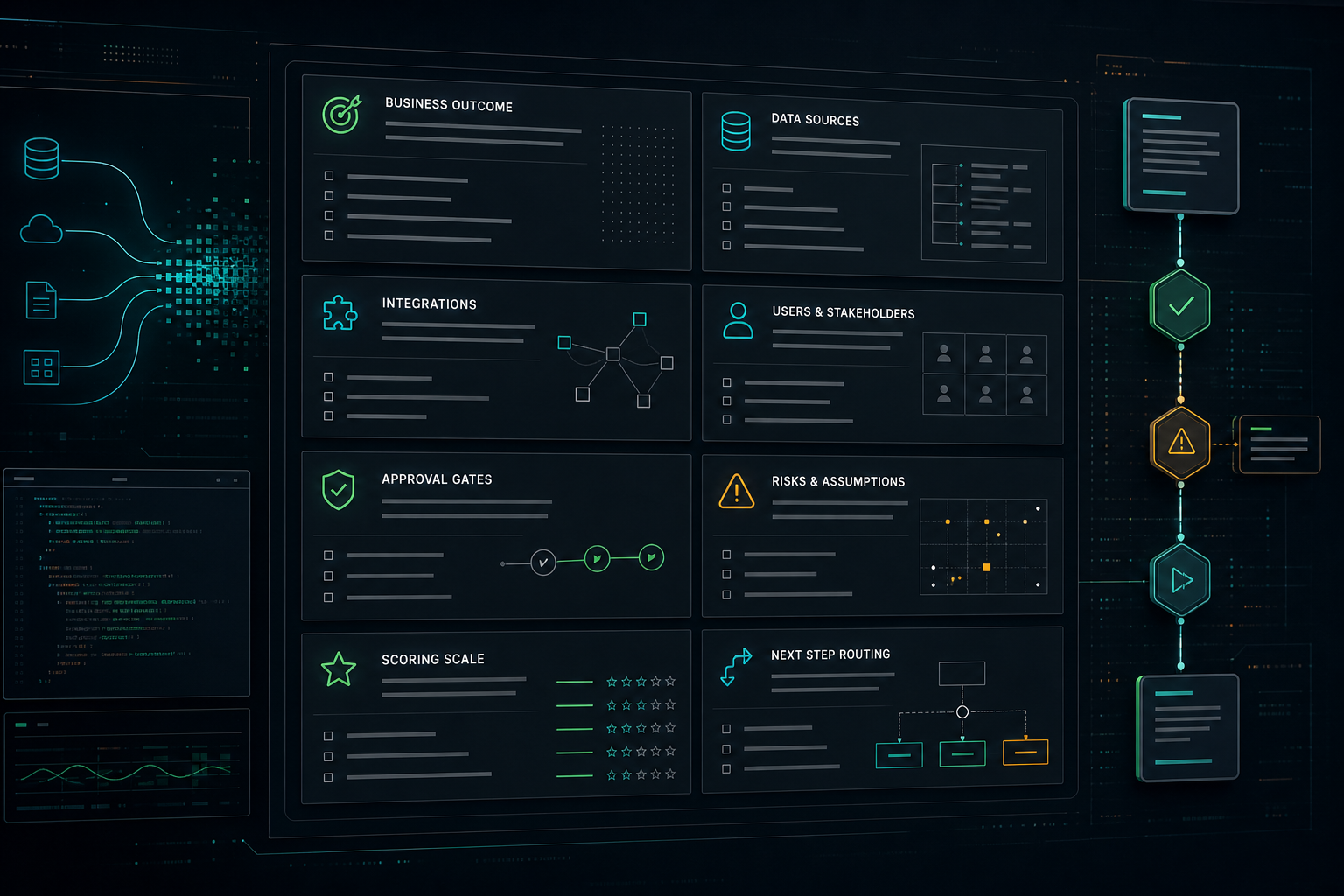
$ brief ai_project --template company
> map: workflow / data / integrations / users / approval
> score: unknown / draft / reviewable / ready
> output: discovery / audit / prototype / pilotA useful AI project brief does not start with a model name. It starts with the business workflow, the people who use it, the data that can be accessed, the systems that must stay the source of truth and the risk that the company is not willing to automate blindly.
The broad commercial intent belongs to the AI specialist in Armenia landing page. This article is narrower: it gives a practical AI project brief template for companies that want to prepare a reviewable scope before talking to an AI developer, AI studio or AI contractor.
When to use the template
Use the template before discovery, vendor selection, budget estimation, RAG design, AI automation, LLM workflow implementation or an internal AI tool. It is most useful when the team has a real business process, but the request is still expressed as "we need AI for this" instead of a scoped project.
The goal is not to make the client do the contractor's work. The goal is to reduce vague conversations. A good brief helps both sides see what is known, what is missing and what should be checked before a contract or build phase.
Use it when:
- several departments describe the problem differently;
- the team wants an estimate, but integrations and data access are unclear;
- a demo is easy to imagine, but production behavior is risky;
- the project may touch CRM, ERP, documents, messengers, spreadsheets or payments;
- human review, logs, fallback and ownership are not yet defined.
Criteria and readiness scale
Score each brief section from 0 to 3 before sending it to a contractor.
| Score | Meaning | Practical interpretation |
|---|---|---|
| 0 | Unknown | The team has not described the section |
| 1 | Draft | There is a rough answer, but no evidence or owner |
| 2 | Reviewable | The contractor can validate the assumption during discovery |
| 3 | Ready | The section names facts, systems, owner and constraint |
The total score matters less than the blocked category. A brief can be strong on business value and still be unsafe if data permissions, write actions or approval gates are missing.
How to fill the brief
Start with the workflow, not the AI feature. Write the current process in plain operational language: trigger, user, current tool, decision, output and failure condition. If the workflow cannot be explained without the word "AI", it is probably not ready for estimation.
Then describe users and roles. Name who sends the request, who reviews the output, who approves a business action and who owns changes after launch. For AI systems, ownership after launch is part of the product, not an afterthought.
Next, map data sources. Include documents, CRM fields, spreadsheets, emails, call transcripts, chat history, product catalogs, policies and internal notes. For each source, mark whether it can be used in production, whether it contains sensitive data and who can approve access.
For integrations, list the systems that must be read from or written to. A project that only drafts text is different from a project that updates a CRM, creates a task, sends a message or triggers a refund. Write paths need stricter approval and rollback rules.
Finally, define what a useful first version means. Avoid "AI should work well." Use examples: expected output, bad output, acceptable delay, required citation, manual review condition, escalation rule and one case where the system must refuse or ask a human.
Template sections
| Section | What to write | Pass signal |
|---|---|---|
| Business outcome | What changes if the workflow improves | The value is tied to time, quality, risk or throughput |
| Current workflow | Trigger, actor, tool, decision and output | The process can be tested with real examples |
| Users and roles | Requester, reviewer, approver and owner | A human owner exists for every sensitive step |
| Data sources | Documents, records, fields and access rights | Source owner and privacy boundary are visible |
| Integrations | Read systems, write systems, APIs and exports | Write actions are separated from read-only context |
| AI behavior | Draft, classify, retrieve, summarize, route or act | The model responsibility is narrow and checkable |
| Evaluation | Good examples, bad examples and acceptance criteria | Quality can be tested before rollout |
| Risks | Privacy, wrong action, hallucination, delay and bias | Each risk has a control, fallback or stop condition |
| Rollout | Audit, prototype, pilot and production path | The first milestone is small enough to verify |
| Ownership | Repo, docs, logs, support and change process | Maintenance is assigned before launch |
How to interpret the result
Use the score to route the next step.
| Result | Interpretation | Next step |
|---|---|---|
| Any 0 in data, permissions or write actions | The project is not safe to estimate as production delivery | Run a data and integration audit first |
| Many 1 scores in workflow or users | The team is aligned on the idea, not the operation | Run a short discovery workshop |
| Weak evaluation section | Quality will be argued by opinion | Build a small evaluation set before implementation |
| Weak ownership section | The system may become unsupported after launch | Define logs, support owner and change process |
| Mostly 2 and 3 scores | The project is ready for a scoped technical review | Ask for audit, prototype or pilot proposal |
Do not punish the brief for showing uncertainty. A visible unknown is better than a confident but false requirement. The practical risk is hidden uncertainty: permissions that appear after contract, data quality gaps found after demo or approval rules discovered only when the system is already connected.
Downloadable Markdown template
Use the downloadable artifact as the original proof template: AI project brief template.
The template includes fields for workflow, data, integrations, users, approval gates, risks, scoring and next-step routing. It can be copied into a project document or filled before a vendor call.
What to do after the brief
If the brief has critical gaps, do not request a production build estimate. Start with discovery, data mapping or integration review. If the brief is mostly reviewable, use it to ask for a narrow proposal with acceptance criteria and a controlled first milestone.
For broader service context, use the AI specialist in Armenia page. For proof, review the case studies. For nearby procurement checks, compare 25 questions before starting an AI project and red flags when choosing an AI contractor.
Checked and updated
Checked on 2026-07-10 against the aicoding.am content plan, current service pages, public case-study layer and the local procurement article cluster. The article avoids ranking claims and keeps broad local AI intent with the dedicated landing page.
Where This Applies
AI project scoping, vendor review and first production-safe milestone
This article is useful when a company in Armenia needs to turn an AI idea into a reviewable project brief before estimating AI automation, RAG, agent, LLM workflow or internal tool work.
- Founders preparing a vendor conversation without over-scoping the first build.
- Operations teams mapping workflow, data, integrations and approval gates.
- Companies that need a downloadable brief template before asking for an estimate.
project_brief = workflow_clarity
  + data_permissions
  + integration_map
  + approval_gates
  + ownership_after_launch;
if (score.data == 0 || score.write_actions == 0) require("audit_first");
if (score.evaluation <= 1) require("evaluation_set");