AI Reporting: How to Use Data Without Invented Conclusions
Make every material claim traceable to an approved source and calculation
Source lineage, deterministic metrics, validation gates, bounded narrative and owner review
Original REPORT-8 architecture with evidence contract, failure modes and release gate
AI reporting automation, AI back office automation, data lineage, report validation, AI analytics governance, grounded AI narrative, AI automation ROI and REPORT-8
$ build report --contract REPORT-8
> receive: period / audience / template-version
> collect: approved sources / receipts / freshness
> calculate: versioned formulas / comparable periods
> validate: completeness / reconcile / exceptions
> explain: bounded claims / evidence / uncertainty
> publish: owner review / read-back / recoveryWhy AI reporting needs a truth boundary
An AI reporting assistant can make a useful draft from many records, but it cannot make the underlying data complete, current or comparable. A confident narrative is especially risky when it turns missing data into a causal explanation, mixes periods, or silently changes a metric definition. A report is operationally useful only when a reader can trace each material statement to an approved source, its version and the rule used to calculate it.
The broad service question belongs on the AI automation service page. This guide answers a narrower implementation question: how to create a controlled reporting pipeline that prepares a readable draft while preserving source lineage, validation results and a human decision boundary. It does not promise accurate forecasts, reliable ROI or autonomous management decisions.
Begin with one recurring report for one named audience. Define the decision it supports, the reporting period, metric dictionary, source owners and acceptable delay. If a KPI has no agreed definition or an owner cannot explain its source, that is a data-governance issue to repair before adding an AI layer.
The REPORT-8 architecture
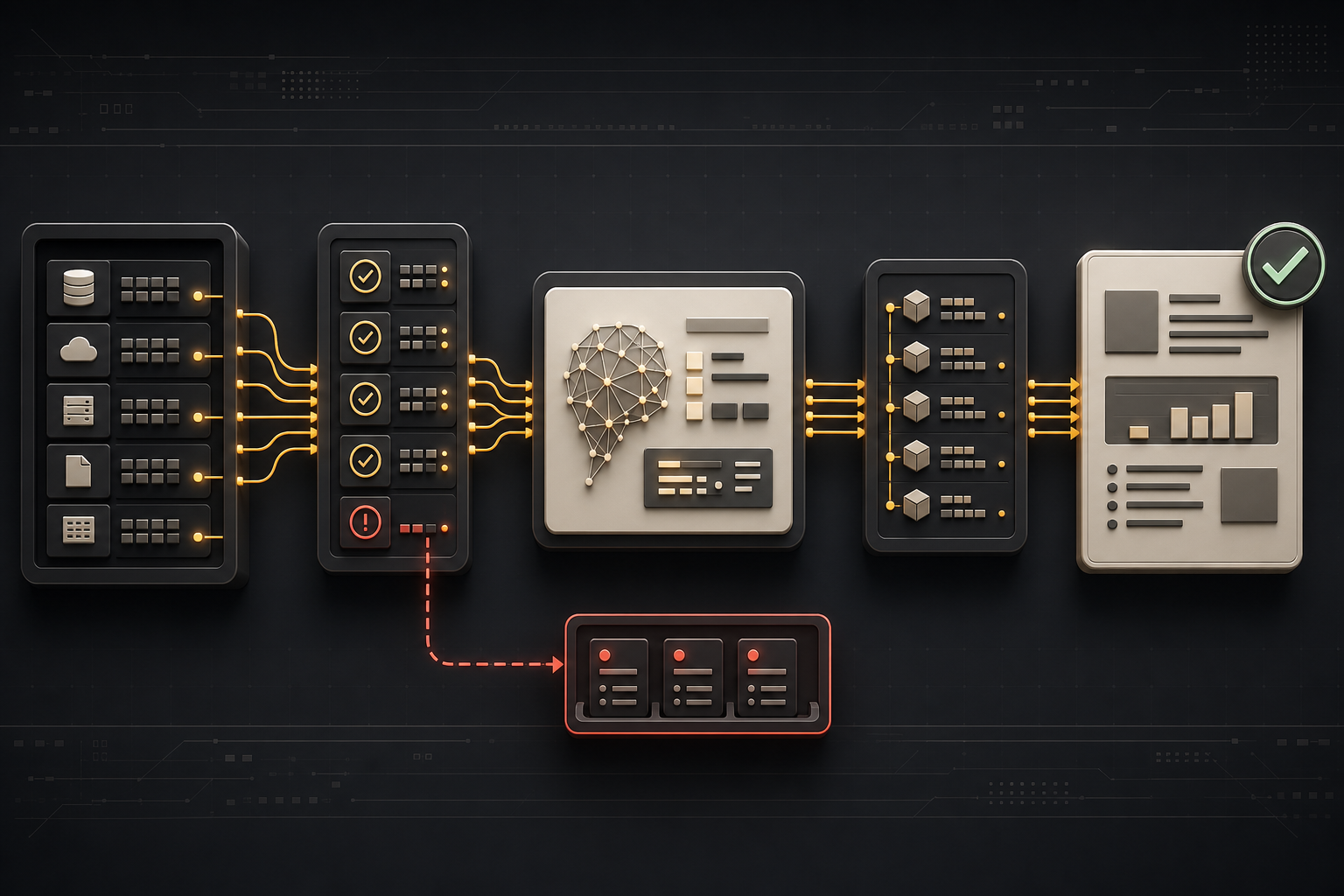
REPORT-8 separates collection, calculation and narrative generation. The model receives a bounded evidence packet; it does not query production systems freely or invent a reason for a movement.
- Receive. Retain a run ID, requested period, audience, report template version and an immutable source receipt.
- Collect. Fetch only approved datasets through scoped connectors. Record source IDs, extract time, schema version, permission scope and freshness status.
- Normalize. Convert dates, currencies, entity IDs and metric names using explicit rules. Preserve rejected rows and mapping warnings.
- Calculate. Produce deterministic aggregates from versioned formulas. The calculation artifact, not the model response, owns totals and comparisons.
- Validate. Test completeness, period alignment, reconciliation, threshold rules and unexpected variance. A failed check becomes an exception, not a hidden footnote.
- Explain. Give the model the validated metric table, permitted evidence snippets and uncertainty flags. Require it to label observations separately from hypotheses and to cite evidence IDs.
- Review. A named owner accepts, edits or rejects a draft that contains material decisions, external claims or unresolved exceptions.
- Publish and reconcile. Deliver the approved report to its permitted destination, read it back, retain the rendered version and open recovery for ambiguous delivery.
approved sources -> deterministic metrics -> validation gates -> bounded AI narrative -> owner review -> verified reportThe architecture deliberately keeps calculation outside generative text. An assistant may say that revenue is lower than the previous comparable period only after the data contract has defined both the revenue metric and the comparison period. It may not turn a correlation into a cause without source-backed evidence.
A minimal evidence contract
Each metric row should carry more than a number. It needs a metric ID, definition version, period, dimensions, source references, calculation version, freshness result and validation state. The report draft should link a claim to those IDs. For example, a safe output can distinguish a confirmed observation from an unresolved question:
{
  "metric": "qualified_leads",
  "period": "2026-07",
  "value": 84,
  "comparison": { "period": "2026-06", "value": 96, "change": -12 },
  "evidence": ["crm_export_2026-08-01", "metric_definition_v4"],
  "validation": "passed",
  "narrative": "Qualified leads were lower than the prior period.",
  "hypothesis": "No causal explanation is available from this evidence set."
}
This is not a universal report schema. It is a boundary: the workflow can state what the data supports, preserve what it does not know and route the next question to an owner. Definitions, access rights and retention must follow the organisation's approved policy.
Failure modes to design for
The most damaging reporting failures look plausible. A connector can return a partial export after an API timeout; a dashboard can compare a calendar month with a fiscal period; a renamed CRM stage can change a funnel without changing the query; a late adjustment can make yesterday's report stale. A model can then produce a polished explanation for a defect it cannot see.
Treat these as explicit routes:
- Missing or stale source: block the affected metric, show its source status and assign a recovery owner.
- Schema or definition drift: stop calculation until mapping and metric version are reviewed.
- Reconciliation mismatch: retain both totals, evidence and tolerance rule; do not choose the nicer number.
- Unsupported explanation: label it as a question or omit it rather than presenting it as analysis.
- Duplicate or ambiguous delivery: use an idempotency key, read the destination back and repair from the retained report artifact.
- Permission leakage: filter the evidence packet before generation; a reporting audience is not automatically entitled to every row or document.
An error budget or a single “accuracy” percentage cannot substitute for these controls. The useful operating signals are validation-pass coverage, freshness exceptions, reconciliation mismatches, claim-to-evidence coverage, review corrections and verified delivery coverage.
Test before a production report
Use representative historical or synthetic fixtures: a normal close, an empty source, delayed export, duplicate event, changed KPI definition, timezone boundary, currency conversion, late correction, a reconciliation mismatch and a reader without access to one source. Test formulas independently from narrative prompts, then test the assembled report and the delivery recovery path.
The release gate can be small and inspectable:
require(run.id && period.closed && template.version && sources.every(hasReceipt));
require(metrics.every(isFormulaVersioned) && checks.every(isPassedOrOwned));
publish = review.authorized && report.claims.every(hasEvidenceOrQuestion) && destination.readBack;
For a first pilot, keep the output advisory: a weekly operations summary, a finance-preparation pack or a sales-quality review. Keep a manual reporting route available. Expansion is justified only when the team can trace a statement, correct a defect, recover a failed delivery and explain who owns each exception.
From draft to decision support
AI can reduce the effort of assembling a report without becoming the source of truth. The production unit is an evidence-backed report: source receipts, deterministic calculations, visible validation results, bounded narrative, owner review and a verified destination. Teams planning that boundary can use the AI automation service guide, see the broader local engineering scope on AI specialist Armenia, review implementation evidence in the case studies, or start with a focused architecture review through the project brief.
require(run.id && period.closed && sources.every(hasReceipt));
require(metrics.every(isFormulaVersioned) && checks.every(isPassedOrOwned));
publish = review.authorized && report.claims.every(hasEvidenceOrQuestion) && destination.readBack;