How to Choose an AI Developer in Armenia for a Production Project
A practical guide for teams choosing an AI developer in Armenia for production delivery
Selection criteria, workflow, red flags, evaluation and ownership after launch
How to separate an AI expert, an AI developer and a production AI engineer without advertising rankings
AI developer Armenia, AI specialist Yerevan, RAG, LLM systems and AI automation
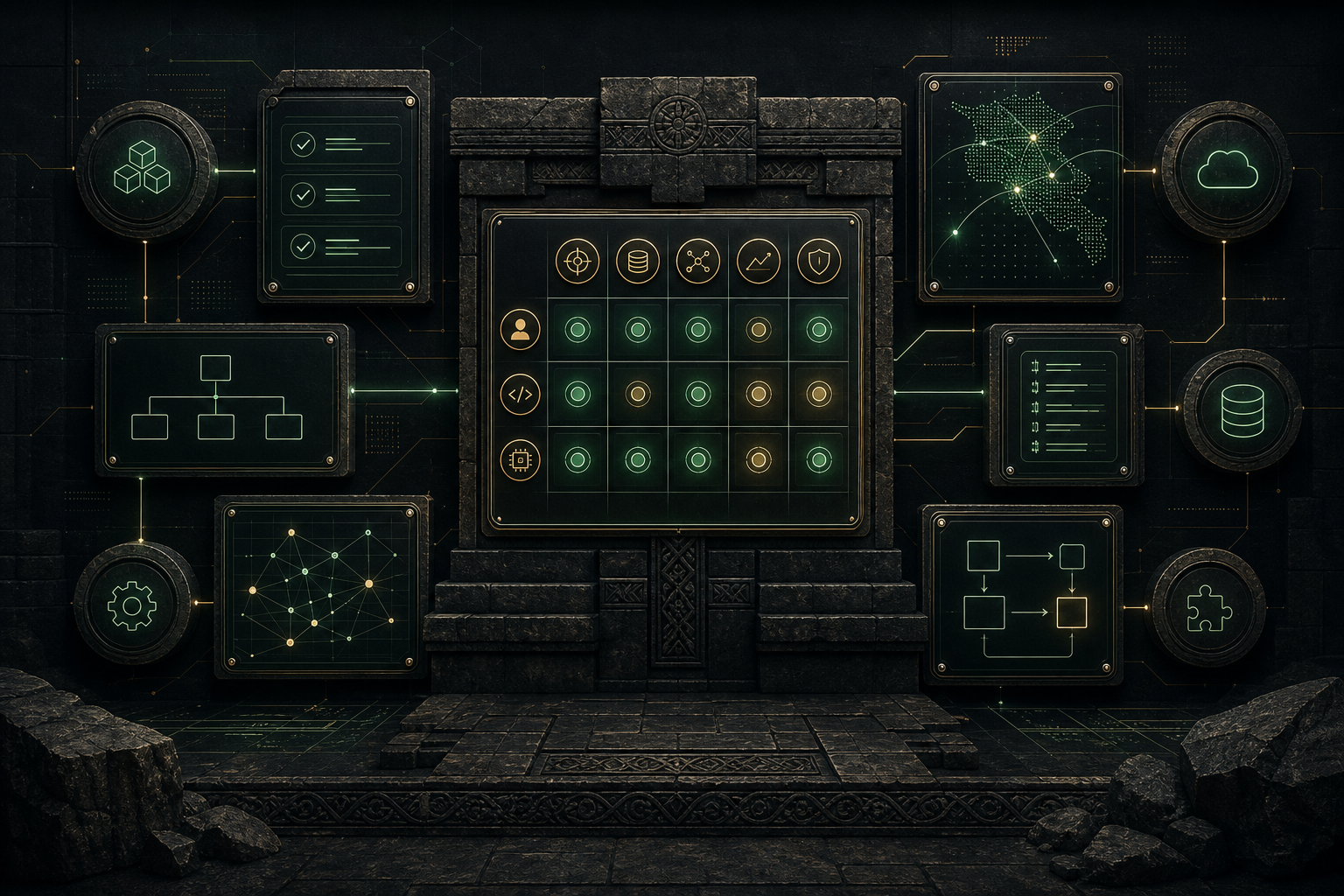
$ evaluate ai_developer --market armenia
> task: business workflow, not generic chatbot
> check: data access, integrations, evaluation
> proof: case studies, method, ownership
> red_flags: demo-only promises rejected
> route: brief -> AI audit -> production-safe prototypeContext: when you need an AI developer, not just an AI expert
The question "how to choose an AI developer in Armenia" usually appears when a company needs more than a chatbot demo. The real task is often to connect AI with CRM data, documents, internal workflows, websites, inventory, support, sales, analytics or operational tools.
That is why the first decision is to separate a person who can talk about AI from a specialist who can ship an AI system into production. These are different roles. An AI expert can explain tools, show demos, tune prompts or run workshops. An AI developer has to turn the idea into a working loop: data, access control, integrations, fallback paths, logs, quality checks and support.
For teams in Armenia and Yerevan, the choice is also shaped by local and remote delivery. A local company may need Armenian market context, Russian-language communication, English technical documentation and integrations with global APIs at the same time. The useful question is not "who promises AI transformation", but "who can decompose the workflow into verifiable engineering parts".
If you need the commercial service page, start with AI Developer and AI Specialist in Armenia. This article has a narrower role: it gives a practical selection method.
Comparison table: similar labels, different outcomes
| Role | Typical capability | Best use | Production risk |
|---|---|---|---|
| AI expert | Explains AI tools, demonstrates LLM capabilities, helps choose direction | Discovery, training, early strategy | May not cover integrations, security, operations and support |
| AI developer | Builds prototypes, API integrations, RAG, agents, automation flows and internal tools | MVPs, workflow automation, fast validation | Without production discipline, the demo can remain a separate script |
| Production AI engineer | Designs data flow, integrations, evaluation, human review, deployment and monitoring | Systems that must operate inside a business process | Requires more discipline at the beginning, but reduces rework |
The practical conclusion is simple. For a workshop or a strategy session, an AI expert may be enough. For business process automation, you need an AI developer. For systems that affect daily operations, you should look for a production AI engineer or a studio that can work at that level.
Selection criteria: five filters before the project starts
1. The task is described through a process, not a model
A weak starting point is: "we need GPT in the company". A useful starting point is: "we have inbound requests, documents, CRM statuses and repeated operator decisions; we want to reduce manual triage while keeping human control".
A strong AI developer does not begin with the model name. They ask about the process: who uses the system, where the data comes from, where decisions are made, what counts as an error, who approves the result and where the audit trail should live.
2. Data access and constraints are clear
RAG systems, AI agents and LLM workflows depend on more than the model. They depend on sources: documents, knowledge bases, CRM, APIs, files, spreadsheets, messages, product data and internal rules.
If a specialist promises accurate results without seeing the data and without checking the sources, treat that as a red flag. A proper approach defines which data can be used, which data cannot be sent to external services, where access rights are needed and how the knowledge will be updated.
3. Integrations are discussed before the prototype
An AI system rarely lives alone. It may need to read from a CRM, write to a task manager, receive a webhook, answer inside a messenger, trigger an n8n workflow, call an internal API or generate a document.
That is why the integration surface should be reviewed early: API availability, token ownership, rate limits, error handling and audit trail. If integrations appear only after a polished demo, the production path becomes more expensive.
4. There is a quality evaluation method
Production AI cannot be judged by "it seems to answer well". You need test cases, examples of bad answers, refusal criteria, human review and a definition of which errors are acceptable.
For RAG systems, this can mean control questions and source checking. For AI agents, it means action scenarios and boundaries. For automation workflows, it means test inputs, expected statuses and fallback logic.
5. Ownership after launch is defined
AI systems change after launch. New documents, products, rules, model behavior and user errors appear. Before starting, clarify who maintains the system, how prompts are versioned, where logs are checked, who handles incidents and when architecture should be reviewed.
If the vendor talks only about delivery and not about support, observability and responsibility boundaries, that is a risk.
What a production process looks like
A sane AI delivery process does not have to be heavy, but it should be sequential.
- Intake: define the business task, current workflow, users, constraints and expected effect.
- Process map: document inputs, actions, decisions, systems, roles and human review points.
- Data review: check sources, access, document quality, privacy and knowledge updates.
- Prototype: build a small working loop that validates the main hypothesis.
- Evaluation: test the prototype on real or realistic scenarios.
- Production path: add integrations, error handling, access rights, logs, monitoring, deployment and support.
This is also how the article supports the local service page for aicoding.am as an AI engineering partner in Armenia: the landing page owns the broad commercial intent, while this article explains selection criteria.
Red flags when choosing an AI developer
- The specialist promises accuracy without tests or data access.
- The conversation is only about prompts, not workflow architecture.
- The demo is disconnected from CRM, APIs, documents and real workflow.
- There is no answer for what happens when the model is wrong.
- Access rights, private data, logs and human review are not discussed.
- The proposed "AI agent" has no tool boundaries, action limits or audit trail.
- The portfolio has screenshots but does not explain task, solution, result and stack.
- The vendor claims to be "the best" without verifiable proof.
A red flag does not always mean the person is bad. It may mean they are suitable for education or a prototype, but not for a system that must run inside a daily business process.
A practical proof point
The aicoding.am case studies show two useful kinds of evidence for evaluating an AI developer.
The first is production systems. Narciss CRM is not an AI demo; it is an operating platform with orders, inventory, CRM, delivery, POS, messengers and integrations in one business loop. This matters because AI automation usually depends on real data and operational workflows.
The second is browser-first runtime and controlled workflow. AmoBit Inbox shows how messengers, protected media, workspace boundaries and a backend source of truth can become a foundation for future AI-assisted workflows: summaries, routing, drafts and operator copilots.
These examples should not be read as a ranking. They are better used as a thinking check: does the implementer understand production boundaries, and can they connect interface, backend, data and operations?
Questions to ask before starting
1. Which business error should the AI system reduce?
2. What data does it need and where does that data live?
3. Which systems must it read from or update?
4. How will we know that the answer or action is correct?
5. What happens when the model is uncertain?
6. Who approves ambiguous decisions?
7. Where will logs, prompt versions and change history live?
8. How will the system be updated after launch?
If these questions have concrete answers, the project is closer to production. If the answers are replaced by generic claims that "AI will automate everything", stop and clarify the task.
Practical next step
Do not start with a large "AI implementation" commitment. Start with a short AI audit: choose one workflow, map inputs and decisions, inspect the data, identify integrations, define risks and create a plan for the first production-safe prototype.
If you are choosing an AI developer in Armenia or need a remote delivery format with local context, start with the AI audit brief. If you want to understand who is behind aicoding.am, read the page about Sevada Yenokyan and the studio.
Where This Applies
AI audit, local/remote delivery and production-safe first prototype
This guide is useful for companies in Armenia and Yerevan choosing a developer for AI automation, RAG, LLM workflows or internal AI tools.
- A founder or operations team needs to connect AI with a real workflow.
- Documents, CRM, APIs, messengers or n8n flows need to become one production loop.
- The project should start with a short AI audit before a prototype or implementation.
define business error
map process and users
inspect data sources
check integration surface
design evaluation cases
set human review boundaries
clarify post-launch ownership