Local or International AI Contractor: A Business Comparison
One weighted decision matrix for two delivery models and three business scenarios
Context, specialist depth, speed, TCO, risk, control, support and handover
Criteria-based long-tail guidance supporting the AI specialist Armenia landing page
Local versus international AI contractor, AI vendor selection Armenia and delivery model comparison
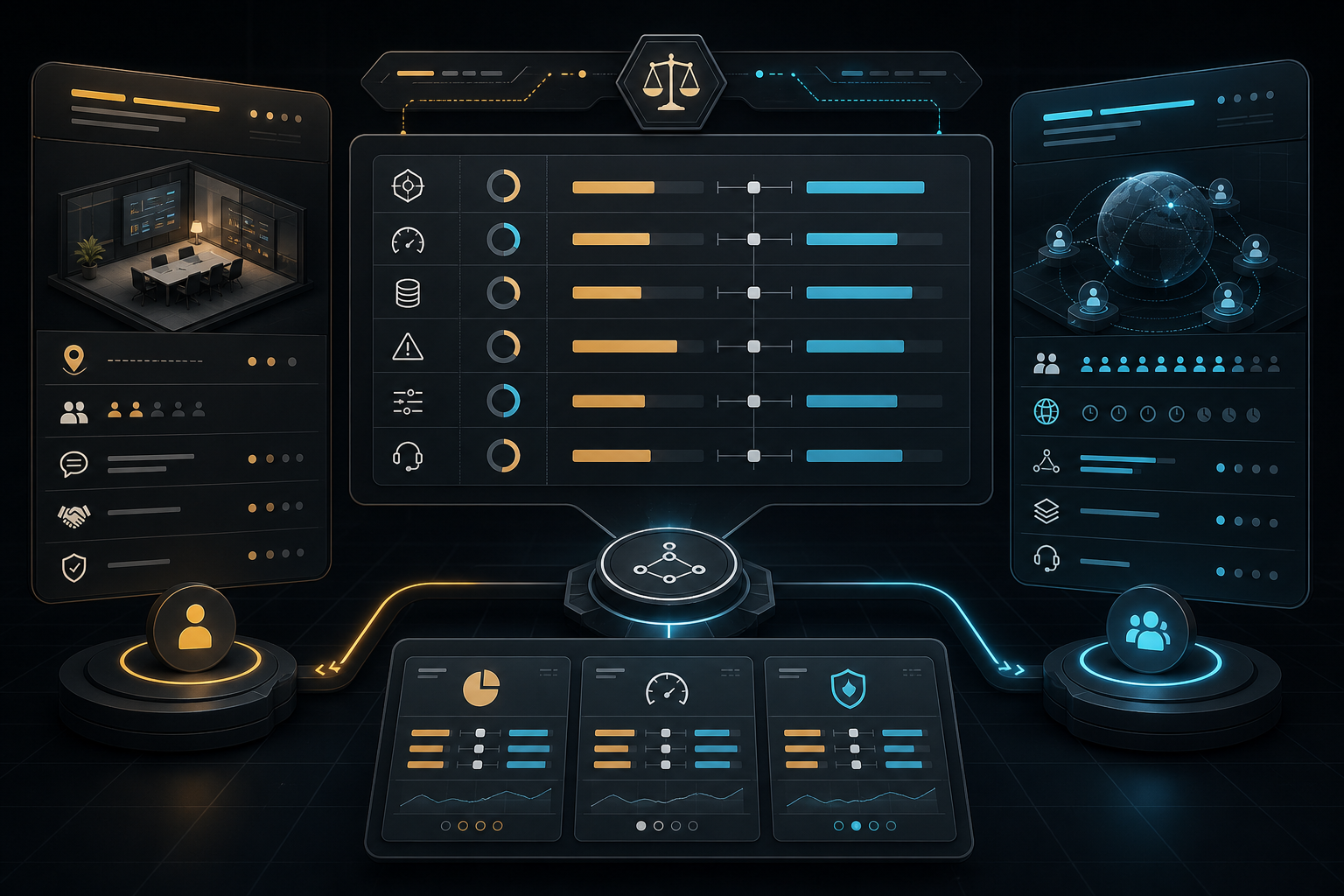
$ compare ai_contractor --local --international
> criteria: context / depth / speed / tco / risk / control / support
> scenarios: armenia_ops / research_spike / multi_country_platform
> output: local / international / hybrid / discovery_firstWhat Is Actually Being Compared?
The choice is not simply “a person nearby” versus “a larger team abroad.” A local AI contractor may be an independent specialist, a compact studio or a delivery partner with a small network. An international team may be a specialist boutique, an agency or a distributed product group. Each can be excellent or unsuitable. Geography changes some delivery conditions, but it does not prove engineering quality.
Start by defining the outcome: the workflow to improve, the users involved, the data and systems that must be accessed, the decisions the AI may influence, and the person who will own the result after launch. Then compare candidate delivery models against the same evidence. This keeps the article’s long-tail question separate from the broader commercial intent owned by the AI specialist in Armenia landing page.
A procurement comparison should answer five questions:
- Can the contractor understand the operating context quickly enough?
- Does the team have the specialist depth required by the architecture?
- What is the total cost of reaching and operating an accepted result?
- Which risks remain with the client, and which are owned by the contractor?
- Can another team continue the system without starting discovery again?
Use One Set of Criteria
Changing criteria for each candidate turns a comparison into a sales presentation. Use a weighted matrix, request the same evidence and score only what can be reviewed.
1. Workflow and market context
Local context matters when a system touches Armenian, Russian and English communication, local customer behaviour, on-site operations, informal process knowledge, local vendors or rapid workshops with decision-makers. It matters less for a well-specified technical component with stable inputs and outputs.
Ask candidates to explain the current workflow in their own words, identify ambiguous steps and list the assumptions that could change the design. A nearby address is not proof of context. The proof is an accurate process model and a plan to validate unknowns.
2. Specialist depth
An international team may offer a wider bench of data, ML, security, platform and domain specialists. A focused local contractor may provide more direct senior attention and fewer handoffs. Compare named people and availability, not the company’s total headcount.
For a RAG system, ask who owns document ingestion, access control, retrieval evaluation and production monitoring. For an agentic workflow, ask who designs tool permissions, approval boundaries, retries and audit logs. If the required expertise is absent, location cannot compensate for it.
3. Time to a reviewable result
“Fast” should mean time to an artifact the business can evaluate: a process map, data audit, evaluation set, integration spike or controlled pilot. It should not mean time to a polished chat demo.
Local access can shorten scheduling, context discovery and stakeholder feedback. A distributed team can move quickly when it already has the right specialists and a mature delivery system. Request a dependency list, milestone definitions and acceptance criteria. Penalize timelines that hide data access, security review, integrations or user testing.
4. Total cost of ownership
Day rates are incomplete. Total cost of ownership includes discovery, implementation, client coordination, data cleanup, third-party services, evaluation, deployment, monitoring, incident handling, change requests, documentation and eventual transition.
A lower rate can become expensive when the client must translate context repeatedly or repair an undocumented system. A higher rate can also be wasteful when a large team adds coordination without reducing risk. Compare the estimated cost of an accepted outcome and the first year of operation, with assumptions visible.
5. Delivery and continuity risk
Local delivery may reduce timezone and communication friction, but a single specialist can create concentration risk. An international team may provide backups, yet continuity can still be weak when work is distributed across changing subcontractors.
Request evidence for source-code ownership, credential handling, documentation, backups, incident escalation and handover. Ask what happens if the lead engineer is unavailable for two weeks. The practical question is not team size; it is whether responsibility and knowledge survive personnel changes.
6. Control and communication
AI projects contain uncertain requirements. Control comes from short review cycles, decision logs, explicit approval boundaries and visible evaluation results. Proximity can make workshops easier. A disciplined remote team can be equally transparent with recorded demos, written decisions and reliable overlap hours.
Ask for a sample weekly report and issue workflow. Confirm who can approve scope, model changes and production write actions. A communication channel is not a governance model.
7. Support and handover
The system will outlive the first release. Compare monitoring, response windows, maintenance ownership, runbooks, training and exit support. Determine whether the contractor can support local working hours and whether critical incidents need broader coverage.
The case studies show the kind of production evidence worth reviewing, while the about page describes the operating context behind aicoding.am. Use those as evidence surfaces, not as substitutes for a project-specific evaluation.
Strengths and Weaknesses of Each Option
Local AI contractor
Potential strengths include faster access to stakeholders, more shared business context, easier on-site discovery, practical language alignment and direct accountability. These advantages are strongest when the workflow is not documented and users need to shape the solution through frequent review.
Potential weaknesses include a smaller specialist bench, concentration risk, limited support coverage and less capacity for a large parallel programme. These are not automatic defects. A local contractor can mitigate them through partner networks, narrow scope, documented architecture and a clear escalation plan.
International team
Potential strengths include access to niche specialists, larger delivery capacity, multi-region experience and broader coverage. These advantages matter for complex platforms, unusual research problems or programmes that genuinely require several disciplines at the same time.
Potential weaknesses include context translation, coordination overhead, timezone delay, changing account teams and higher transition cost. A mature international team can mitigate them with stable named roles, overlap hours, local discovery partners and strong written operations.
Neither option receives a default bonus for brand, location or size. Score the delivery model that will actually work on the project.
Three Selection Scenarios
Scenario A: Armenia-first operational automation
A company wants to classify multilingual requests, update a CRM and keep a human approval step before consequential actions. Process knowledge is mostly in employees’ heads. Here, context access, workshops, language handling and support during local working hours deserve high weights. A local contractor or hybrid local lead may be the better starting model, provided integration and production skills are demonstrated.
Scenario B: narrow frontier-model research spike
A product team needs a short experiment in a specialised model technique, with no production data write path. Specialist depth and research evidence may outweigh local context. An international boutique or named remote expert can be a rational choice. Define the deliverable as reproducible findings, code, limitations and a recommendation—not a promise of production readiness.
Scenario C: multi-country production platform
A business needs several integrations, access controls, evaluation, monitoring and support across regions. No single geography is decisive. A hybrid model may work best: a local product or process owner paired with a distributed specialist team. Contract interfaces, ownership and handover between the parties must be explicit.
The Weighted Decision Matrix
Use the downloadable weighted comparison matrix. The default weights are: context 15, specialist depth 15, speed 10, TCO 20, risk 15, control 10 and support 15.
Score each option from 1 to 5 and attach evidence to every score. Multiply each score by its weight and divide by 5. The arithmetic makes trade-offs visible, but it does not replace judgment.
Before scoring:
- Agree on weights with business, technical and operational stakeholders.
- Define any non-negotiable gates, such as data residency, local workshops or 24-hour incident coverage.
- Give every candidate the same project brief and evidence request.
- Record confidence as high, medium or low for each score.
- Re-score after discovery when assumptions become facts.
If two options are within ten weighted points, treat the result as inconclusive. Run a paid discovery or controlled prototype with identical acceptance criteria. This is more reliable than forcing a winner from weak evidence.
Procurement Questions That Expose the Real Difference
Ask both candidates:
- Who will work on discovery, implementation and production support by name and role?
- Which project assumptions are currently too weak for a fixed estimate?
- How will you test multilingual inputs, retrieval quality or model behaviour?
- Which production actions require human approval?
- How are credentials, customer data and logs protected?
- What will the client own at the end: code, prompts, schemas, evaluation sets and runbooks?
- How can another team take over?
- What is excluded from support and how are incidents escalated?
Good answers expose boundaries and uncertainty. Weak answers rely on company size, proximity, model brands or generic claims about speed.
Contract Shape Should Follow Uncertainty
The contractor format and the contract format are separate decisions. A capable team can still fail under a contract that assumes facts the project does not yet have. When process ownership, data quality or integration behaviour is unclear, begin with a time-bounded audit or discovery. The output should be a process model, risk register, data and integration findings, evaluation proposal, architecture options and a revised delivery decision.
Use a prototype when the main uncertainty is technical feasibility and the result can remain isolated from production. Use a pilot when the workflow, users and acceptance criteria are known but operational behaviour must be observed with limited scope. Use a production contract only when ownership, security, evaluation, rollout and support are explicit enough to estimate responsibly.
Apply the same rule to both local and international candidates. Do not give a local contractor an informal scope merely because meetings are easy. Do not give an international team a large fixed programme merely because its proposal looks comprehensive. Tie payments to reviewable artifacts and decisions, not to vague percentages of completion.
The statement of work should name the client owner, contractor owner, decision cadence, included systems, excluded systems, data access method, approval gates, acceptance tests, source ownership, credentials, documentation and transition deliverables. It should also define what triggers a change request and what happens when an assumption is disproved.
How to Validate the Scores
A matrix is only as good as its evidence. Validate high-impact scores through a technical walkthrough. Give each candidate a simplified but realistic workflow and ask them to map data boundaries, tool calls, failure modes, human approval and monitoring. The goal is not free solution design; it is to observe how the team reasons about constraints.
For context, ask the candidate to identify where local language, policy or customer behaviour changes the system. For depth, inspect a relevant architecture or evaluation artifact with confidential details removed. For speed, review the first two milestones and their dependencies. For TCO, ask which client activities and third-party costs are excluded. For risk, inspect ownership and fallback plans. For control, review a decision log or weekly report. For support, inspect a runbook and escalation route.
Record the evidence source beside each score. If evidence is only verbal, lower confidence even when the answer sounds plausible. If a reference project is materially different, treat it as partial evidence. If a candidate refuses to discuss boundaries, handover or failure modes, do not compensate with a higher score elsewhere.
After discovery, re-score the candidates or the selected delivery model. Context, integration complexity and support requirements often become clearer. Keeping the original scores provides an audit trail: stakeholders can see which assumptions changed and why the final delivery shape differs from the first preference.
A Practical Decision Process
First, prepare a one-page brief covering workflow, users, data, integrations, risk and desired outcome. Second, set weights and non-negotiable gates before meeting vendors. Third, request comparable evidence and run the same technical walkthrough. Fourth, score independently across business and technical stakeholders, then discuss large differences. Finally, choose a contract shape that matches uncertainty: audit, discovery, prototype, pilot or production delivery.
The result may be local, international or hybrid. The right answer is the smallest delivery model that has enough context, specialist depth and operational ownership for the risk of the system.
Final Recommendation
Choose a local AI contractor when fast context discovery, language alignment, direct stakeholder access and local support dominate—and the contractor can prove the required technical depth and continuity plan. Choose an international team when the project truly needs scarce specialist skills, parallel capacity or multi-region operations—and the team can prove stable ownership and context transfer.
Choose a hybrid model when local product understanding and international specialist depth are both material. In every case, compare total ownership cost, not day rates; evidence, not presentation; and production responsibility, not demo quality.
For a project-specific view, request an independent recommendation on architecture or contractor format. The goal is to select the delivery shape that fits the workflow, not to make geography the decision.
Where This Applies
AI vendor selection, delivery-model design and production ownership
This guide is useful when a company in Armenia must choose a contractor format before an AI automation, RAG, agent or internal-tool project.
- Founders compare local context against scarce specialist depth.
- Operations teams compare total ownership cost, control and support.
- Procurement teams need a documented decision instead of a geography-based preference.
weighted_fit = Σ(score[criterion] * weight[criterion]) / 5;
if (ownership == "unclear" || handover == "missing") reject();
if (abs(local - international) < 10) require("controlled_discovery");