n8n Specialist in Armenia: When Low-Code Is Actually Appropriate
A practical selection framework for production-ready workflow automation in Armenia
Process mapping, credentials, error handling, human approval, monitoring and handoff
How to support the broad Armenia AI landing page with long-tail n8n specialist criteria
n8n specialist Armenia, n8n automation Armenia, AI automation and production workflow control
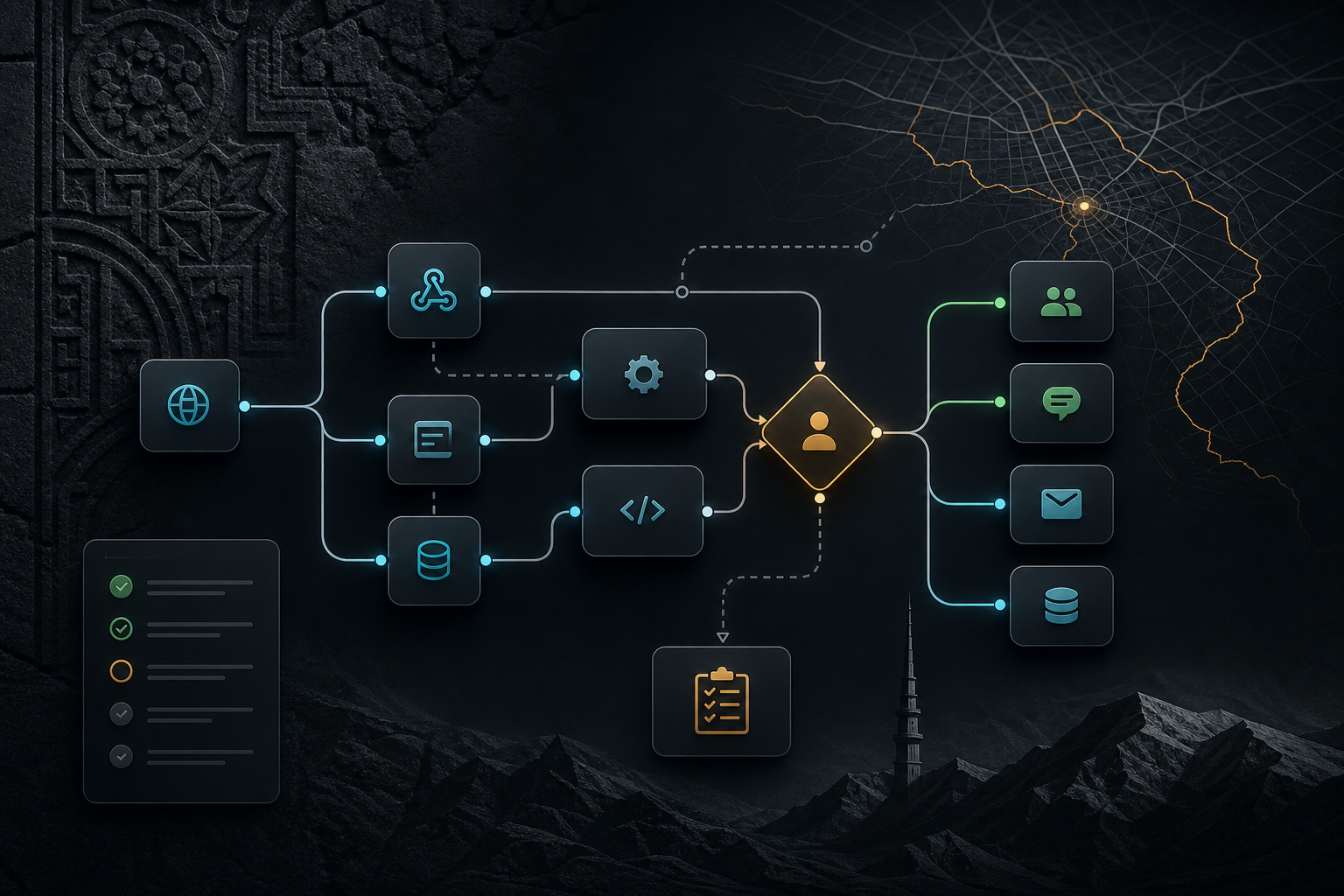
$ evaluate n8n_specialist --market armenia
> inspect: workflow / credentials / errors / approvals / handoff
> route: audit / controlled_pilot / production_automation
> output: criteria_based_selection, not demo-only low-codeAnswer first: choose n8n for workflow control, not because it looks fast
An n8n specialist in Armenia is useful when a company needs repeated work to move across systems: CRM, forms, messengers, spreadsheets, internal tools, APIs and AI models. The value is not "low-code" by itself. The value is a visible workflow with clear inputs, permissions, error handling, approvals and ownership after launch.
Broad commercial intent still belongs to the AI specialist in Armenia landing page. This article supports that page with a narrower long-tail guide: when n8n is a good fit, how to evaluate a specialist, what process to expect and which red flags matter before a workflow becomes production automation.
Use this as a selection framework, not as a ranking. Some tasks should be built in n8n. Some should be handled by custom backend code. Some should not be automated until the business process is cleaned up.
Who needs an n8n specialist
A company usually needs an n8n specialist when work already repeats in a predictable pattern but still depends on manual copying, reminders or routing. Typical examples include lead routing, support triage, invoice checks, CRM enrichment, document intake, Telegram or WhatsApp notifications, report preparation and human approval flows.
n8n is especially useful when the team needs to connect several tools quickly while keeping the workflow inspectable. A founder or operations manager can look at the workflow, understand the main path and discuss where approval, retries and exceptions should happen.
It is less useful when the process itself is unclear. If nobody owns the data, if CRM fields are inconsistent, if approvals change every week or if the team cannot name unacceptable mistakes, the first step should be an audit rather than a build.
Local selection matrix
Use this table when comparing an n8n specialist, AI automation engineer, freelancer, studio or internal developer in Armenia.
| Criterion | Strong signal | Weak signal | Practical risk |
|---|---|---|---|
| Process mapping | names owner, trigger, data, output and exception path | starts by adding nodes | workflow automates the wrong process |
| Credentials | separates secrets, roles and environments | stores tokens in node notes or shared docs | security and handoff risk |
| Error handling | uses retries, idempotency and alert paths | assumes all API calls succeed | duplicate writes or silent failures |
| Human approval | gates sensitive actions before live writes | lets AI or workflow update records directly | unsafe automation |
| Data contracts | validates fields and payload shape | passes raw JSON across nodes | brittle workflow after a source changes |
| Maintainability | uses naming, notes and small reusable patterns | creates one large unreadable workflow | no one can support it later |
| AI usage | keeps model output advisory and checked | treats model text as a business decision | hallucination becomes an action |
| Production handoff | documents owner, logs, rollback and update path | ships only a demo export | operations depend on one person |
This is the original proof requirement for the article: a local comparative table and evaluation method. It avoids self-awarded "best" language and focuses on observable delivery signals.
When low-code is the right tool
Low-code is appropriate when the business rule is understandable, the systems have usable APIs, the volume is moderate, the failure path can be described and the team benefits from a workflow that non-developers can inspect.
For example, a company can use n8n to receive a website lead, enrich it with source data, classify the request with an LLM, ask a human to approve the category, create a CRM task and send a Telegram notification. The model can suggest, but the workflow should decide what requires approval and what can be safely written.
Low-code is also appropriate for a pilot. A short n8n workflow can test whether the process is worth automating before investing in a full custom application.
When custom code is better
Custom backend code is usually better when the workflow has high volume, complex permissions, strict latency needs, complicated state, deep product UI, heavy testing requirements or business logic that should be version-controlled as software.
This does not make n8n weak. It means the boundary should be honest. n8n can orchestrate APIs, approvals and notifications. The backend can own sensitive business rules, data models and product behavior. A good specialist should be comfortable recommending this split when it reduces risk.
How the work should run
Start with process mapping. The first deliverable should be a short map of trigger, inputs, systems, owner, expected output, sensitive actions, failure paths and the smallest useful pilot.
Then build a controlled workflow. Use real examples but bounded permissions. Add validation, logging, naming conventions and approval gates before connecting live writes.
After that, test failure cases: missing fields, duplicate events, expired credentials, API limits, webhook retries, model uncertainty and user cancellation. Most production issues appear outside the happy path.
Only then should the workflow become production. Production means environment separation, secrets discipline, monitoring, alert routing, export backup, rollback notes and a named owner who can review future changes.
Practical example from aicoding.am work
One confirmed practice pattern from aicoding.am is the Codex Skills / Project Memory methodology described in the public proof layer. It is not presented as a client n8n case study. But it shows the same discipline needed for workflow automation: separate durable rules from session state, keep source-of-truth documents explicit, route responsibilities by owner and make operational decisions inspectable.
The same thinking applies to n8n. A workflow should not hide credentials, business rules, model decisions and support logic in one opaque chain. It should show what triggers the action, which data is trusted, where the human approves, how errors are handled and who maintains the workflow after launch.
For broader proof, review the case studies. For service context, use AI automation. For broad local selection, use AI specialist in Armenia.
Red flags
The first red flag is demo-only automation. If the specialist cannot explain duplicate prevention, retries, alerting and rollback, the workflow is not production-ready.
The second red flag is uncontrolled AI inside the workflow. LLM output can classify, draft and recommend, but sensitive writes should have validation and human approval.
The third red flag is weak credential handling. API keys, CRM access and messenger tokens should not live in shared screenshots, exported examples or plain text notes.
The fourth red flag is an unreadable workflow. If every step is named vaguely and all logic lives in one giant flow, future support becomes expensive.
What to prepare before asking for a quote
Before contacting an n8n specialist in Armenia, prepare a compact brief:
- The repeated process you want to automate.
- The trigger: form, webhook, CRM event, schedule, email or manual action.
- Systems involved: CRM, ERP, website, messenger, spreadsheet, database or API.
- Fields that must be read and written.
- Which actions need human approval.
- Examples of good inputs, bad inputs and duplicates.
- Expected notification or output format.
- Credential and permission constraints.
- Failure cases that must not be silent.
- The smallest pilot that would prove value.
Ask for a proposal that separates audit, pilot workflow and production hardening. A useful answer should name assumptions, exclusions, operational owner and maintenance path.
Practical next step
If your company needs an n8n specialist in Armenia, start by mapping one workflow and three failure cases. Then decide whether the first phase is a process audit, controlled pilot or production automation.
For broad local AI selection, use the AI specialist in Armenia page. For automation-specific service context, review AI automation. To start with a concrete brief, use the project intake.
Where This Applies
n8n workflow audit, controlled automation pilot and production-safe handoff
This article is useful when a company in Armenia needs workflow automation across CRM, forms, messengers, spreadsheets, APIs and AI models before choosing between audit, low-code pilot and custom backend work.
- Founders comparing n8n specialist, AI automation engineer, studio or internal developer.
- Operations teams preparing triggers, credentials, fields, approval points and failure cases.
- Companies that need criteria-based selection instead of demo-only low-code promises.
n8n_readiness = process_map
  + credential_policy
  + data_contracts
  + retry_strategy
  + approval_gates
  + monitoring
  + maintenance_owner;
if (workflow_owner === null) start("audit_before_build");
if (writes_to_live_systems) require("validation_approval_rollback");