Monitoring n8n Workflows: Logs, Alerts and Failure Diagnostics
Make an execution trace lead to a safe operational decision
Correlation, error classes, actionable alerts, reconciliation and controlled recovery
Original SCOPE-7 operating model with an event example and production acceptance criteria
n8n workflow monitoring, logs, alerts, error diagnostics, queue health, correlation IDs and incident recovery
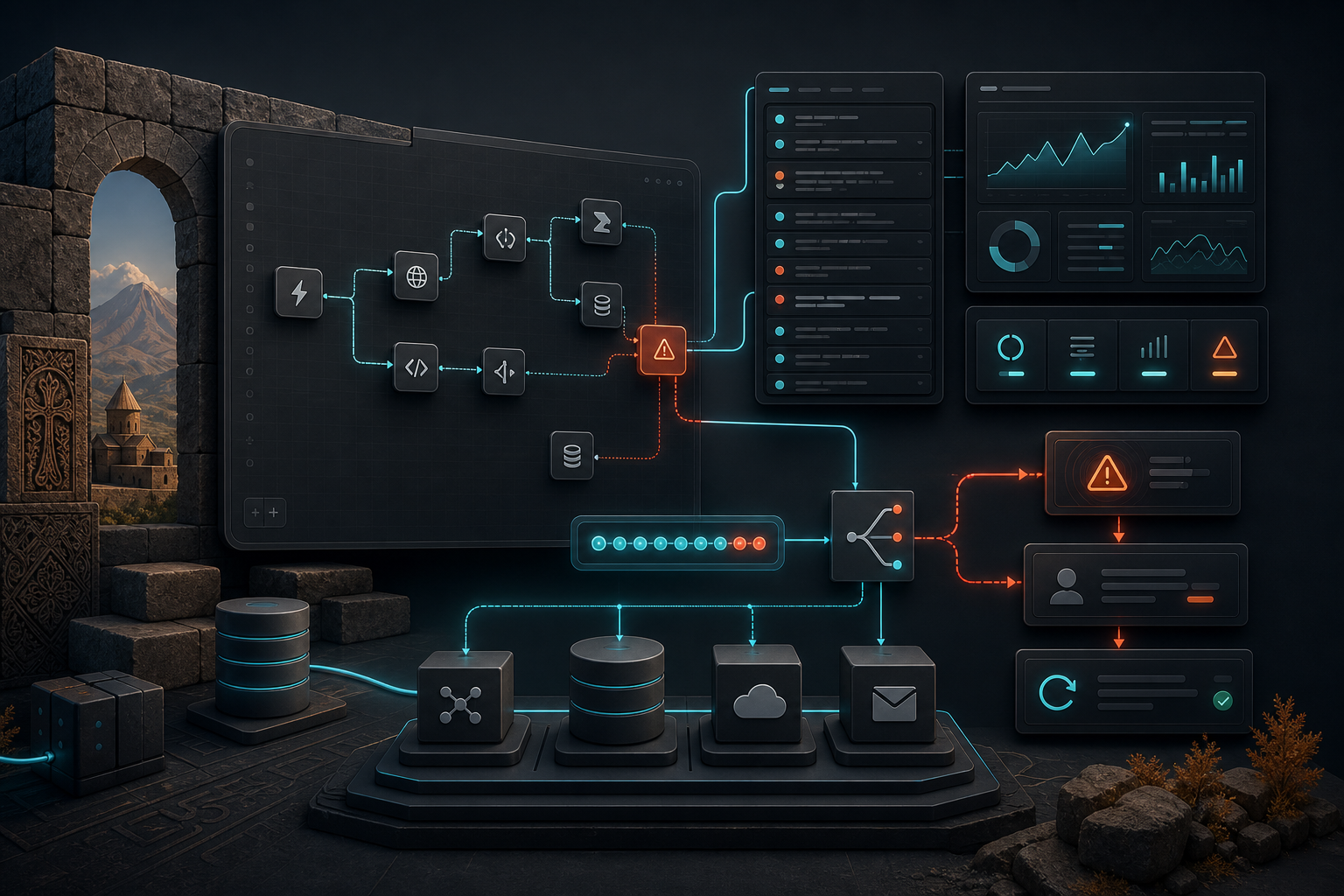
$ monitor n8n --model SCOPE-7
> source: event-id / schema / owner
> correlate: workflow / version / trace
> observe: outcome / duration / queue
> classify: retryable / review / rejected
> escalate: action / incident / recoveryMonitoring is part of the workflow, not an afterthought
An n8n canvas can show that a workflow completed, but that is not enough evidence that the business outcome happened. A webhook may have been accepted twice, a CRM write may have timed out after succeeding, an LLM step may have returned an unusable payload, or a queue worker may be falling behind while individual executions still look green.
Production monitoring answers a narrower and more useful question: can an owner see a failing workflow, understand the affected business item, decide whether a retry is safe and prove the outcome after recovery? This article introduces SCOPE-7, an original operating model for n8n workflow logs, alerts and failure diagnostics. It is not a promise of uptime and it does not replace the n8n platform documentation or observability tooling.
The broader decision about AI automation belongs on the AI automation service page and the AI specialist in Armenia landing page. Here the topic stays specific: observable n8n workflows that a team can operate after launch.
1. Start with an observable business event
Monitoring fails when it begins with a dashboard instead of a contract. Before adding nodes, state what one workflow run represents. A useful event record has a stable identity, a source timestamp, a business owner and an intended side effect. The payload itself may contain sensitive data; the monitoring record should retain only the fields needed to diagnose and reconcile the run.
workflow_event:
  event_id: order-1842:status-paid:v3
  correlation_id: checkout-72b9
  workflow: crm-payment-sync
  source: payment-webhook
  received_at: 2026-08-02T09:14:00Z
  intended_effect: create-or-update CRM payment record
  owner: revenue-operations
  sensitivity: customer-data-minimized
The event_id protects the discussion around duplicate delivery. The correlation_id connects a sequence across webhook intake, n8n execution, external APIs and a support ticket. workflow and a deployed version make a change traceable. owner is not a decorative field: an alert without a person or team that owns the next decision is simply noise.
For each workflow, agree on three observable outcomes:
- accepted — the event was durably received and validated enough to process;
- completed — the intended effect has a receipt or read-back proof;
- needs review — the system cannot safely decide whether a side effect occurred.
Do not compress the third state into “failed”. A timeout after a write is different from a rejected payload, and replaying it blindly can create duplicate messages, invoices or CRM actions.
2. Design SCOPE-7 before choosing alert channels
SCOPE-7 separates the operational questions that often get mixed into a single execution log:
- S — Source: where did the event originate, and is its identity stable?
- C — Correlation: how can an operator follow this item across steps and systems?
- O — Outcome: what receipt, read-back or explicit state proves the business result?
- P — Policy: which failures retry automatically, which require review, and which stop?
- E — Escalation: who receives an actionable alert and in what time window?
- 7 — Seven retention signals: execution, error class, version, duration, queue state, target receipt and recovery decision.
This is a design checklist, not a required product configuration. A small internal workflow might keep the record in n8n execution data and a shared operations channel. A high-volume or regulated workflow may need centralized logs, restricted fields, a durable event ledger and on-call integration. The architecture should follow risk, volume and recovery requirements rather than an arbitrary tool list.
A compact workflow map
source event
  -> validate identity and schema
  -> persist correlation + workflow version
  -> execute bounded steps
  -> classify result: completed / retryable / review / rejected
  -> record target receipt or unknown state
  -> notify the owner only when a decision is needed
  -> reconcile and close the recovery record
The key distinction is between telemetry and control. Telemetry reports what happened. Control decides whether a retry, replay or human review is allowed. An LLM may help summarize a log for an operator, but it should not receive authority to re-run a consequential action merely because an alert looks urgent.
3. Logs: retain diagnostic context without turning logs into a data leak
Execution logs should make the path inspectable while avoiding full copies of customer records, credentials or model prompts. Define an allowlist for operational fields and a redaction rule for everything else. A useful record commonly contains:
| Field | Why it matters | Keep out of the log |
|---|---|---|
event_id, correlation_id | Trace one business item | Full raw payload by default |
| workflow and version | Compare behavior after releases | Credentials and tokens |
| node or stage | Locate the failing boundary | Sensitive free text unless required |
| error class and code | Route recovery consistently | Stack traces with secrets |
| target receipt or state | Prove / reconcile side effects | Entire target response if unnecessary |
| duration and attempt number | Detect degradation and retry storms | Unbounded execution history |
Keep semantic error classes small and explicit. For example: validation, authentication, rate_limit, transient_network, target_rejected, ambiguous_outcome, and internal_defect. A free-text error message can be attached as bounded evidence, but it should not be the policy engine. The policy needs a stable class, maximum attempt budget and an owner.
The existing guides on retries, idempotency and dead-letter flow and secure n8n credentials explain two monitoring dependencies in more detail: a failure needs a safe recovery route, and observability data must not expose authority.
4. Alerts should represent an operator decision
An alert is valuable only when it tells a recipient what changed, who owns it and what safe next action exists. Sending one notification for every failed execution trains a team to ignore the channel. Start with a limited severity model:
| Severity | Example condition | Initial route |
|---|---|---|
| Info | a new workflow version is receiving traffic | deployment record, no page |
| Warning | retry budget is partly consumed or duration crosses a baseline | workflow owner, grouped notification |
| Action | ambiguous target outcome or business deadline at risk | named owner with correlation link |
| Incident | persistent intake failure, backlog growth, or data-boundary concern | operations escalation and recovery lead |
The alert payload should contain the correlation identifier, workflow/version, error class, observed time, attempt count, safe runbook link and a direct route to the retained evidence. It should not contain a copied secret, full customer document or a vague instruction such as “check n8n”.
Use grouping and deduplication. One provider outage may create hundreds of executions; the meaningful alert is a single incident with affected count, first/last occurrence, error class and backlog trend. Conversely, one failed payroll, contract or customer-facing message may deserve individual review even when the technical error rate is low. Severity follows business consequence, not just HTTP status.
5. Integration contracts and health signals
Every boundary should have a small contract. For a source webhook: authentication, schema version, event identity and accepted response. For a target API: allowed action, idempotency key, timeout behavior, receipt shape and reconciliation query. For a notification channel: escalation recipient, delivery failure behavior and acknowledgement path.
Monitor both run signals and system signals:
- Run signals: accepted/completed/reviewed counts, error classes, duration percentiles, retry use, unknown outcomes and recovery age.
- System signals: queue depth, worker availability, webhook intake errors, database/storage capacity, external dependency health and notification delivery.
Neither group alone is sufficient. A healthy queue can process the wrong schema quickly; a successful target response can hide a growing intake backlog. Pick a small baseline for each workflow, observe it before setting thresholds, and review thresholds when volume or release behavior changes. A dashboard is a decision aid, not proof of an SLA unless the SLA and measurement method are explicitly agreed.
6. A controlled launch checklist
Run the workflow against non-production or safely reversible fixtures before opening the production trigger. The purpose is to test the diagnostic path as well as the happy path.
- Send a valid event and verify its correlation record, target receipt and completion state.
- Send the same event again and verify the duplicate path does not create another side effect.
- Simulate a retryable dependency error; check the bounded retry schedule and grouped alert.
- Simulate a timeout after a possible target write; verify the workflow reaches
needs review, not blind replay. - Reject the schema or authorization and confirm that sensitive payload fields are not exposed in the alert.
- Disable the notification route in a safe environment and verify the fallback owner or delivery-failure evidence.
- Perform one documented recovery and record who approved it, what was checked and how the final result was reconciled.
The following gate captures the intent:
require(event.id && event.correlationId && workflow.version);
require(policy.errorClass && policy.maxAttempts && policy.owner);
release = completedReceipt.tested && ambiguousOutcome.routesToReview && alertEvidence.redacted;
7. Operation and continuous improvement
Monitoring becomes useful when teams review it on a schedule. A lightweight weekly review can sample completed, retried and reviewed runs; examine the oldest unresolved recovery; compare new error classes with the current policy; and remove alerts that did not lead to action. After a workflow release, compare the new version with the previous one using the same event family rather than assuming that a visually cleaner canvas is safer.
When an incident occurs, preserve a minimal evidence packet: correlation ID, event and workflow version, timestamps, error class, attempted actions, target read-back, decision owner and final resolution. Turn recurring packets into improvements: a schema check before a costly call, a clearer error class, a missing idempotency key, a revised threshold or a more explicit handoff.
For teams planning a bounded production pilot, the AI automation service page describes the broader delivery surface and case studies show implementation-oriented work. A useful next step is not a universal monitoring stack: map one workflow, one business owner, one reconciliation query and one safe recovery path before scaling it.
Summary: make failures diagnosable before they become urgent
Reliable n8n monitoring connects technical evidence to an operational decision. SCOPE-7 starts with a stable event and correlation ID, records outcome proof, classifies failures, limits retries, routes alerts to an owner and closes recovery with reconciliation. That creates a workflow a team can inspect and improve—without claiming that an alert channel alone makes automation production-ready.
require(event.id && event.correlationId && workflow.version);
require(policy.errorClass && policy.maxAttempts && policy.owner);
release = completedReceipt.tested && ambiguousOutcome.routesToReview && alertEvidence.redacted;