Project Diary for AI Sessions
Compact durable memory for AI sessions across context resets
AGENTS.md, summaries, plans and diary files each keep a separate responsibility
Operational memory for decisions, meaningful changes, verification and continuation points
AI workflow, project memory and Codex session lifecycle
$ read diary/current.md diary/decisions.md
> load compact project state
> preserve durable decisions
> skip transcripts and cosmetic noiseDate: 2026-05-18
Short Idea
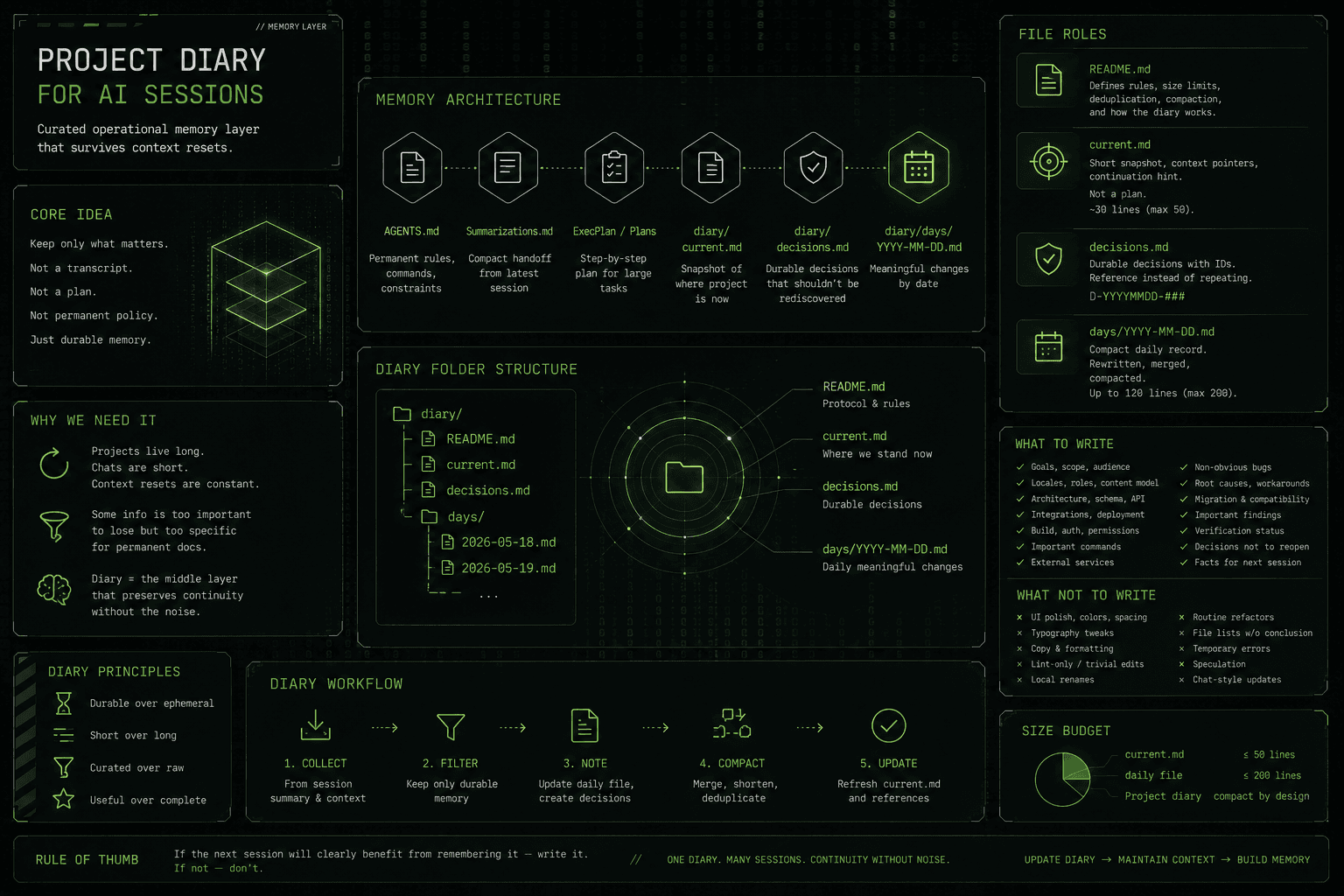
A project diary is a compact memory layer between permanent project instructions, execution plans, and short session summaries. Its job is to help a new AI session quickly understand what changed recently, which decisions are already settled, and where the project stands now.
The diary is not a chat transcript, changelog, backlog, roadmap, or replacement for AGENTS.md. It is curated operational project memory.
The main problem it solves: one project may continue across several chats in one day, but each new session should not reconstruct context from long conversation history. At the same time, the diary must not grow into a wall of text. Therefore it stores only durable memory - information that remains useful after a context reset.
Why A Diary Is Needed
In a typical AI workflow, a project lives for a long time, but each chat should stay relatively short. At the end of a task the user runs end-session, then starts a new chat and runs new-session.
Without a diary, the next session relies on:
AGENTS.md- permanent project rules;Summarizations.md- compact handoff from the previous session;- active ExecPlan - if a large execution plan exists;
- the current repository state.
That is often enough, but there is an intermediate class of information:
- "today we added a third language, so content must now exist in RU/EN/AM";
- "we decided not to use WordPress";
- "we found that sitemap generation still handles only two locales";
- "this integration requires a specific workaround";
- "this progress matters, but it is not a permanent repo instruction".
This information is too specific for AGENTS.md, too short-lived for architecture documentation, but too important to lose between chats. The diary is designed for that layer.
Memory Architecture
We split project memory into separate layers:
AGENTS.md
  Permanent project rules:
  commands, constraints, conventions, definition of done.

Summarizations.md
  Compact handoff from the latest session.

ExecPlan / active plans
  Step-by-step plan for a large task.

diary/current.md
  Short snapshot of where the project is now.

diary/decisions.md
  Durable decisions that should not be rediscovered.

diary/days/YYYY-MM-DD.md
  Meaningful changes by date.
This separation matters: the diary must not become a plan, and a plan must not become history. AGENTS.md must not store session noise, and the diary must not become permanent project policy.
Diary Folder Structure
Each project stores its diary in:
diary/
  README.md
  current.md
  decisions.md
  days/
    2026-05-18.md
    2026-05-19.md
We intentionally removed open-threads.md. If unfinished work matters only within a day, it belongs in days/YYYY-MM-DD.md under Carry Forward. If it is a real plan, it belongs in the planning file or the output of the planning skill.
File Responsibilities
diary/README.md
README.md is the local constitution of the project diary.
It defines:
- what counts as durable memory;
- what to write;
- what not to write;
- size limits;
- deduplication rules;
- compaction rules;
- how
Write Diaryworks; - how
Read Diaryworks; - how the diary relates to
AGENTS.md,Summarizations.md, and plans.
This file prevents future AI sessions from interpreting "diary" differently. The global skill provides the base protocol, while local diary/README.md fixes the rules inside a specific project.
diary/current.md
current.md is a short snapshot of the current project state.
Important: it is not a plan, backlog, or task list. If the project already has a planning skill or ExecPlan, current.md must not duplicate it.
The purpose of current.md is to:
- show where the project stands now;
- point to important context;
- provide a continuation hint - where to look first;
- remind the agent about boundaries: plans live elsewhere, permanent rules live in
AGENTS.md.
Target size: around 30 lines. Hard limit: 50 lines.
diary/decisions.md
decisions.md stores durable decisions that future sessions should not casually reopen.
Examples:
- the project supports RU/EN/AM;
- every article must be created in three locales;
- deployment uses Vercel;
- auth uses Supabase;
- WordPress is not used;
- a specific data format or API contract was selected.
Each decision gets an ID:
D-YYYYMMDD-001
D-YYYYMMDD-002
Daily files may reference these IDs instead of repeating the full rationale.
diary/days/YYYY-MM-DD.md
A daily file is a compact record of meaningful changes for one date.
It is not append-only in the usual sense. Write Diary may rewrite the daily file, merge similar points, remove stale carry-forward items, and move durable decisions into decisions.md.
Target daily size: up to 120 lines. Hard limit: 200 lines.
Durable Memory: What To Write
Write only information that helps continue the project after a context reset.
Write when any of these changed:
- project goals;
- scope;
- audience;
- languages, locales, currencies;
- user roles;
- content model;
- architecture;
- data schema;
- API contract;
- integrations;
- deployment;
- build process;
- auth;
- permissions;
- storage;
- important commands;
- external services;
- project workflow.
Also write:
- non-obvious bugs;
- root causes;
- workarounds;
- migration issues;
- compatibility rules;
- important findings;
- verification status;
- decisions that should not be reopened casually;
- facts that will clearly help the next AI session.
What Not To Write
Usually do not write:
- button color changes;
- spacing tweaks;
- typography polish;
- minor copy polish;
- formatting;
- lint-only edits;
- local variable renames;
- routine refactors with no behavior change;
- lists of inspected files without a conclusion;
- temporary errors that were immediately fixed;
- long command output;
- repeated facts already present in
current.md,decisions.md, or the daily file.
Exception: a small change should be recorded if it expresses a durable rule. For example:
All destructive actions must use the danger style.That is no longer "changed a button color"; it is a design-system rule.
Write Diary
Write Diary is the skill responsible for creating and updating the diary.
It owns:
- creating
diary/; - creating base files;
- deciding whether a diary update is needed;
- filtering important vs. unimportant changes;
- updating
current.md; - updating
decisions.md; - creating or updating the daily file;
- deduplication;
- compaction.
If the diary does not exist, Write Diary creates:
diary/
  README.md
  current.md
  decisions.md
  days/
    YYYY-MM-DD.md
If there is no durable update, Write Diary should not add noise. It may simply report that no diary update is needed.
Read Diary
Read Diary is the skill responsible only for reading diary context.
It does not edit files, create the diary, or invent missing context.
It reads:
diary/README.md;diary/current.md;diary/decisions.md;- selected files from
diary/days/.
Examples:
Read Diary for today
Read Diary for 3 days
Read Diary for the last 5 days
Read Diary from 2026-05-15 to 2026-05-18
After reading, it returns a compact context warm-up:
Read diary: 2026-05-16..2026-05-18.
Current state:
- ...
Durable decisions:
- ...
Recent changes:
- ...
Carry forward:
- ...
Notes:
- ...
Integration With end-session And new-session
We integrated the diary into the existing session lifecycle.
end-session
end-session is the session shutdown orchestrator.
It should not implement diary rules itself. Instead, it always invokes project-diary-write.
Order:
1. update-exec-plan, if an active ExecPlan exists
2. summarizations - update Summarizations.md
3. project-diary-write - create/update diary or skip if there is no durable update
4. create-agents-md through promote-lessons, only if permanent repo-level lessons appeared
Why project-diary-write runs after Summarizations.md:
- the summary already separates important session content from noise;
- the diary can use a clearer session result;
AGENTS.mdis updated last because it should receive only rare permanent rules.
new-session
new-session is the session startup orchestrator.
It does not create the diary. It reads it only if diary/ already exists.
Order:
1. AGENTS.md
2. Summarizations.md
3. .agent/PLANS.md
4. active ExecPlan
5. project-diary-read, if diary/ exists
6. optional CLAUDE.md, if cross-tool context is useful
Diary read rule:
If today's diary/days/YYYY-MM-DD.md exists:
  read the latest 3 existing daily files, including today.

If today's daily file does not exist:
  read the latest 2 existing daily files.

Always read:
  diary/README.md
  diary/current.md
  diary/decisions.md
This gives the new session recent context without reading the whole project history.
Why new-session Does Not Create diary
We considered letting new-session create an empty diary if none exists. We rejected that design.
Reason: the normal workflow is:
end-session -> new chat -> new-sessionIf end-session already ran, the diary was either created or project-diary-write deliberately decided that no durable update was needed. Therefore new-session should not mutate files at startup.
Diary creation belongs to Write Diary / end-session, not new-session.
current.md Template
Last updated: YYYY-MM-DD HH:MM
Purpose: short snapshot of where the project is now. This is not a plan, backlog, or replacement for AGENTS.md.
Project Snapshot
- Project:
- Current state:
- Main active area:
- Recent meaningful change:
Important Context
- Supported languages/locales:
- Important content or product rules:
- Important files or modules:
- Important commands or services:
Continuation Hint
- If continuing work, first check:
Boundaries
- Read
AGENTS.mdfor permanent project instructions if it exists. - Read
decisions.mdfor durable decisions. - Read recent
days/files only when the user asksRead Diary. - Detailed task plans belong in the project's planning file or planning skill output, not here.
decisions.md Template
Purpose: record durable decisions that future AI sessions should not rediscover or casually reverse.
Format
D-YYYYMMDD-001 - Decision Title
- Date: YYYY-MM-DD
- Status: active
- Context: why the decision was needed.
- Decision: what was decided.
- Rationale: why this option was chosen.
- Consequences: what future work must assume or preserve.
- Applies to: files, modules, workflows, documents, or project areas.
- Replaces: D-YYYYMMDD-000 or none.
Active Decisions
<!-- Keep newest first. -->
Superseded Decisions
<!-- Move replaced decisions here. Keep their replacement ID. -->
Daily File Template
Purpose: compact daily project memory. This file is not a transcript.
Snapshot
- Project state:
- Main focus:
- Next best action:
Changes
-
Decisions
-
Findings
-
Verification
-
Carry Forward
-
Example Daily Entry
Purpose: compact daily project memory. This file is not a transcript.
Snapshot
- Project state: content pipeline now assumes three required locales.
- Main focus: localization scope.
- Next best action: check sitemap and article generation for AM support.
Changes
- Added Armenian as a required project locale alongside Russian and English.
- Content tasks must no longer assume one article per topic.
Decisions
- D-20260518-001 - Project requires RU/EN/AM content variants.
Findings
- Existing sitemap logic may still assume only RU/EN.
Verification
- Scope decision only; no code verification performed.
Carry Forward
- Check sitemap locale handling.
- Update content generation prompts to require RU/EN/AM variants.
Deduplication
Write Diary should compare points by meaning, not exact text.
Rules:
- if a new point clarifies an old one, replace the old point;
- if a new point cancels an old one, keep only the current truth;
- if several points describe one issue, merge them into one finding;
- if a decision already exists in
decisions.md, keep only theD-...reference in the daily file; - if a carry-forward item is completed, remove it from
Carry Forwardand record the result inChangesorVerification.
Compaction
If a daily file approaches 200 lines:
- Update
Snapshotto the latest true state. - Merge repeated entries.
- Preserve outcomes, decisions, findings, verification, and carry-forward items.
- Remove narrative, dead investigation paths, command noise, and cosmetic-only details.
- Move durable decisions to
decisions.md. - Leave only decision ID references in the daily file.
- Update
current.mdonly if the compact project snapshot changed.
Practical Lifecycle
Normal usage looks like this:
1. The user works with AI in a project.
2. At the end, the user runs end-session.
3. end-session updates the plan, summary, and invokes project-diary-write.
4. project-diary-write creates or updates diary.
5. The user starts a new chat.
6. At the beginning, the user runs new-session.
7. new-session reads AGENTS.md, summary, plans, and invokes project-diary-read.
8. The AI receives compact recent context and continues work.
Terms And Mental Model
The easiest way to understand this system is context routing: different kinds of knowledge are not merged into one large file; they are routed to different memory targets.
| Term | Meaning |
|---|---|
| Durable memory | Context that remains useful after a chat reset. |
| Session handoff | A compact state transfer from one session to the next. |
| Operational memory | Working project memory: not policy, not a plan, but important recent context. |
| Compaction | Compressing the diary: less text, more signal. |
| Deduplication | Removing semantic duplicates, even when the wording differs. |
| Snapshot | The current project state without history or backlog. |
| Decision ID | A stable reference to a decision, for example D-20260518-001. |
| Mutation boundary | The boundary where a skill is allowed to write files. |
The key idea: not every fact deserves persistence. If a fact matters only during the current task, it can stay in the chat. If it matters to the next session, it belongs in the diary. If it must become a permanent project rule, it becomes a candidate for AGENTS.md.
Responsibility Matrix
| Artifact | Primary role | Stores | Does not store |
|---|---|---|---|
AGENTS.md | Permanent policy | Commands, constraints, conventions, definition of done | Current task progress, temporary notes |
Summarizations.md | Session restart | Handoff from the latest session | Full project history |
| ExecPlan | Task execution | Step-by-step plan for a large task | Daily observations and incidental findings |
diary/current.md | Project snapshot | Where the project is now, where to look first | Backlog, roadmap, detailed plan |
diary/decisions.md | Decision memory | Durable decisions and consequences | Small tactical choices |
diary/days/*.md | Daily durable history | Meaningful changes, findings, verification | Transcript, command logs, cosmetic edits |
This matrix protects the system from memory sprawl. When a new fact appears, the question is not "where can we write it?" but "what role will this fact play in a few days?".
Why This Is Not A Wiki
A wiki usually tries to be a reference system: pages, topics, relationships, explanations. A project diary solves a different problem. It does not describe the whole project; it accelerates continuation.
A wiki answers:
What is this system and how is it structured?A diary answers:
What changed recently, what is already decided, and where should work continue?That is why the diary can use a denser format: bullets, short statuses, file paths, decision IDs, verification notes. It does not need literary completeness. It needs a high signal-to-token ratio.
Read/Write Split
We intentionally split reading and writing into separate operations.
Write Diary
  mutates files
  creates diary/
  filters durable memory
  compacts daily notes
  updates decisions/current/day files

Read Diary
  reads files
  does not mutate
  does not create diary/
  does not invent missing context
  returns compact startup context
This is an important engineering boundary. If one skill reads, writes, creates, interprets, and plans at the same time, responsibilities quickly blur. A dedicated write path keeps persistence strict. A dedicated read path makes session startup predictable and cheap.
Lifecycle Routing
working session
  |
  v
end-session
  |
  +--> update-exec-plan      # if an active plan exists
  +--> summarizations        # compact restart file
  +--> project-diary-write   # durable memory only
  +--> create-agents-md      # only rare permanent lessons

new chat
  |
  v
new-session
  |
  +--> AGENTS.md
  +--> Summarizations.md
  +--> active ExecPlan
  +--> project-diary-read    # if diary/ exists
In this design, end-session and new-session do not know diary internals. They invoke specialized skills. This keeps the orchestration layer thin.
Entry Classification
Before writing, Write Diary should classify the candidate fact:
| Question | If yes | Target |
|---|---|---|
| Is this a permanent repository rule? | Yes | AGENTS.md through a separate promotion flow |
| Is this a step in a larger plan? | Yes | ExecPlan or planning file |
| Is this recent durable context? | Yes | diary/days/YYYY-MM-DD.md |
| Is this current project state? | Yes | diary/current.md |
| Is this a decision that should not be reopened? | Yes | diary/decisions.md |
| Is this cosmetic or local noise? | Yes | Do not write |
This classification prevents the diary from becoming a backlog. A single fact may have two projections: a short daily event in days/ and a stable decision in decisions.md.
Signal Examples
A good diary point:
- Added Armenian as a required locale alongside Russian and English.
- Future content tasks must produce RU/EN/AM variants.
Why this is signal:
- it changes scope;
- it affects future tasks;
- it prevents wrong assumptions;
- it avoids reading the old chat.
A bad diary point:
- Changed button spacing and adjusted some text.
Why this is noise:
- no durable consequence;
- unclear where and why;
- it does not help the next session;
- it looks like changelog or commit detail.
Write Diary As A Persistence Gate
Write Diary acts as a persistence gate. Its job is not to "write something"; its job is to decide whether information deserves persistence.
Algorithm:
collect candidate facts
classify durable vs non-durable
drop cosmetic/noisy facts
merge with existing daily note
update decisions if a durable decision exists
update current only if snapshot changed
compact if limits are close
The most important outcome sometimes looks like this:
No durable diary update needed.That is not a failure. It is entropy control.
Read Diary As Context Warm-Up
Read Diary should not become a full project scan. Its job is to warm up a new session with the smallest set of high-signal files.
Default startup read:
diary/README.md
diary/current.md
diary/decisions.md
latest 2-3 diary/days/*.md
Why not read everything:
- old daily notes may be superseded;
- decisions have already been moved into a separate file;
- the current snapshot should contain the latest truth;
- reading all history breaks token economy.
If historical investigation is needed, the user can request a date range explicitly:
Read Diary from 2026-05-15 to 2026-05-18Token Economy
The purpose of the diary is not to add another mandatory document. The purpose is to reduce the cost of context restoration.
Correct token economy looks like this:
| Instead of | Read |
|---|---|
| History from multiple chats | current.md + recent days |
| Re-discussing decisions | decisions.md |
| Scanning the whole project | AGENTS.md + summary + targeted files |
| Long changelog | compact daily snapshot |
The diary saves tokens only while it stays:
- compact;
- selectively read;
- non-duplicative with plans and summaries;
- free of cosmetic noise;
- regularly compacted;
- clear about decisions vs daily notes.
If the diary is read in full every time, it stops being a memory optimization and becomes memory overhead.
Failure Modes
| Failure mode | Symptom | Fix |
|---|---|---|
| Transcript drift | Daily files read like chat summaries | Remove narrative, keep outcomes |
| Backlog creep | current.md contains task lists | Move tasks to a plan, keep snapshot |
| Decision duplication | The same decision repeats in every daily file | Move it to decisions.md, keep the ID |
| Policy leakage | AGENTS.md fills with current task details | Keep AGENTS for permanent rules only |
| Read amplification | new-session reads all history | Read only current, decisions, 2-3 days |
| Cosmetic noise | Notes about colors, spacing, copy polish | Write only durable design rules |
Implementation Checklist
Minimal implementation:
1. Create global skill project-diary-write.
2. Create global skill project-diary-read.
3. Integrate project-diary-write into end-session.
4. Integrate project-diary-read into new-session.
5. Allow Write Diary to create diary/ on the first durable update.
6. Prevent new-session from creating diary/.
7. Keep current.md as a short snapshot.
8. Move durable decisions into decisions.md.
Implementation checks:
end-session must invoke Write Diary
new-session must invoke Read Diary
Read Diary must not write files
Write Diary must be allowed to say "no update needed"
daily files must not become append-only transcripts
Extended Routing Example
Fact: "Added Armenian as a required locale"
Route:
  days/YYYY-MM-DD.md -> Changes
  decisions.md -> D-YYYYMMDD-001
  current.md -> Supported languages/locales

Fact: "Changed button color"
Route:
  none

Fact: "All destructive actions now use danger style"
Route:
  decisions.md -> durable design decision
  AGENTS.md -> only if this is a permanent repo convention

Fact: "Next step is to finish sitemap"
Route:
  plan file, if part of a plan
  Carry Forward, if it is a short daily continuation item
Quality Criterion
The diary works correctly if a new AI session can understand:
- what is true now;
- what changed recently;
- which decisions must not be casually reopened;
- what was verified;
- where to look next;
- which recent facts matter but are not permanent project rules yet.
If a note does not help with this, it should not be written.
Where This Applies
AI-assisted engineering teams that need durable project memory
This pattern is useful when AI coding work spans multiple sessions, multiple agents or long-lived projects where decisions and verification need to survive context resets.
- Teams using Codex, Claude Code or similar agents on production codebases.
- Projects where architecture decisions, deployment notes and open risks must stay compact.
- AI-assisted development workflows that need memory without storing full chat transcripts.