RAG Citations and Traceability: How to Show the Source Behind Every Answer
A useful answer becomes inspectable only when every material claim keeps its source, version and locator
Source identity, evidence workflow, acceptance criteria and operational ownership
Original TRACE-8 workflow with input/output example and a controlled pilot gate
RAG citations, RAG traceability, RAG sources, retrieval evidence, RAG architecture and TRACE-8
$ trace rag --contract TRACE-8
> input: question / authenticated scope
> retrieve: source / version / locator
> select: citable evidence / coverage
> verify: links / lifecycle / access
> route: answer / review / no-answerA RAG answer becomes reviewable only when a reader can reach the source passage that supports it. A link beside the final sentence is not enough on its own: the system also needs to know which source version was retrieved, which passage was selected, whether the caller was allowed to see it, and whether that evidence still supports the claim after an update.
This is a practical guide to the long-tail question of citations and sources in RAG. The wider product decision belongs to the RAG systems service; teams evaluating an implementation can use this workflow in an architecture brief, rather than treating the article as a broad local-services page.
Preconditions: make a source citable before retrieval
Do not add citations as a presentation feature after the model has produced an answer. At ingestion, give every source a stable identity, version, owner, lifecycle state, access attributes and a human-openable locator. At chunking, retain the parent source and a section-level locator. At retrieval, carry these fields alongside text instead of reconstructing them from a title later.
A minimal evidence record can look like this:
{
  "sourceId": "policy-refunds",
  "sourceVersion": "2026-08-21T09:40Z",
  "passageId": "policy-refunds#returns-3.2",
  "locator": "/policies/returns#3-2",
  "lifecycle": "current",
  "accessScope": ["support"],
  "contentHash": "..."
}
The fields are a contract, not a universal schema. A PDF may need a page and paragraph locator; a knowledge-base page may need a revision URL; a database record may need an immutable record ID. The important part is that an operator can reproduce the evidence path without trusting model prose.
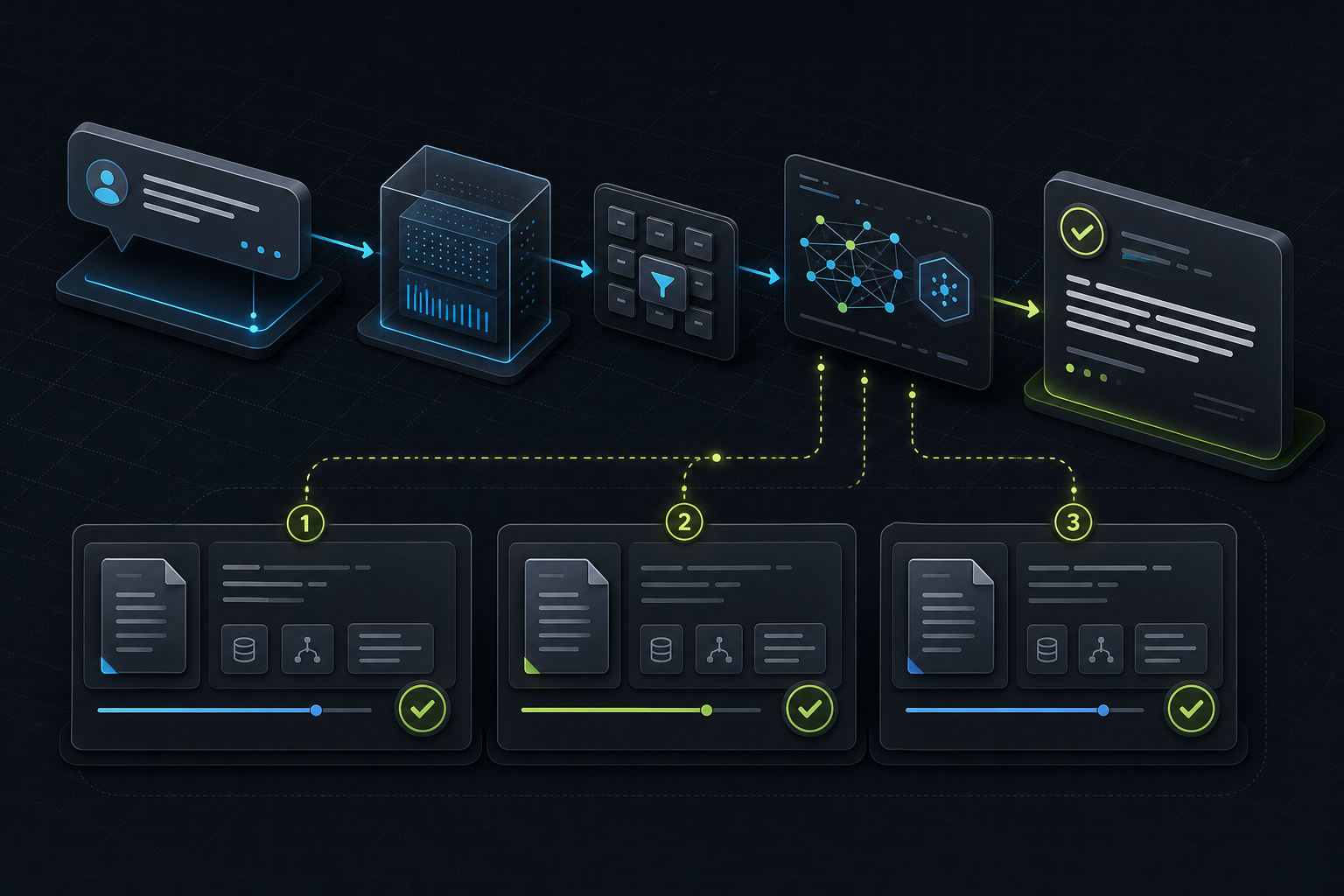
TRACE-8 workflow: from question to a source-linked answer
The original TRACE-8 workflow keeps evidence attached through every decision. It is deliberately vendor-neutral.
QUESTION + authenticated scope
  -> retrieve eligible passages with source/version/locator
  -> reject stale, unauthorized or unlocatable candidates
  -> select diverse evidence for each planned claim
  -> draft only from selected evidence
  -> attach claim-to-passage citations
  -> verify links, versions and coverage
  -> answer | ask for review | no-answer
For example, a support user asks whether a return is accepted after a stated time window. The workflow retrieves only current policy passages permitted for that user, selects the section that defines the window and any exception section, and then shows the answer with links to those exact locations. If the policy is ambiguous, the system should say so or route the case to a reviewer; it should not cite a general FAQ as a substitute for the governing rule.
Integration contracts
Ingestion to index. Publish a source version and its locators atomically where possible. When a document changes, mark the superseded version ineligible before claiming the new version is searchable. A successful embedding job alone does not prove that an old citation can no longer surface.
Retriever to reranker. Pass source identity, lifecycle and access scope with every candidate. A reranker may improve ordering but must never discover a passage outside the trusted corpus. The related article on reranking in RAG explains why this selection layer needs an explicit no-answer route.
Answer composer to UI. Keep citations as structured objects, not HTML assembled from model output. The UI can then render a title, locator, version date and verified link consistently, while telemetry can distinguish a missing citation from a broken link.
Acceptance criteria before a controlled pilot
Use representative, permission-safe questions and check the workflow end to end:
| Criterion | Evidence to inspect |
|---|---|
| Source identity | every selected passage has immutable source and version IDs |
| Locator | a reviewer can open the cited section, page or record |
| Access | denied and wrong-tenant sources never enter retrieval or reranking |
| Freshness | superseded sources are rejected after an update |
| Coverage | each material claim has supporting evidence or is explicitly qualified |
| Failure route | missing, conflicting or inaccessible evidence results in review/no-answer |
| Observability | trace contains safe IDs, config version and final route without unnecessary content |
These checks should be tested as cases, not inferred from an aggregate answer-quality score. Include a recently updated policy, a denied source, a removed document, contradictory current sources and a question with no supporting evidence.
Operations: preserve traceability after launch
Traceability decays when source ownership and lifecycle are not operated. Assign an owner for source changes, index reconciliation, broken citation monitoring and rollback. Record which ingestion and retrieval configuration produced an answer, but redact query and document content according to the product's retention policy.
Track actionable signals: citation-link success, selected passages without locators, stale-version rejections, no-answer rate by query class, and evaluation regressions after source or model changes. None of these is a universal quality number; each is a diagnostic signal tied to a known evidence boundary.
For a controlled RAG pilot, bring representative questions, document types, access rules, update paths and a definition of when a human must decide. The RAG systems service is the broader technical entry point; case studies provide delivery context. Start with a bounded corpus and make each answer's evidence path inspectable before expanding access or automation.
require(source.id && source.version && source.locator);
require(policy.allows(source, request.scope));
require(evidence.every(isCurrentAndCitable));
require(testSet.updated && testSet.denied && testSet.noEvidence);

if (!coverage.supportsMaterialClaims) route = "review-or-no-answer";
if (locator.broken || source.lifecycle !== "current") route = "fail-closed";