RAG Developer in Armenia: Competencies and Selection Criteria
A practical selection framework for retrieval-augmented generation work in Armenia
Source audit, retrieval design, evaluation, citations, security and update workflow
How to support the broad Armenia AI landing page with long-tail RAG developer criteria
RAG developer Armenia, RAG systems Armenia, AI knowledge base and retrieval augmented generation
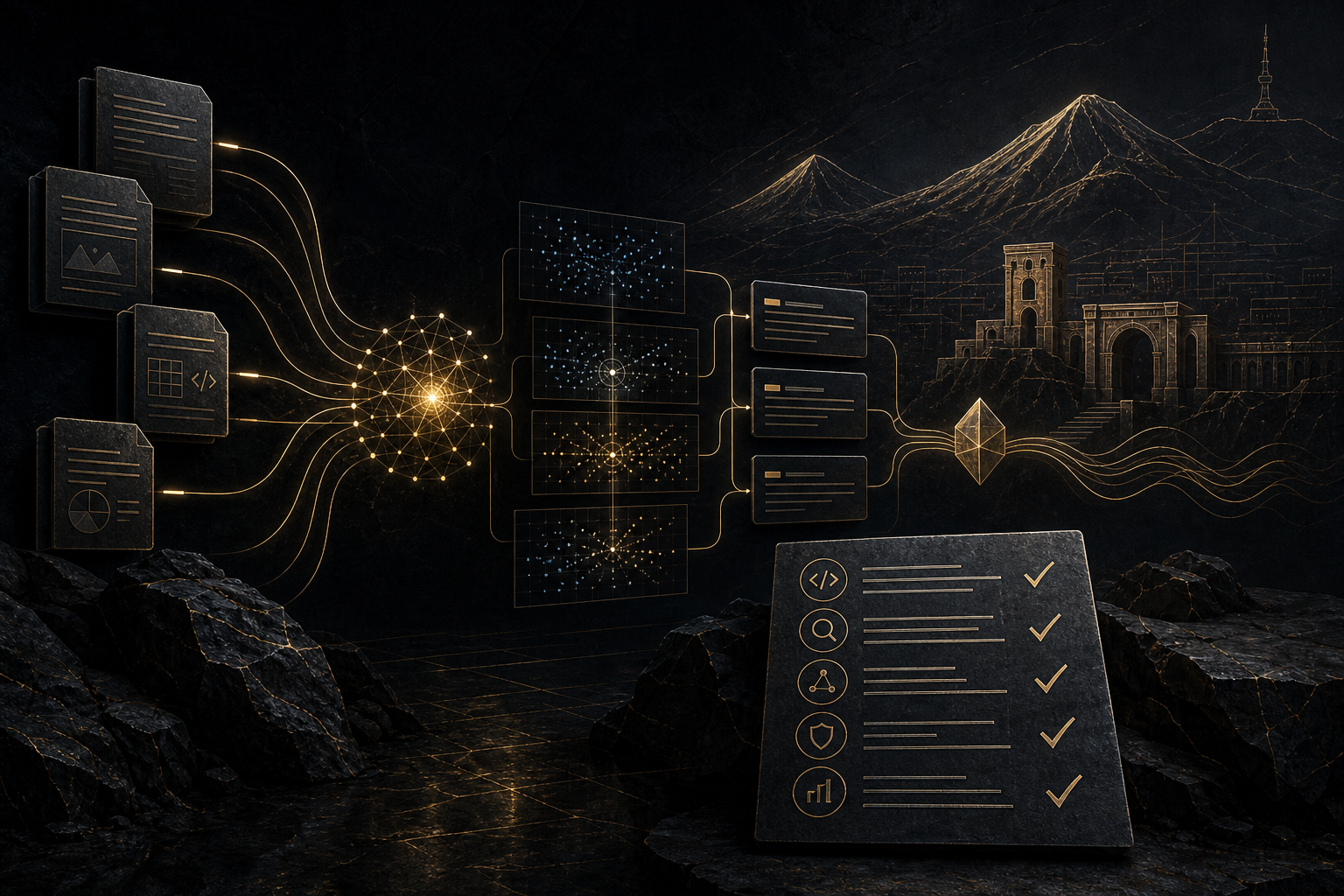
$ evaluate rag_developer --market armenia
> inspect: sources / permissions / retrieval / evaluation / updates
> route: audit / controlled_prototype / production_knowledge_assistant
> output: criteria_based_selection, not advertising rankingAnswer first: choose for retrieval discipline, not chatbot wording
A good RAG developer in Armenia is not just someone who can connect a language model to a folder of files. The useful role is closer to a systems engineer: they understand documents, permissions, search quality, prompts, evaluation, integration boundaries and how people will update the knowledge base after launch.
Broad commercial intent still belongs to the AI specialist in Armenia landing page. This article supports that page with a narrower long-tail guide: how to evaluate a RAG developer in Armenia, which competencies matter, what the working process should look like and which red flags should stop a project before it becomes an expensive chatbot.
Use this as a selection framework. It is not a ranking, a promise of universal quality or a claim that one vendor is best. The right choice depends on your documents, language mix, risk level, integrations and operating owner.
Who needs a RAG developer
RAG, or retrieval augmented generation, is useful when a company wants AI answers grounded in its own material: policies, contracts, manuals, product documentation, CRM notes, support history, training guides or internal procedures. The model should not invent an answer from general internet knowledge when the company has an approved source.
Teams in Armenia usually ask for RAG when they already have one of these problems:
- employees spend too much time searching documents and chats;
- support or sales answers depend on scattered knowledge;
- managers need a reliable assistant for policies, contracts or product details;
- multilingual Armenian, Russian and English materials need one search layer;
- an existing chatbot gives fluent but unverifiable answers;
- document updates happen often enough that static prompts are not enough.
If the real problem is broad process automation, start with AI automation. If the problem is knowledge-grounded answers and source control, a RAG developer or RAG systems specialist is the more precise role.
Core competencies to check
The first competency is source modeling. A RAG developer should ask what documents exist, who owns them, how often they change, which versions are authoritative and which content must never be used. Without this step, the system may retrieve old policies or private material.
The second competency is retrieval architecture. The developer should be able to explain chunking, metadata, embeddings, lexical search, vector search, reranking, filters, source citations and fallbacks without pretending one vector database solves everything. Some projects need semantic search. Some need exact matching. Many need both.
The third competency is evaluation. A RAG system is not ready because it gives a confident answer once. It needs test questions, expected source coverage, bad cases, missing-answer behavior and regression checks after document updates.
The fourth competency is integration discipline. A business RAG system often touches authentication, CRM, file storage, website content, internal tools, Slack, Telegram, WhatsApp, email or operator dashboards. The developer should separate read-only knowledge access from actions that change business records.
The fifth competency is product ownership. RAG becomes useful only when someone can add, remove and review sources after the first release. If the system requires a developer for every document update, the operating cost may exceed the value.
Local selection matrix
Use this table when comparing a RAG developer, AI specialist, freelancer, studio or internal engineer in Armenia.
| Criterion | Strong signal | Weak signal | Practical risk |
|---|---|---|---|
| Source audit | asks for owners, formats, freshness and permissions | asks only for a folder upload | stale or private sources enter answers |
| Retrieval design | explains semantic, lexical, metadata and reranking tradeoffs | says embeddings are always enough | weak recall or irrelevant answers |
| Evaluation | requests real questions and failure examples | tests only with demo prompts | quality cannot be measured |
| Citations | shows source links, snippets or traceable references | hides where the answer came from | users cannot trust the response |
| Multilingual handling | tests Armenian, Russian and English terms separately | assumes translation will solve everything | missed documents and inconsistent terminology |
| Security | separates read access, permissions and logs | indexes everything into one shared bucket | data leakage between teams |
| Operations | defines update workflow and owner | ships a static prototype | knowledge base becomes stale |
| Integration | scopes CRM/API/tool access carefully | gives the model broad tool power | unsafe actions and audit gaps |
This is the original proof requirement for the article: a local comparative table and selection method. It is intentionally criteria-based because self-awarded "best RAG developer" language would not be useful or verifiable.
How the work should run
The safest process begins with an audit. The audit should list source types, owners, access rules, update frequency, language coverage, expected user groups, typical questions, unacceptable mistakes and the first useful workflow.
After that comes a narrow prototype. The prototype should not be a public chatbot. It should answer a controlled set of questions, show sources, fail gracefully when sources are missing and expose where retrieval did or did not work.
The next step is evaluation. A small but real evaluation set is enough to reveal whether the system is useful: common questions, rare questions, ambiguous questions, stale policy questions, out-of-scope questions and questions where the answer must be "not enough information".
Only then should the team discuss production integration. Production means authentication, permissions, logging, monitoring, source updates, owner training and a clear path for changing prompts, sources and retrieval settings.
Practical example from aicoding.am work
One confirmed practice pattern from aicoding.am is the Codex Skills / Project Memory methodology described in the public proof layer. It is not sold as a client RAG case study, but it shows the same engineering discipline that matters in RAG: separate durable instructions from session state, keep source-of-truth documents explicit, route context by responsibility and avoid dumping all knowledge into one prompt.
That pattern matters for business RAG too. A document assistant should not mix every source into one opaque context window. It should know which materials are permanent, which are current, which are user-specific, which need approval and which should not be used at all.
For business proof, review the case studies. For the specific service surface, use RAG systems. For broad local AI selection, use the AI specialist in Armenia page.
Red flags
The largest red flag is a demo that cannot show sources. A RAG system without source traceability may still be a useful brainstorming tool, but it is not a reliable business knowledge assistant.
Another red flag is indexing everything. Contracts, HR policies, customer records and internal notes can have different permissions. A developer who ignores access boundaries can create a data leak even when the model itself is not the main problem.
Be careful with fixed promises about hallucination. RAG can reduce unsupported answers, but it does not remove the need for evaluation, refusal behavior, source checks and human review for sensitive use cases.
Also watch for overbuilt architecture. A small internal assistant may not need a complex multi-agent system. It may need clean documents, metadata, search quality, citations and an update workflow.
What to prepare before asking for a quote
Before contacting a RAG developer in Armenia, prepare a compact brief:
- The business question the assistant should answer.
- The source types: PDFs, docs, website pages, CRM notes, knowledge base, spreadsheets or tickets.
- Languages used in sources and questions.
- Which sources are authoritative and which are drafts.
- User roles and permission boundaries.
- Examples of correct answers and unacceptable mistakes.
- Whether answers need citations, snippets or document links.
- Expected update frequency.
- Integrations needed for the first release.
- The smallest useful pilot that can be evaluated.
Ask for a proposal that separates audit, prototype and production rollout. A useful answer should name assumptions, exclusions, quality checks and who owns source updates after launch.
Practical next step
If your company needs a RAG developer in Armenia, start with the source audit: documents, owners, permissions, language coverage and ten real questions. Then decide whether the first phase should be an audit, a controlled prototype or a production-ready knowledge assistant.
For broader service context, use the AI specialist in Armenia page. For RAG-specific delivery, review RAG systems. To start with a concrete brief, use the project intake.
Where This Applies
RAG developer selection, knowledge-base audit and first production-safe assistant scoping
This article is useful when a company in Armenia needs grounded AI answers over business documents before choosing between audit, controlled prototype and production RAG system.
- Founders comparing a RAG developer, AI specialist, studio or internal engineer.
- Operations teams preparing documents, permissions, evaluation cases and update ownership.
- Companies that need criteria-based selection instead of unverifiable vendor rankings.
rag_readiness = source_audit
  + permission_model
  + retrieval_design
  + evaluation_set
  + citation_policy
  + update_workflow
  + production_monitoring;
if (sources_are_unowned) start("audit");
if (answers_have_no_citations) block("production_claim");