RAG for Support: Answers with Verifiable Documentation Links
Make every material support answer inspectable against current documentation
Evidence records, retrieval filters, link checks, escalation boundaries and operational ownership
Original SUPPORT-LINK-8 workflow with an input/output example and acceptance criteria
RAG for support, support documentation links, verifiable RAG citations, enterprise RAG assistant, AI knowledge base and SUPPORT-LINK-8
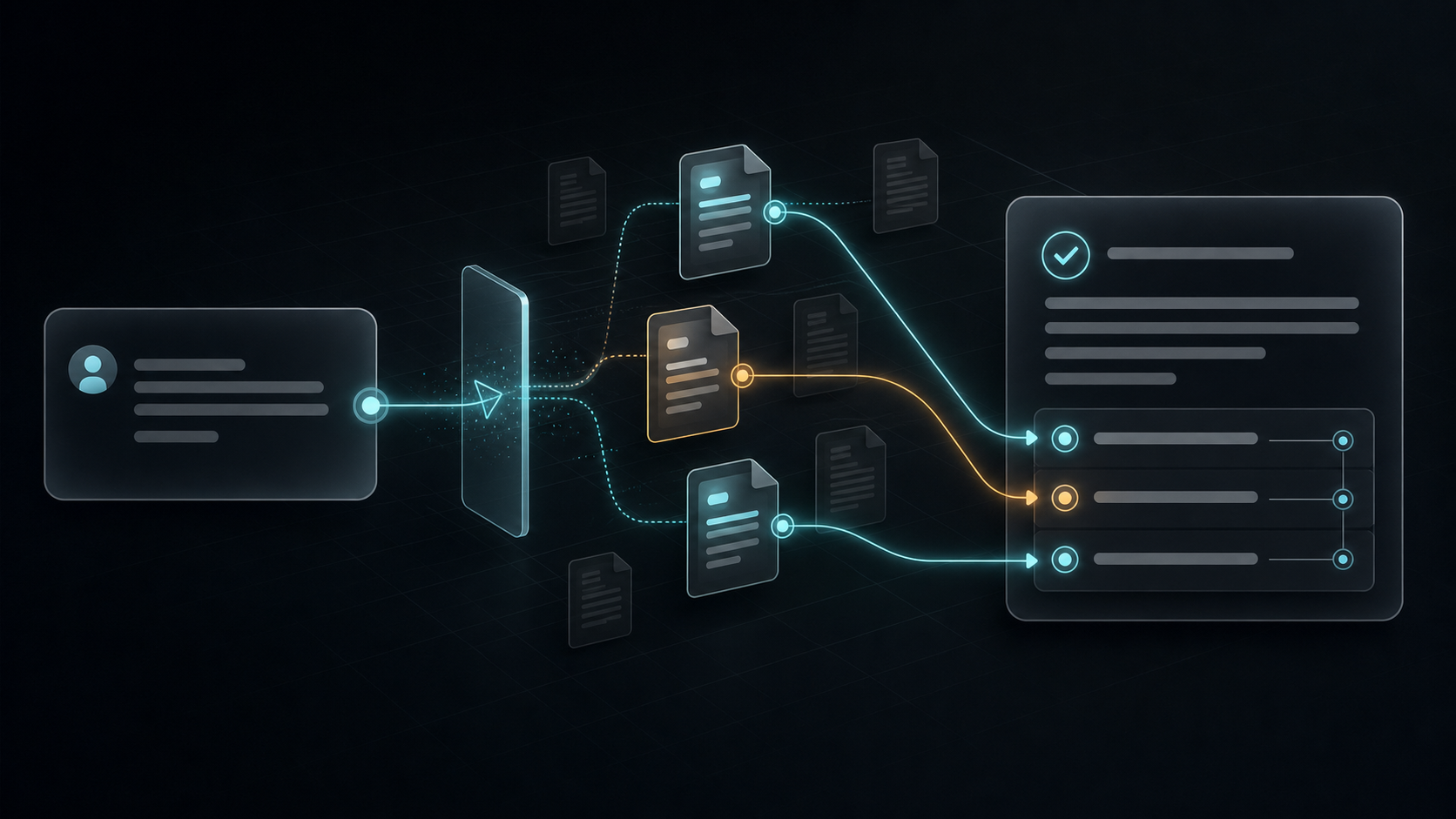
$ support-rag --contract SUPPORT-LINK-8
> receive: question / channel / trusted scope
> filter: product / locale / state / audience
> retrieve: current passages / revision / locator
> verify: claim coverage / link health / lifecycle
> route: answer / no-answer / escalation / account-actionA support assistant is useful only when an agent can check why it answered. A fluent reply without a current documentation link can create a second problem: the customer gets an answer, but the support team cannot tell whether it was approved, current or applicable to that account.
This guide covers a bounded implementation question: how to use RAG for support answers that carry verifiable links to documentation. It complements the broader RAG systems service and a controlled AI engineering brief. It does not turn the assistant into a policy owner or a substitute for support judgement.
Start with the support decision, not the chat UI
Choose one support job with a defined reader and consequence: explain a documented configuration step, point to the current billing rule, or help an agent find a known troubleshooting procedure. Record what the assistant must not decide: account-specific exceptions, refunds outside a published rule, legal or security statements, and undocumented product behaviour. These requests need a named human route.
A documentation link is useful only when it identifies the source actually used. The minimum evidence record is a source ID, revision, section locator, URL, document state and eligibility scope. Store these alongside the chunks rather than asking the model to reconstruct them from text.
Prepare documentation as evidence
Support documentation is often fragmented: product guides, release notes, runbooks, macros and internal escalation notes have different audiences and lifecycles. Register each source before indexing it.
| Field | Example | Why support needs it |
|---|---|---|
| Source ID | help-center/refunds | stable identity across edits |
| Revision | 2026-09-02 or content hash | detects stale answers |
| Locator | heading, anchor or line range | lets an agent inspect the claim |
| Scope | public, agent-only, account tier | filters before retrieval |
| State | draft, approved, retired | prevents draft instructions reaching customers |
| Owner | product or support owner | gives conflicts a repair path |
Do not index a document merely because it is easy to export. A draft without an owner, an obsolete FAQ or a private escalation note lacking an access contract belongs in a review queue. The article text, its title and its links must remain connected when chunking; a result that only contains a short sentence may be semantically similar but impossible to verify in the support workflow.
Design the SUPPORT-LINK-8 workflow
This original workflow makes the answer-to-source connection explicit.
- Receive. Accept the support question with channel, product, language and trusted agent or customer context.
- Classify. Determine whether the request is documentation lookup, account action, escalation or unsupported.
- Filter. Restrict candidates by product, locale, audience, document state and effective date before ranking.
- Retrieve. Select diverse current passages with their source IDs, revisions and locators.
- Compose. Produce a concise answer only from the permitted evidence and attach human-openable links.
- Verify. Check that each material claim has a matching live locator and that the cited revision is still current.
- Route. Send insufficient evidence, conflict, account-specific action or high-consequence requests to the named queue.
- Record. Store a minimised answer receipt: request class, source IDs, revisions, citation links, route and feedback.
The boundary between retrieve and compose matters. Retrieval selects eligible evidence; it does not authorize the assistant to invent missing steps. If the result cannot support a short answer with a usable source link, the correct output is a no-answer or escalation route.
Example: support input and reviewable output
An agent asks: “Can a customer change the billing contact after an invoice has been issued?” The system receives a product code and the agent role. It filters for approved billing documentation valid for that product, retrieves the relevant procedure and confirms the anchor is available.
INPUT
question: change billing contact after invoice
scope: support-agent / product-a / en

OUTPUT
answer: The documented path is to submit the billing-contact change before the next invoice cycle.
evidence: Billing contacts — revision 24 — "After an invoice" section
link: https://docs.example.com/billing-contacts#after-an-invoice
boundary: Existing issued invoices require the billing operations queue.
route: support-answer / billing-operations
The answer does not claim what the company will do in an individual account. It separates the documented general rule from the next owner for the exception. If two approved pages conflict, show the conflict to the agent and route it; wording similarity is not a tie-breaker.
Treat integrations as contracts
The documentation system must provide stable identifiers, revisions, lifecycle events, audience labels and openable canonical URLs. The support desk integration must distinguish retrieval-only assistance from a write action such as changing a ticket, issuing a credit or updating an account. A write action needs its own authorization, idempotency and read-back; a cited article is not permission to change data.
The identity boundary is equally important. Resolve actor, tenant and role on the server side; do not accept an access label provided in a chat message. When documentation is available in more than one language, retain the source language and version in the receipt. A translated explanation must not silently cite a different rule.
For updates and removals, use a source event plus reconciliation. First mark a revised or revoked source ineligible for retrieval; then rebuild or remove derived chunks; finally probe for absence or currentness. This prevents an old support macro from remaining available because an embedding job succeeded yesterday.
Verify the pilot before agents depend on it
Acceptance criteria should test decisions, not only answer style.
- A permitted agent receives a current answer with a clickable source locator.
- Every material statement maps to a source ID, revision and locator in the answer receipt.
- A retired document and its chunks are excluded from retrieval after a lifecycle change.
- A user outside the source scope cannot obtain it through paraphrase, another language or a ticket quote.
- A request without sufficient evidence produces a clear no-answer or escalation route.
- Conflicting current sources show both locators and reach the responsible owner.
- Broken or redirected links are detected before an answer is delivered.
- Account actions remain outside the retrieval flow unless their own authorization contract passes.
Use a small curated test set first: known answers, no-answer questions, stale revisions, denied scopes, conflicting documents and link failures. Avoid a generic accuracy claim unless the team has a defined sample, method and threshold. A reviewable set of failure cases gives a support owner something concrete to approve.
Operate link-backed support answers
Watch source-to-index lag, citation-link failures, no-answer rate, conflict routes, access denials, feedback corrections and handoffs that revealed a missing source. These signals have different meanings. A no-answer can be a safe boundary; a spike after a release may expose a documentation or ingestion gap. A link failure means the answer cannot be checked even if the wording was accurate.
Give source classes a review rhythm. Product release notes may need fast promotion; policy pages may need owner approval; temporary incident notes need an expiry. Keep the answer receipt small and access-controlled: it should help audit a support answer without becoming another uncontrolled copy of customer or internal content.
Begin with one product area, one documentation family and one support queue. Run the evaluation set, observe real agent feedback, repair the source register and only then extend the scope. For a controlled pilot around a specific support workflow, see RAG systems or start an AI engineering brief.
require(request.scope && request.product && request.locale);
require(evidence.every(isCurrentPermittedAndCitable));
require(answer.claims.every(hasMatchingLocator));
require(testSet.knownAnswer && testSet.noAnswer && testSet.denied && testSet.brokenLink);

if (!evidence.supportsAnswer) route = "no-answer-or-escalation";
if (citation.broken || source.retired) route = "fail-closed";
if (request.isAccountAction) route = "separate-authorized-workflow";