Vibe Coder in Armenia: Where Prototype Ends and Engineering Begins
A practical comparison for AI-assisted prototypes, MVPs and production builds
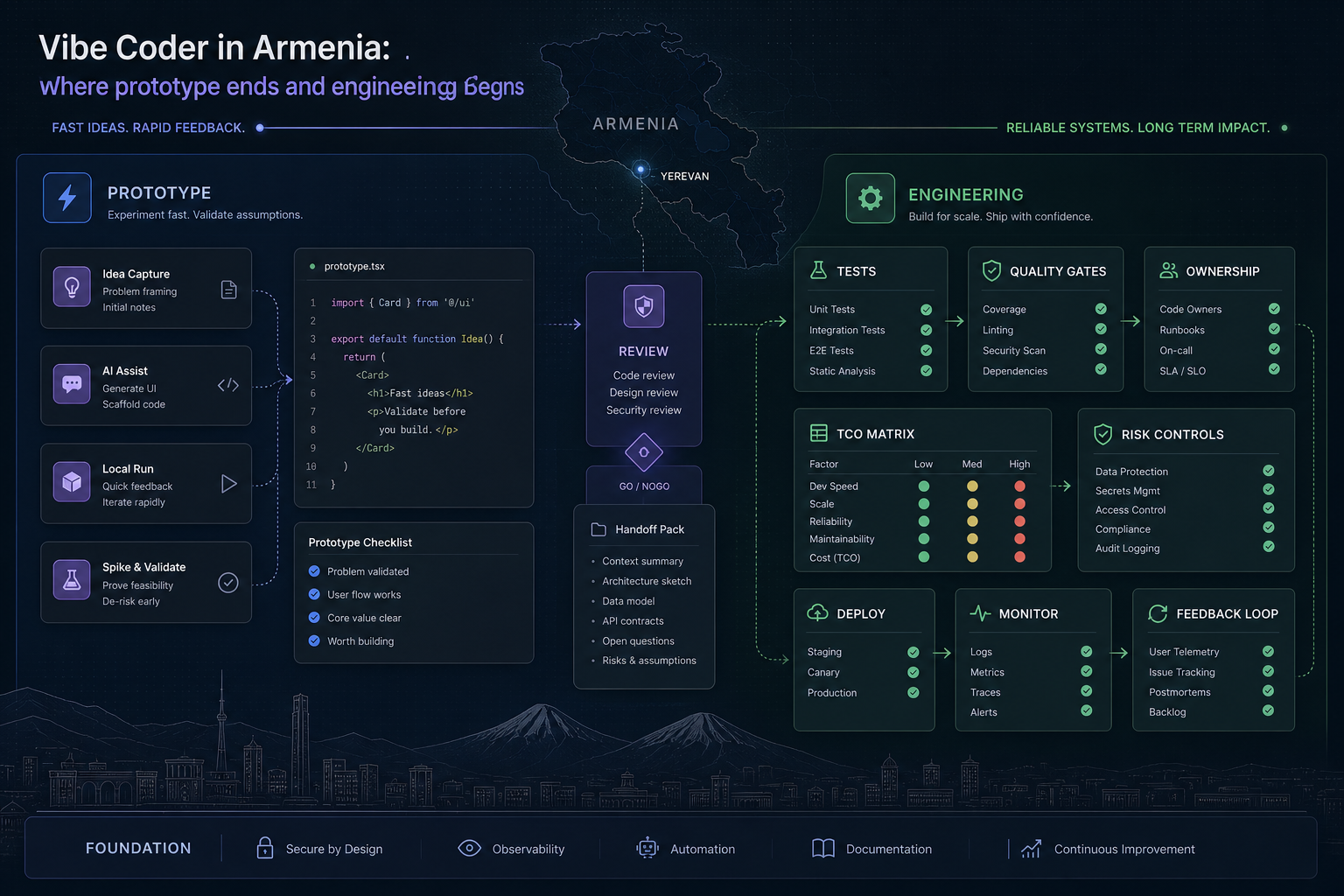
Speed, TCO, integrations, review, tests, deployment and ownership after launch
How this guide supports the broad Armenia AI specialist landing page with long-tail criteria
vibe coder Armenia, AI-assisted product development, MVP hardening and production engineering
$ evaluate vibe_coder --market armenia
> compare: prototype / mvp / production_engineering
> inspect: data / integrations / review / tests / ownership
> output: route_by_risk_and_tcoSearching for a vibe coder in Armenia can mean two different things. One company wants a fast prototype made with AI-assisted coding. Another wants a production system and uses "vibe coding" as shorthand for speed. Those are not the same request, and mixing them is where budget, ownership and delivery risk usually start.
This article is a comparison guide for teams evaluating vibe coding, AI-assisted product development and engineering delivery in Armenia. The broad commercial intent belongs to the AI specialist in Armenia landing page. This page is narrower: it helps you decide when a vibe-coded prototype is enough, when it needs engineering hardening and when a different delivery model is safer.
What exactly is being compared
In practice, the phrase "vibe coder" can point to at least four delivery shapes:
- a rapid AI-assisted prototype that proves an interface, workflow or product idea;
- a solo developer using AI tools to build a small MVP;
- an AI engineering studio that combines AI speed with review, tests and deployment discipline;
- a traditional software team that uses AI tools only as a productivity layer.
None of these options is automatically good or bad. The useful question is whether the output must survive real users, integrations, data changes, permissions, errors and maintenance.
Common criteria for choosing the format
Use the same criteria for every option instead of asking who looks faster.
| Criterion | Prototype signal | Engineering signal |
|---|---|---|
| Goal | Learn if the idea is worth building | Run a workflow reliably in production |
| Data | Dummy data or small controlled input | Real sources, permissions and migration path |
| Integration | Mocked API or manual import | CRM, ERP, payments, messengers or internal APIs |
| Quality bar | Demo works on a known path | Tests, edge cases, monitoring and rollback |
| Ownership | One person can adjust the demo | Someone owns code, deploys, logs and changes |
| Budget logic | Pay for learning speed | Pay for long-term cost of ownership |
The main risk is not that a prototype exists. The risk is treating prototype code as if it already passed production review.
Strengths and weaknesses of each option
A vibe-coded prototype is useful when the team needs to see an idea, test a product flow or align stakeholders quickly. It can be a good fit for landing-page experiments, internal tool sketches, clickable workflow demos, AI prompt trials and early MVP screens. The weakness is that the speed often comes from skipping contracts, tests, error states, accessibility checks, security review and deployment discipline.
A solo AI-assisted developer can be a good choice when the project is small, the domain is clear and the business can tolerate a direct handoff. The risk appears when the scope quietly grows into integrations, roles, billing, customer data or operations.
An AI engineering studio or senior AI developer is better when the prototype must become a maintained product. That work still uses AI-assisted coding, but the important layer is not the prompt. It is architecture, typed boundaries, review, test coverage, observability, secure secrets handling, deployment and ownership after launch.
A general agency can help when there is a broader product roadmap, but it may be less efficient if the project is mostly LLM workflows, RAG, AI automation, n8n, prompt contracts or internal AI tooling.
Weighted decision matrix
Here is a practical matrix for three typical scenarios.
| Scenario | Speed | Risk control | Integration depth | Maintenance | Recommended route |
|---|---|---|---|---|---|
| Idea validation | 40% | 15% | 15% | 10% | Vibe-coded prototype with clear disposal rules |
| Internal MVP | 25% | 25% | 25% | 20% | AI-assisted developer or studio with review and tests |
| Production workflow | 10% | 35% | 30% | 25% | Engineering-led build with AI as acceleration, not governance |
The weights matter more than the labels. If the project writes to a CRM, handles customer data, calls paid APIs or affects decisions, risk control and maintenance must outweigh raw speed.
Where the prototype should stop
A prototype should stop before it becomes the hidden source of truth. Good prototype boundaries are explicit:
- It can use mock data, but real data contracts must be documented before production.
- It can use one happy-path flow, but edge cases must be listed before a launch decision.
- It can skip deep automation, but integration points must be named.
- It can be visually polished, but accessibility and mobile behavior must be verified before users depend on it.
- It can be built quickly, but the team must decide whether to harden, rewrite or discard it.
The most expensive mistake is not rebuilding prototype code. The expensive mistake is maintaining unreviewed prototype code as a production dependency.
What production hardening looks like
Engineering begins when the system needs contracts and consequences. For a business in Armenia, that often means connecting the AI-assisted product to CRM records, WhatsApp or Telegram workflows, spreadsheets, payment records, internal approvals or document stores.
The hardening checklist should include:
- typed data boundaries and API contracts;
- authentication, roles and secrets handling;
- input validation and safe error states;
- tests for the main user path and failure cases;
- logging, monitoring and deployment rollback;
- documentation for the next developer or operator;
- clear owner for product decisions after launch.
For AI features, add prompt contracts, evaluation examples, model fallback behavior, cost limits and human approval where sensitive actions are involved.
Original proof method
One practical way to evaluate a vibe coder or AI-assisted team is to ask for two artifacts before the first sprint ends:
| Artifact | What it proves | Risk it reduces |
|---|---|---|
| Prototype decision log | Which parts are demo-only, which can be hardened and which should be rebuilt | Prevents accidental production dependency |
| Engineering hardening map | Tests, contracts, integrations, permissions, deploy path and owner | Shows whether the team can move beyond prompt-driven speed |
This is stronger proof than a polished demo because it shows judgment. A serious AI-assisted developer should be willing to say: this part is good enough, this part needs review, and this part should not go live.
Red flags
Be careful when the proposal says "AI built it, so it will be cheaper" without naming what is being skipped. AI can reduce drafting time, but it does not remove responsibility for security, data quality, testing, deployment or maintenance.
Other red flags:
- no distinction between prototype, MVP and production system;
- no plan for code review or test coverage;
- no owner for deployment and rollback;
- no explanation of how secrets and API keys are handled;
- no mobile, accessibility or browser QA plan for user-facing screens;
- no documentation of which generated code was accepted, rewritten or discarded.
Practical next step
If you are choosing a vibe coder in Armenia, start by naming the desired outcome: learning, MVP or production workflow. Then list real integrations, user roles, data sensitivity, expected lifetime and what happens when the system fails.
For aicoding.am, the useful intake is a short project brief: prototype goal, current tools, data sources, approval points, risks and the smallest release that would prove value. That keeps vibe coding as a supporting AI-assisted development topic while the broad AI specialist Armenia intent remains with the dedicated landing page.
Where This Applies
AI-assisted prototype, internal MVP and production hardening decision
This article is useful when a company in Armenia wants AI-assisted development speed but still needs to decide what must be reviewed, tested, rebuilt or maintained.
- Founders comparing vibe coder, AI developer, studio, agency or internal product team.
- Operations teams deciding whether a workflow demo can become a real internal tool.
- Companies that need a criteria-based recommendation instead of generic AI coding speed claims.
vibe_coding_fit = learning_speed
  + clear_disposal_rules
  + small_scope
  + low_data_risk;
if (writes_to_live_systems) require("engineering_hardening");
if (customer_data || paid_actions) require("tests_review_monitoring");