What an AI Specialist in Armenia Does for Business
A practical map of AI specialist tasks for Armenian companies
Process mapping, data review, RAG, automation, integrations, evaluation and rollout ownership
How to choose the first useful AI workflow without replacing the commercial landing page
AI specialist Armenia, AI developer Yerevan, AI automation, RAG and business workflows
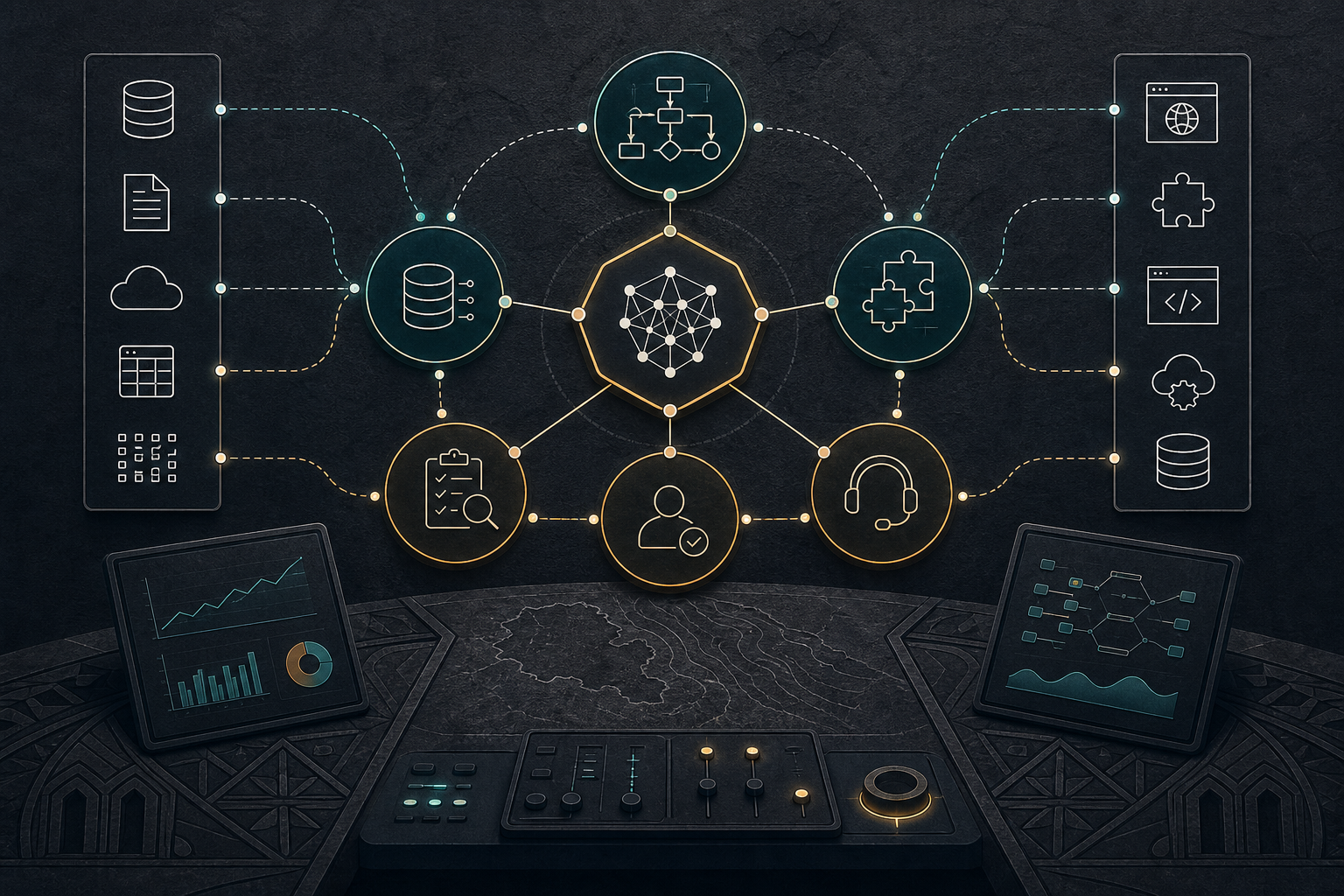
$ map ai_specialist --market armenia
> input: process, users, data, systems
> choose: automation | rag | agent | internal_tool
> guardrails: human_review, fallback, logs
> output: first narrow workflow, not AI transformation sloganShort answer: the role is to turn a business process into a controlled AI system
An AI specialist in Armenia is useful when a company has a real workflow that can be improved with language models, retrieval, automation, computer vision or AI-assisted internal tools. The job is not to add a chatbot to every page. The job is to understand the process, decide where AI is appropriate, connect the right data, design review points and ship a system that can be checked after launch.
For companies in Armenia and Yerevan, this often means a mixed delivery context: local business operations, Russian or Armenian-language users, English technical platforms, international APIs and existing tools such as CRM, ERP, spreadsheets, messengers, websites and accounting exports. A good AI specialist makes these constraints visible before choosing the model.
The broad commercial page for this topic is AI Developer and AI Specialist in Armenia. This article has a narrower purpose: it explains what the specialist actually does inside a business project, what tasks should be prioritized and where the risks are.
Decision tree: when AI is the right layer
| Business signal | AI may help when | AI is not the first step when |
|---|---|---|
| Repeated text work | Staff classify, summarize, draft or search similar content every day | The source data is missing, outdated or inconsistent |
| Knowledge retrieval | Operators need answers from policies, product docs, manuals or contracts | The company has no approved source of truth |
| Lead or support routing | Requests need triage, enrichment and next-step suggestions | There is no clear routing policy or owner |
| Document processing | Invoices, forms, claims or reports follow repeatable patterns | Legal or financial decisions would be automated without review |
| Internal tools | A team needs a workflow tool faster than a full product build | The team has not agreed what problem the tool should solve |
This is the first responsibility of the specialist: decide whether AI is the right layer or whether the company first needs process cleanup, data hygiene, access control, integration work or a simpler rule-based automation.
Task 1: map the business process
AI implementation starts with a process map, not a model comparison. The specialist should identify the inputs, users, decisions, systems, exceptions and success criteria.
For example, "automate support" is too vague. A practical version is: new messages arrive from a website and messengers, the operator identifies the product category, checks internal documentation, drafts an answer, escalates complaints and updates CRM status. Now the project can be designed.
The process map answers four questions:
- What work is repeated often enough to justify automation?
- Which decision is expensive, slow or error-prone?
- Where should a human approve the result?
- What evidence will show that the AI layer improved the workflow?
Without this step, AI becomes a demo that looks impressive but does not change daily operations.
Task 2: inspect data and sources
Most business AI projects depend on company knowledge: CRM records, product catalogues, price lists, policies, manuals, chat history, uploaded files, spreadsheets or internal APIs. The AI specialist has to inspect what exists, what is trustworthy and what should stay out of the model context.
For RAG and AI knowledge bases, this includes source structure, document versions, access rights, update frequency and citation quality. For automation workflows, it includes field names, statuses, IDs, webhooks, API limits and error cases.
The practical question is not "can the model answer". The question is "which source is allowed to support the answer, who can see it and how do we know it is current".
Task 3: choose the implementation pattern
An AI specialist should not force every problem into one architecture. The common patterns are different:
- AI automation: a workflow classifies, drafts, enriches, routes or triggers actions while keeping logs and approval points.
- RAG system: the model retrieves from approved documents or records before answering.
- AI agent: the model can call tools, but only inside explicit permissions, boundaries and audit trails.
- Internal AI tool: a small product interface helps staff complete a workflow with AI assistance.
- AI-assisted development: AI helps build an MVP or internal system, but engineering review, testing and deployment discipline still matter.
The right pattern depends on risk. A low-risk content draft can be reviewed manually. A CRM update needs logs. A financial or legal decision needs stronger controls and may not be appropriate for automation at all.
Task 4: design human review and failure handling
Production AI fails in ordinary ways: the source document is outdated, the user asks an edge-case question, the model overconfidently summarizes, a tool call times out, a CRM field is missing or an API returns a partial response.
The specialist should define what happens in those cases. The answer may be: ask for clarification, refuse, escalate to a person, create a draft only, log the event or route the case to a manual queue.
Human-in-the-loop is not a decorative phrase. It is a design decision: which action can the AI perform alone, which action only suggests a draft and which action must be approved before it touches a business system.
Task 5: evaluate quality before rollout
AI quality cannot be validated by reading three nice answers. A serious project needs test cases. For a support assistant, this can be a set of real questions, expected source documents and unacceptable answers. For a lead qualification workflow, it can be sample leads, expected categories, required fields and escalation cases. For a RAG system, it can be source-grounded questions and citation checks.
Evaluation does not need to be academic at the start. It needs to be practical and repeatable. The company should know which errors block launch, which errors are acceptable during a pilot and how quality will be checked after documents or prompts change.
Task 6: connect integrations and ownership
Business value appears when the AI layer connects to the systems where work happens: CRM, ERP, task manager, website, messenger, document storage, email, spreadsheet, internal dashboard or n8n workflow.
This is where many AI demos fail. They answer in isolation, but do not update status, keep an audit trail, handle permissions, retry safely or expose logs. A production-oriented specialist plans these details early.
Ownership after launch is part of the project, not an afterthought. Someone must know where prompts live, how documents are updated, who reads logs, who receives incident reports and when the workflow should be changed.
Priority matrix for the first AI project
| Candidate task | Business value | Risk | Good first step |
|---|---|---|---|
| Internal knowledge assistant | High | Medium | Audit documents, define access rules and build a small RAG pilot |
| Lead triage and CRM enrichment | High | Medium | Start with draft categories and human approval before CRM writes |
| Support answer drafting | Medium | Low-medium | Draft-only workflow with source links and operator approval |
| Document extraction | Medium | Medium-high | Process one document type and keep manual review for exceptions |
| Autonomous purchasing or legal decisions | Unclear | High | Do not automate first; map policy, authority and compliance limits |
The best first AI project is usually narrow, measurable and connected to a real workflow. It should reduce one concrete bottleneck instead of trying to transform the whole company at once.
What aicoding.am brings to this type of work
The case-study layer matters because AI projects depend on ordinary software engineering. Narciss CRM shows how orders, inventory, delivery, POS, messengers and integrations become one operational system. AmoBit Inbox shows why messaging workflows need workspace boundaries, protected media and a backend source of truth before AI summaries or routing become safe.
That experience is relevant to AI work because the hard part is rarely the prompt alone. The hard part is connecting interface, backend, data, permissions, workflow and support into one controlled system.
Practical next step
If you are evaluating what an AI specialist in Armenia could do for your company, do not start with a broad "AI transformation" request. Choose one workflow, collect a few real examples, list the systems involved and define what error would be unacceptable.
Then use a short discovery audit to decide whether the first step should be RAG, AI automation, an internal tool, an AI-assisted MVP or simply process cleanup before AI. For a structured start, use the project brief or review the broader AI specialist in Armenia page.
Where This Applies
Discovery audit, first workflow selection and production-safe pilot planning
This article is useful when a team knows it needs AI help, but still has to decide which workflow, data source and implementation pattern should come first.
- Operations teams evaluating AI automation for repeated decisions.
- Founders choosing between RAG, AI agents, internal tools and simple process cleanup.
- Teams in Armenia that need local context plus production engineering discipline.
if (!approvedSource) escalate_to_human();
if (risk === "high") draft_only();
if (writesToCrm) require_audit_log();
if (answerNeedsFacts) retrieve_before_answer();
if (workflowChanges) rerun_eval_set();