What Can You Build with Vibe Coding?: Practical Uses and Limits
Map the task
Check the impact
Choose the route
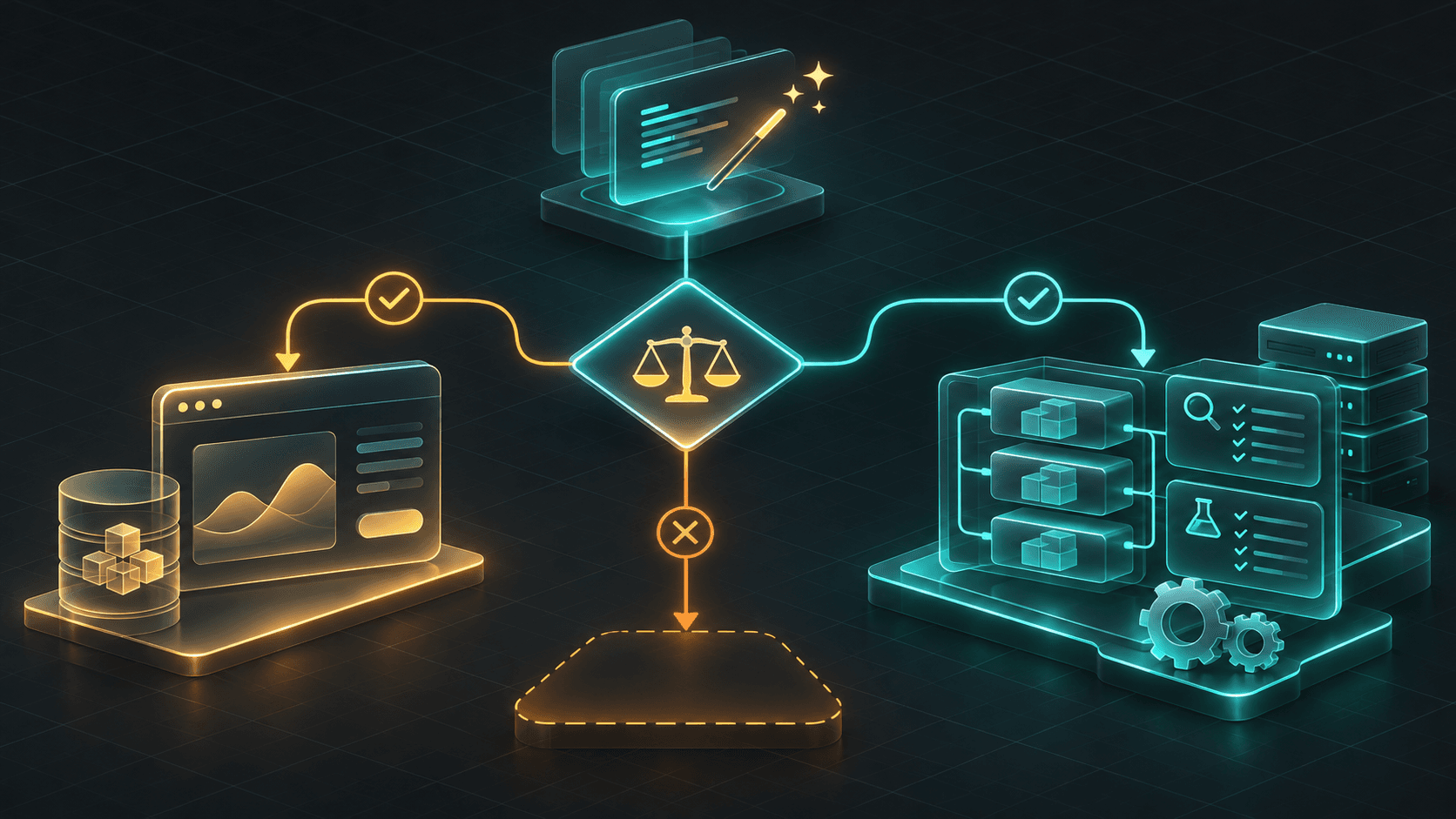
Original decision tree for selecting the next step
$ route --contract BUILD-GATE
> classify: data / side effects / lifespan
> choose: disposable draft / bounded pilot / hold
> release: review rights and recoveryVibe coding can turn an idea into an inspectable draft quickly. But “what can I build?” has two meanings: what can be demonstrated in a short loop, and what can be used responsibly afterward. This guide uses data, impact and lifespan to choose the next step. For the broader service, see vibe coding; for delivered examples, see case studies.
Start with the business task
Imagine a team trying to reduce the time spent handling requests. “Build an AI interface” is a proposed solution, not the task. First map where requests arrive, what data is available, who makes a decision and what outcome would count as improvement. A prototype can show whether an operator understands a new screen. It cannot prove that CRM writes, access controls and retry behavior are safe.
Ask who uses the result, which data it touches, what it changes beyond the screen, how long it will live and who will repair a failure. Those answers should determine the route before choosing a model or coding tool.
Three possible routes
Disposable mockup. A screen, demonstration flow or local calculator on synthetic data. Vibe coding is useful for testing language and interaction when the draft can be deleted and has no connection to a live system.
Bounded pilot. An internal tool for a small group using approved data. AI can accelerate implementation, but the pilot still needs an owner, reviewed dependencies, failure handling and a way to observe problems.
Operating system. A customer portal, payments, personal data, CRM writes, bulk messaging or an autonomous agent. AI can draft code here too. Release requires acceptance criteria, permissions review, failure tests, recovery and maintenance.
Original decision tree
This tree was created for this article. It selects a next step; it is not a certification of product quality.
Does it write, send, delete or use personal data?
  Yes → define permissions, owner, failure tests and recovery;
        stay on a mockup until those controls exist.
  No → will anyone rely on it after the demonstration?
    No → use a constrained vibe-coded draft with synthetic data.
    Yes → assign an owner, define inputs and outputs,
          review the diff and dependencies, test failures;
          release as an engineered pilot.
To prioritize, place the idea on two axes: value of learning and cost of error. High learning value with low error cost is a good candidate for a fast mockup. High error cost means access and recovery work must start early, however simple the screen looks. Low learning value and high error cost suggest postponement. This qualitative matrix deliberately avoids invented measurements; fill it with facts from your process.
Selection criteria
Check the data boundary. If a demo requires uploading real customer requests to an outside tool, the experiment has changed. Replace them with a synthetic fixture or agree on an approved environment. Check side effects: a write, email, payment or deletion needs explicit authority and a reversal path.
Check lifespan. A meeting mockup can disappear that day. A tool people will use next month needs clear interfaces, known dependencies and an owner. Check observability: how will the team notice failure and tell a model error from an integration error? Check maintenance: who updates dependencies and investigates incidents?
The transition signal is not a line count. It is the point where a draft affects another person's data or a promised service. The release process must then change. See our vibe coding versus AI-assisted engineering matrix for a more detailed comparison. A later article in this cluster will examine why prototypes fail in production once published.
Risks and limits
A working screen can conceal empty states, retries, incorrect permissions and upstream API failures. Generated code may add unnecessary dependencies or expose a secret in client code. Tests help when they check intended behavior and failure paths rather than repeating the implementation.
Handoff is another risk: without recorded assumptions, a new maintainer cannot tell which choices were deliberate. Include upkeep and recovery in the decision, not just time to first demo. Even a careful pilot does not automatically justify using live data at scale.
A practical sequence
- Describe one process, user and observable outcome. For example, an operator finds a request without reentering its details.
- Prepare synthetic normal, empty and invalid cases.
- Build a disposable draft and show it to a user. Record what the test clarified and what it did not establish.
- If the hypothesis is valuable, define the data contract, rights, acceptance criteria and owner. Review code changes and dependencies.
- Test the normal path, failure, retry, denied access and reversal. Prepare monitoring and recovery.
- Only then connect approved live data and release a bounded pilot. Expand based on observed results.
If the task crosses systems and the cost of error is unclear, request a short discovery review. It can define the prototype boundary and conditions for a safe pilot. For broader AI engineering work in Armenia, use our dedicated service page.
if (liveWrite || personalData) return REVIEW_RIGHTS_AND_RECOVERY;
if (syntheticData && disposable) return PROTOTYPE;
return ENGINEERED_PILOT_WITH_OWNER;