When RAG Is Not Needed: Seven Cases Where It Adds Complexity
Compare retrieval with the smallest system that safely creates the needed outcome
Rules, templates, direct integrations, search, data readiness and human review
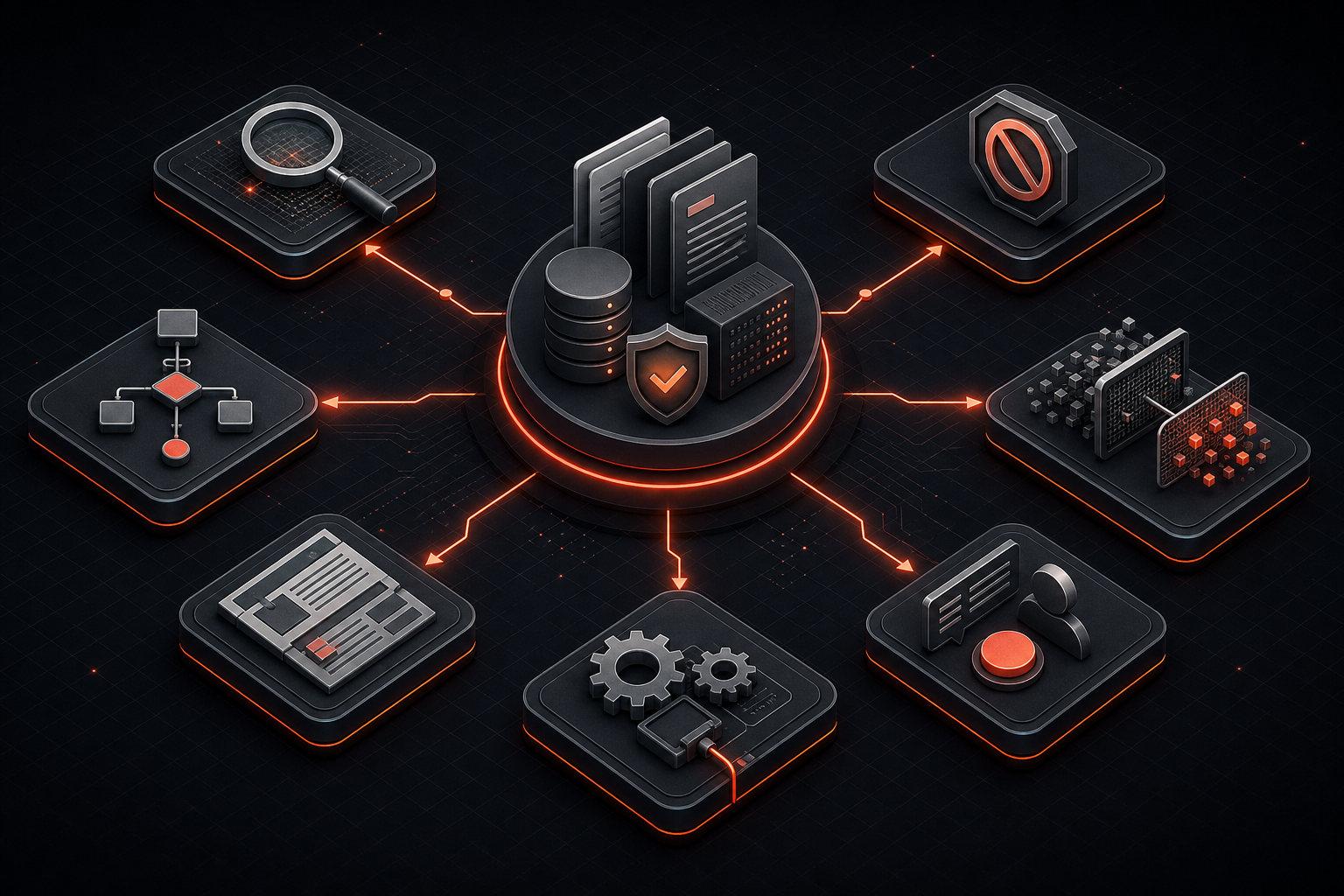
Original RAG-NO-7 decision tree with seven routes before a bounded evaluation
when RAG is not needed, when not to use RAG, RAG limitations, RAG alternatives, RAG system, AI knowledge base and RAG-NO-7
$ decide rag --contract RAG-NO-7
> frame: outcome / owner / failure-cost
> inspect: authority / freshness / access
> compare: rule / template / system / search
> test: baseline / no-answer / review
> route: readiness / bounded-rag / simpler-pathStart with the work that needs to improve
RAG is useful when a person needs an answer grounded in permitted, current documents. It is not a default layer for every workflow that mentions AI. Adding ingestion, chunking, indexing, access checks, retrieval evaluation and source ownership to a problem that does not need them can make the system harder to operate without improving the result.
The broad service discussion belongs on the RAG systems page. This guide answers a narrower question: when should a team choose a simpler, more inspectable path before building retrieval?
The RAG-NO-7 decision tree
Use this original RAG-NO-7 decision tree for one named workflow. It is a route-selection tool, not a claim that one architecture is universally better.
named outcome → current documents needed at answer time?
              ├─ no → deterministic rule / template / direct integration
              └─ yes → user needs source evidence and access-aware retrieval?
                        ├─ no → search, curated link set or human review
                        └─ yes → sources owned, permissioned and testable?
                                  ├─ no → data readiness first
                                  └─ yes → bounded RAG evaluation
The relevant comparison is not “RAG or no AI.” It is RAG against the smallest system that can safely produce the required outcome.
Seven cases where RAG adds the wrong kind of complexity
1. The answer is a fixed rule, not document-dependent knowledge
If a workflow asks “is this request over the approved limit?” or “which queue owns this product code?”, a versioned deterministic rule or lookup table is often the clearer authority. Retrieval can introduce irrelevant passages and a language-model interpretation where a rule engine can return a direct, testable result.
Keep the owner, version and fallback route visible. If the rule becomes ambiguous, route it to review rather than asking a model to create authority from prose.
2. A stable template is the real need
Some teams need a consistent draft: a meeting-note format, an intake checklist or a structured response shell. Start with an approved template, input validation and a bounded generation step. RAG is unnecessary when the required knowledge is already supplied in the request or the output is intentionally generic.
Add retrieval only when the draft must cite changing, permitted internal material and the source trail changes the review decision.
3. The authoritative information already lives in a structured system
An order status, account balance, available slot or current entitlement should come from the system that owns it through a controlled integration. A RAG index is not a substitute for a live, authoritative API or database query. Copying operational facts into documents can create stale duplicates and unclear ownership.
Use a direct read with explicit permissions, a stable record ID and a read-back rule. A model may explain the returned result, but it should not replace the source of truth.
4. Search or a curated navigation layer already solves discovery
If users can find a small, well-labelled set of documents through ordinary search, categories or an approved link directory, improve that path first. Retrieval may be justified later when questions require synthesising several permission-filtered sources, but it is not proof of value by itself.
Measure the actual failure: unsuccessful searches, time to find a document, ambiguous titles or inaccessible sources. Do not infer a RAG requirement from the fact that a document collection exists.
5. The source material is not ready to retrieve
RAG cannot repair documents with no owner, conflicting versions, missing permissions or obsolete policies. Indexing them faster only makes those weaknesses available to more people. The first deliverable may be a source inventory, ownership model, retention rule or a process for removing stale material.
| Readiness question | If the answer is no | Safer next step |
|---|---|---|
| Does every source have an owner and version? | No accountable refresh path | assign ownership and lifecycle |
| Can access be applied before retrieval? | Unauthorized evidence can appear | define identity and permissions |
| Is there a representative question set? | Quality cannot be compared | build a small reviewed test set |
| Can a wrong answer be corrected? | Failure becomes invisible | create an escalation and correction route |
6. The decision is consequential and evidence is incomplete
Legal, financial, personnel, medical, access-control or other high-impact decisions do not become safe because a retrieved passage sounds relevant. When evidence is incomplete, conflicting or outside the declared scope, the appropriate output can be a no-answer, a draft for a named reviewer or a direct route to the responsible owner.
RAG can prepare evidence for a human decision. It should not silently become the authority for a consequential action.
7. The task has no measurable outcome or operating owner
“Build a knowledge bot” is not a bounded system requirement. Before retrieval, name the user group, the question class, the permitted sources, the failure cost, the baseline and the person who owns corrections. Without those boundaries, a RAG prototype usually expands into a vague content project with no way to determine whether it helped.
A small evaluation before a RAG commitment
Choose one workflow and compare a simple baseline with a bounded RAG candidate. The baseline might be search, a direct system query, a rule table, an approved template or a human queue. Use representative normal cases, changed-source cases, permission-denied cases and questions that must receive no answer.
require(workflow.owner && workflow.outcome && baseline.defined);
require(sources.permitted && sources.lifecycle && testSet.representative);
rag_candidate = evidenceRequired && accessAware && retrievalBeatsBaseline;
route = rag_candidate ? "bounded evaluation" : "simpler controlled path";
Record the denominator for each signal: successful task completion, evidence coverage where required, correction rate, no-answer handling, source freshness and reviewer time. A polished demonstration is not evidence if it avoids the ordinary cases that create risk.
Recommended plan of action
- Name one business outcome and its process owner.
- List the authority that should answer it: rule, template, system record, document evidence or human decision.
- Run the smallest safe baseline first.
- If current, permission-aware evidence is essential, audit the sources and build a representative test set.
- Evaluate RAG on that bounded path; keep a no-answer and human-review route.
For a focused architecture discussion, bring the workflow boundary, example questions, source inventory and the results of the simpler baseline. That makes a RAG systems decision inspectable rather than treating retrieval as a default feature. See also RAG in plain language, RAG vs fine-tuning and case studies.
require(workflow.owner && workflow.outcome && baseline.defined);
require(sources.permitted && sources.lifecycle && testSet.representative);
rag_candidate = evidenceRequired && accessAware && retrievalBeatsBaseline;
route = rag_candidate ? "bounded evaluation" : "simpler controlled path";