AI Agent vs Chatbot: The Engineering Difference
Choose the least autonomy that solves the task
Task fit, delivery speed, ownership cost, risk, control and maintenance
Original CHOICE-6 weighted comparison across three synthetic business scenarios
AI agent vs chatbot, tool contracts, state, permissions and verified outcomes
$ compare --contract CHOICE-6
> bind: task / owner / acceptance
> compare: chatbot / workflow / agent
> check: permission / cost / recovery
> route: pilot / review / holdAn AI agent and a chatbot can share the same interface. The engineering difference appears after the user sends a message: the system may return an answer, execute known steps, or choose its next permitted step from observations. That contract determines risk, ownership cost and maintenance. A product label does not.
Start with a concrete question: do you need a verifiable answer or a change in an external system? Explaining a procedure, drafting a request and creating an approved CRM record have different completion evidence. A message saying “created” is not proof that a record exists.
For specialist selection and implementation scope, see AI specialist Armenia. This guide supports architecture selection for a bounded task. Prompt engineering covers model behavior; AI automation covers controlled integrations and processes.
What exactly are we comparing?
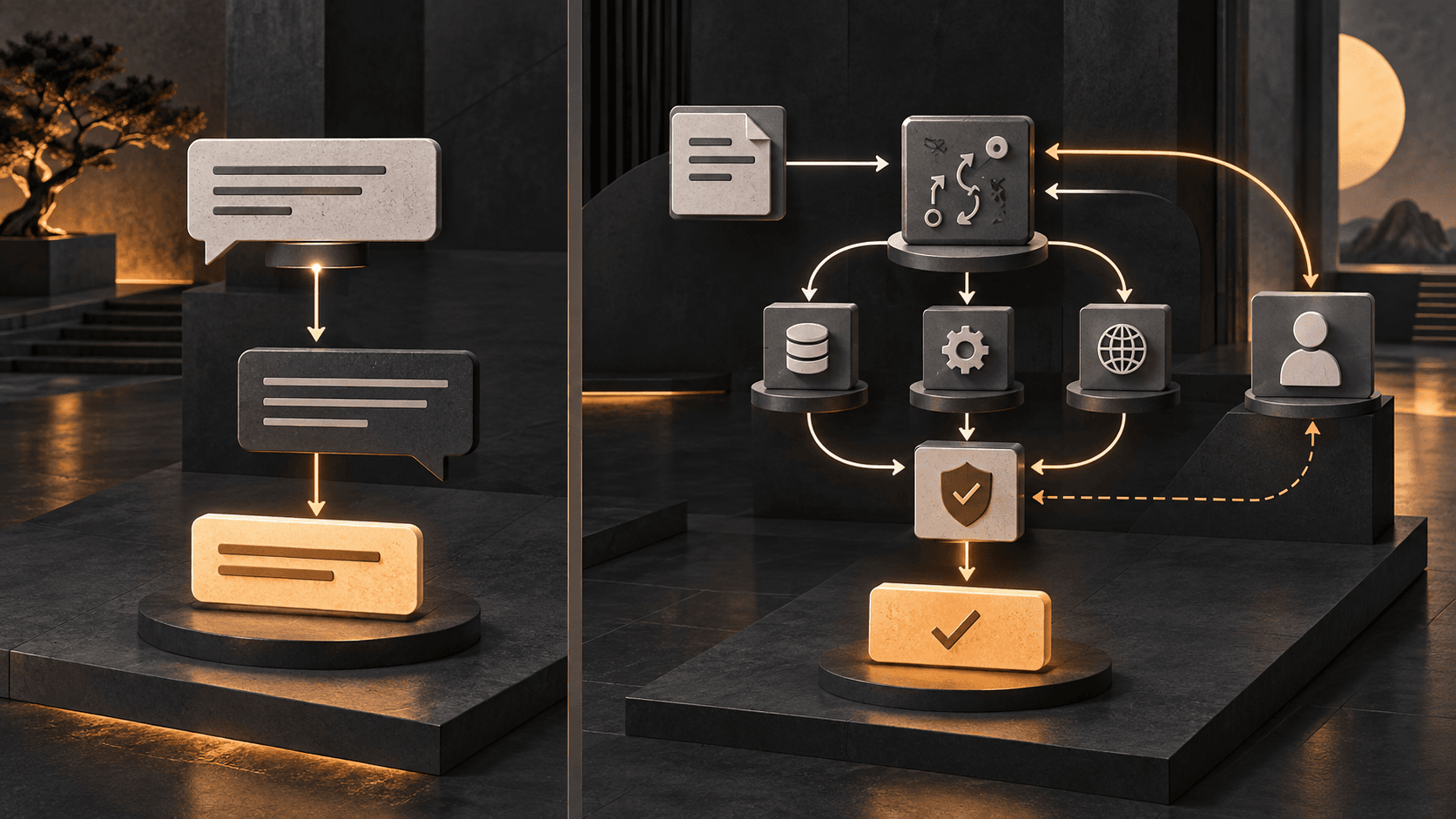
A chatbot is an interface. For this comparison, it is a bounded assistant that answers, searches permitted sources or drafts material without independently managing a changing multi-step process. A chat interface can also sit above an agent, so screen appearance is not a classification.
A deterministic workflow has known transitions: receive a request, extract fields, validate references, request approval, create a record and verify the result. An LLM can classify content while application code controls transitions and writes.
An agent is a bounded loop in which a model selects the next permitted step from the goal, state and observations. The application supplies tools, enforces permissions and budgets, preserves receipts and tests completion. Neither multiple models nor unlimited memory is required.
Anthropic distinguishes workflows from agents by control of the execution path. OpenAI’s practical guide describes models, tools and instructions as agent foundations. The matrix below is our own discussion method, not a provider benchmark.
Six common criteria
Compare alternatives on the same task, data, permissions and acceptance criteria. Giving an agent unrestricted CRM access while a chatbot receives one PDF measures access, not architecture.
| Criterion | Question | Pilot evidence |
|---|---|---|
| Task fit | Answer, known steps or adaptive investigation? | Representative cases and accepted outcomes |
| Launch speed | Which dependencies must be prepared? | Source, tool, state and review inventory |
| Ownership cost | What does an accepted result cost? | Usage, review, recovery and maintenance model |
| Risk containment | What happens after a wrong decision? | Denied-action and recovery fixtures |
| Control | Can we explain and stop execution? | Receipts, permissions, budgets and read-back |
| Maintenance | Who repairs changes in APIs or sources? | Owner, versions, regressions and rollback |
Launch speed differs from response latency. A chatbot usually has fewer integration dependencies, but poor documents can delay either option. Adaptive tool use can find a better path while additional calls increase latency. Measure time to an accepted result across representative cases.
Strengths and limitations
Chatbots fit questions, search, explanations and drafts. The user owns the next action. Document assistants still need current sources, access filters, citations and an honest no-answer route. A simpler interface does not remove evidence risk. The RAG system audit covers that evidence path separately.
Workflows fit repeatable steps and explicit rules. Their transitions are easier to reproduce, but adding branches indefinitely is a poor substitute for genuinely adaptive investigation. If every new case requires a different research order, revisit the process contract.
Agents fit tasks where the next step depends on observations. Their weakness is accumulated decisions: one successful tool call does not establish a correct final result. More freedom requires observable state, bounded permissions and explicit stopping conditions.
Autonomy never implies unrestricted write access. Reading a catalogue, drafting a message and sending it need separate tool contracts. High-impact actions must pass application policy and authorization regardless of the weighted score.
Original weighted matrix: CHOICE-6
Scores run from 1 to 5, where 5 means a stronger fit for the criterion in the declared scenario. A high cost score means lower expected ownership burden; a high risk score means stronger containment. Weights total 100. The total is the sum of weight multiplied by score, divided by 100.
Every number below is an authored teaching assumption. These are not customer measurements, performance promises or technology rankings. Replace them with pilot evidence. Mandatory gates come first: unavailable permission, an unowned critical action or unacceptable recovery excludes an option regardless of its score.
Criterion order: task fit, launch speed, ownership cost, risk containment, control, maintenance.
| Scenario | Weights | Chatbot: scores → total | Workflow: scores → total | Agent: scores → total |
|---|---|---|---|---|
| A: approved procedure answers | 30 / 20 / 20 / 10 / 10 / 10 | 5 / 5 / 5 / 4 / 4 / 5 → 4.80 | 3 / 3 / 3 / 5 / 5 / 4 → 3.50 | 3 / 2 / 2 / 3 / 3 / 2 → 2.50 |
| B: request with fixed approval steps | 30 / 10 / 15 / 20 / 15 / 10 | 2 / 5 / 4 / 4 / 3 / 4 → 3.35 | 5 / 4 / 4 / 5 / 5 / 4 → 4.65 | 4 / 2 / 2 / 3 / 3 / 2 → 2.95 |
| C: adaptive read-only diagnosis | 40 / 10 / 10 / 15 / 15 / 10 | 2 / 5 / 4 / 4 / 4 / 4 → 3.20 | 3 / 3 / 3 / 5 / 5 / 4 → 3.70 | 5 / 2 / 2 / 4 / 4 / 3 → 3.95 |
Scenario C is sensitive to priorities. Moving 15 weight points from task fit to risk containment changes the workflow total to 4.00 and the agent total to 3.80. That is useful: architecture depends on acceptable uncertainty. When alternatives are close, pilot the simpler one first.
Scenario A: internal procedure assistant
An employee asks how to handle a return or find a current policy. Completion means a cited answer, clarification or referral to the policy owner. The assistant does not process the return or change customer state.
A permitted-source chatbot is sufficient if current revisions, citations, restricted sources and no-answer behavior are tested. Adding independent operations changes the task and risk; it is a separate design decision.
Include clear answers, ambiguous conditions, missing documents and forbidden sources in acceptance testing. Measure accepted answers and reviewer time, not generated message volume.
Scenario B: approved request creation
A request follows known stages: required fields, reference validation, owner approval, destination write and result verification. A workflow expresses this contract. A model may suggest a category but cannot change an approval limit.
Test duplicate events, a timeout after a successful write, rejected approval and stale references. After an uncertain API response, check for the record using the existing idempotency key before retrying. Blind replay can create duplicates.
A chatbot may instead prepare a request for manual entry. At low volume that narrower option can be appropriate. Do not build an integration merely to call the product an agent.
Scenario C: technical investigation
A specialist diagnoses a problem across permitted sources. Authorization errors lead to scope checks; missing evidence leads to version checks; API discrepancies lead to contract inspection. The next useful step depends on the observation.
An agent loop may fit if tools remain read-only, time and steps are bounded, and conclusions include locators and uncertainty. Configuration changes, service restarts and permission changes are separate explicitly authorized stages.
Test missing access, contradictory sources, unavailable tools and exhausted budgets as well as successful diagnosis. A partial report with clear limits is a valid terminal result. Invented certainty is not.
Ownership cost: accepted results matter
Include discovery, source preparation, implementation, validation, model and tool calls, infrastructure, monitoring, human review, incident recovery and API maintenance. Token price multiplied by question count omits much of the operating burden.
TCO = discovery + implementation + validation
    + model_and_tool_usage + infrastructure
    + human_review + incident_recovery + maintenance
cost_per_accepted_result = TCO / accepted_results
Use the same period and workload for each alternative. Declare whether failed attempts, retries and operator time are included. This is a calculation structure, not a price quote. Collect values from your own pilot.
Control and maintenance after launch
Preserve task identity, model and instruction versions, scope, tool receipts, transitions, actual outcomes and review ownership. Avoid copying secrets or full personal context into every log. Observability should support recovery without creating another uncontrolled data store.
Agents need iteration, cost and repeated-tool limits. Workflows need persisted transitions and safe resumption. Chatbots need source updates and refusal regression cases. Every option needs an owner, stop mechanism and representative regression fixtures.
Final decision matrix
| Observation | Initial choice | Condition for more complexity |
|---|---|---|
| Answer or verifiable draft | Chatbot or ordinary search | A need for actions is confirmed |
| Known stages and external record | Workflow | Observations genuinely change step order |
| Adaptive permitted steps | Bounded agent pilot | Permissions, state, budget and evaluation are ready |
| No access, owner or acceptance criteria | Discovery first | Prerequisites are confirmed |
require(task.owner && task.acceptanceCriteria);
if (!task.requiresActions) route = "chatbot-or-search";
else if (task.stepsKnown) route = "deterministic-workflow";
else if (tools.scoped && state.durable && budget.bounded) route = "agent-pilot";
else route = "hold-for-design-review";
This is architecture-selection pseudocode, not an authorization implementation. Defend the final choice with requirements and pilot observations. Discovering that search or a rules-based form is sufficient is a useful outcome.
For an independent recommendation, bring one process, sample inputs, expected results, permitted sources and action boundaries. Discuss an architecture brief before selecting technology or a contractor.
require(task.owner && task.acceptanceCriteria);
if (!task.requiresActions) route = "chatbot-or-search";
else if (task.stepsKnown) route = "deterministic-workflow";
else if (tools.scoped && state.durable && budget.bounded) route = "agent-pilot";
else route = "hold-for-design-review";
// Any write still requires policy, permission and verified read-back.