How to Check an AI Project Timeline Estimate
A practical audit matrix for checking AI delivery dates before contract
Scope, data, integrations, evaluation, approval gates, rollout and ownership
How this guide supports the broad Armenia AI specialist landing page with long-tail timeline intent
AI project timeline estimate, AI vendor selection Armenia and production AI planning
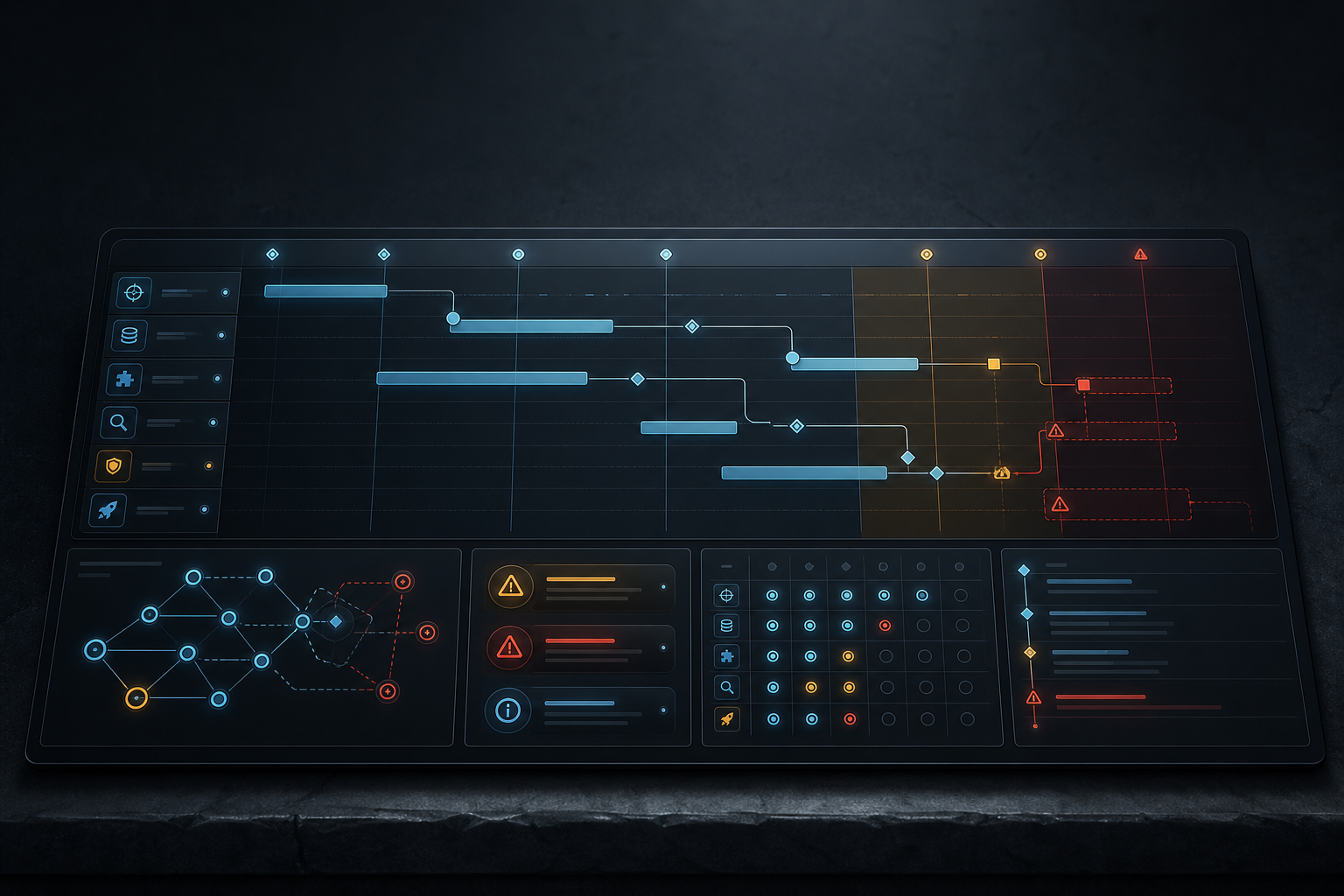
$ audit ai_project_timeline --estimate
> inspect: scope / data / integrations / evaluation / rollout
> score: unknown / draft / reviewable / ready
> output: discovery / prototype / pilot / productionAn AI project timeline is not a calendar guess. It is a dependency map: scope, data access, integrations, evaluation, approval gates, rollout and ownership. If an estimate ignores those dependencies, the number may look attractive, but the project risk is only hidden.
The broad commercial intent belongs to the AI specialist in Armenia landing page. This article is narrower: it gives companies a practical audit matrix for checking whether an AI project estimate is grounded enough before signing with an AI developer, AI studio or contractor.
Scope of the audit
Start by separating the visible feature from the work that makes it production-safe. A demo chatbot, classifier, RAG assistant or AI workflow can be shown quickly. A reliable system needs data review, permission checks, integration contracts, evaluation examples, logging, fallback behavior and handoff.
Review the estimate across six areas:
- business workflow and user roles;
- source data, permissions and cleanup effort;
- model behavior, prompt contract and evaluation cases;
- integrations, write actions and rollback paths;
- approval gates, security boundaries and support owner;
- rollout plan, pilot criteria and maintenance after launch.
The timeline should name assumptions for each area. If an estimate says "three weeks" but does not say whether CRM access is ready, documents are clean, API credentials exist or acceptance criteria are known, it is not an estimate. It is a placeholder.
Maturity criteria
Use a simple 0 to 3 maturity score for each dependency.
| Score | Meaning | Timeline implication |
|---|---|---|
| 0 | Unknown | Do not accept a delivery estimate yet |
| 1 | Draft | Add discovery time and validation gates |
| 2 | Reviewable | Estimate can include a bounded assumption |
| 3 | Ready | Work can move into implementation planning |
The lowest score matters more than the average. A project can have clear business value and still be impossible to schedule if data permissions, write actions or evaluation are unknown.
Typical timeline defects
The most common defect is treating AI work as only model implementation. In real projects, the model is often a smaller part of the schedule than data preparation, integration behavior and review loops.
Watch for these defects:
- the estimate starts at coding without discovery or audit;
- the same timeline is used for read-only AI and write-action automation;
- evaluation is described as "we will test it" without examples and pass criteria;
- integration effort is hidden behind "connect to CRM" or "use API";
- human approval, fallback and audit logs are missing;
- deployment, monitoring and change ownership are outside the estimate;
- the vendor promises a fixed delivery date before seeing data or credentials.
These defects do not always mean the contractor is weak. They often mean the scope is not mature enough for a production estimate. The practical response is to split the next step: discovery first, prototype second, rollout third.
Priority of fixes
Do not try to fix every unknown at once. Prioritize blockers that can invalidate the timeline.
| Blocker | Why it matters | First correction |
|---|---|---|
| No data access | Model behavior cannot be evaluated | Run a data and permission audit |
| Unknown write actions | Business risk is unclear | Separate read-only and write flows |
| No evaluation set | Quality will be argued by opinion | Collect good, bad and edge-case examples |
| Vague integration scope | API work can expand silently | Name systems, endpoints, fields and owners |
| No approval gate | Automation may act without control | Define human review and rollback |
| No owner after launch | The system may decay after demo | Assign logs, support and change process |
After these blockers are visible, ask for a revised estimate that separates discovery, prototype, pilot and production rollout. A serious estimate should show what is included, what is excluded and which assumptions change the date.
Audit matrix
Use the downloadable matrix as the original proof artifact: AI project timeline estimate audit matrix.
The matrix converts schedule review into a repeatable checklist. It helps compare a vendor estimate against dependency maturity instead of judging the number in isolation.
Format of the final report
A useful timeline audit report should be short enough to act on. It should include:
- the current target outcome;
- the delivery phases and their decision gates;
- the dependency maturity score;
- the top timeline risks;
- assumptions that must be validated before production scope;
- recommended next step: discovery, audit, prototype, pilot or rollout.
For example, a two-week prototype may be reasonable if it is read-only, uses a small approved dataset and has manual review. The same two weeks may be unrealistic if it includes CRM writes, multilingual inputs, role-based permissions, production monitoring and client-facing availability.
What to do after the audit
If the estimate has critical unknowns, do not negotiate the date first. Reduce the scope to an audit or discovery milestone. If the estimate is mostly reviewable, ask for a delivery plan with explicit assumptions and acceptance criteria.
For broader service context, use the AI specialist in Armenia page. For proof, review the case studies. For nearby procurement checks, compare 25 questions before starting an AI project, red flags when choosing an AI contractor and the AI project brief template.
Checked and updated
Checked on 2026-07-11 against the aicoding.am content plan, current service pages, public case-study layer and the local procurement article cluster. The article avoids ranking claims and keeps broad local AI intent with the dedicated landing page.
Where This Applies
AI timeline audit, vendor review and first production-safe delivery plan
This article is useful when a company in Armenia needs to check an AI project estimate before committing to AI automation, RAG, agent, LLM workflow or internal tool delivery.
- Founders checking whether an attractive delivery date hides missing discovery.
- Operations teams mapping data access, integrations, evaluation and rollout blockers.
- Companies that need an audit matrix before accepting a production AI timeline.
timeline_risk = hidden_scope
  + data_access_unknown
  + integration_uncertainty
  + missing_evaluation
  + no_rollout_gate;
if (score.data == 0 || score.write_actions == 0) require("discovery_first");
if (score.evaluation <= 1) require("evaluation_set");