AI Support Ticket Routing: Controlled Triage and Escalation
Use a bounded proposal to assist triage, not an unreviewed decision about a customer request
Event contracts, policy gates, named ownership and verified queue assignment
Original ROUTE-7 operating model with acceptance criteria for a controlled pilot
AI support ticket routing, AI customer support automation, support triage, help desk routing, human review, escalation policy and verified queue assignment
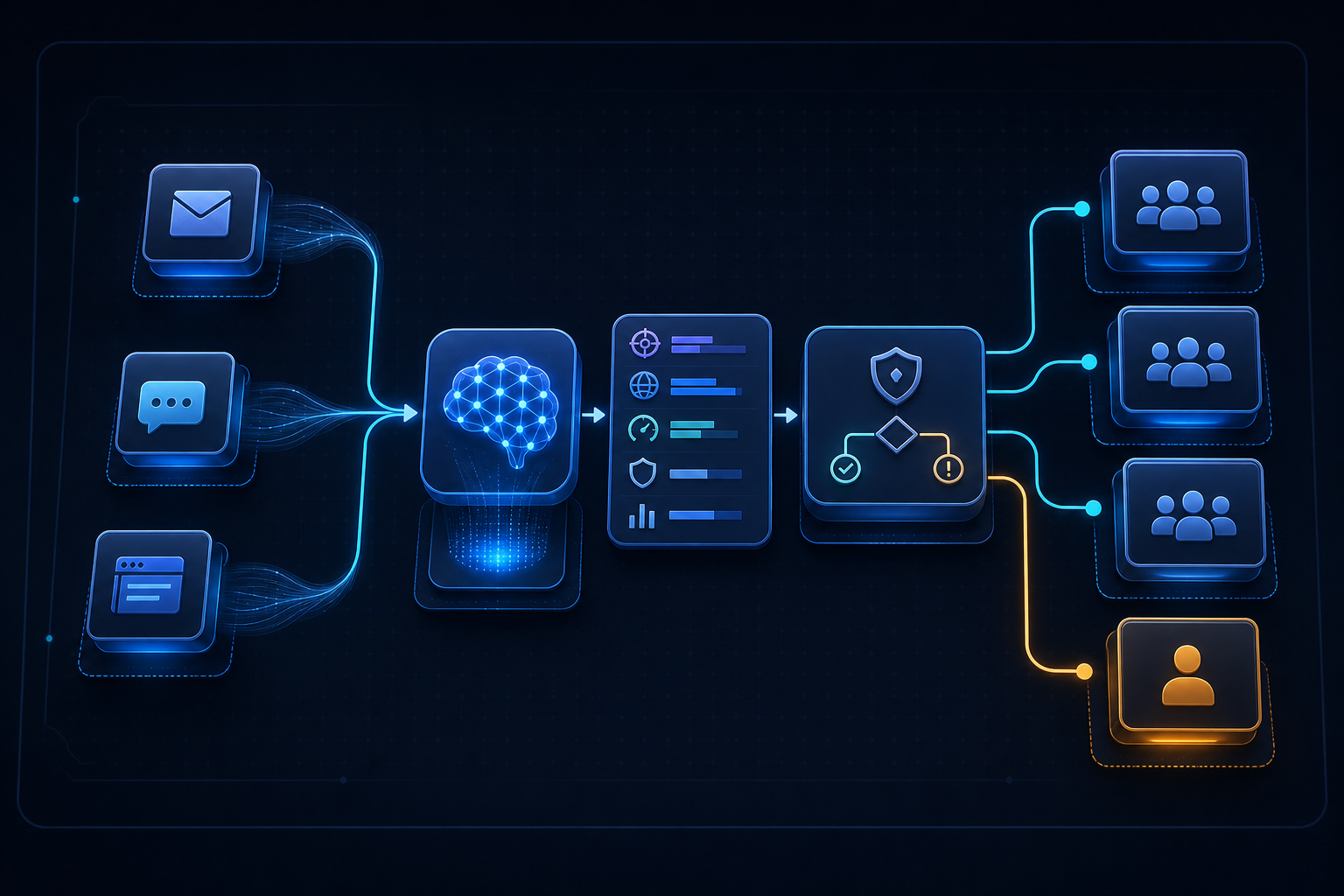
$ route support --contract ROUTE-7
> accept: event / channel / timestamp
> minimize: allowed context / redaction
> classify: intent / language / evidence
> validate: schema / queue / policy
> gate: review / escalation / owner
> assign: idempotent route / read-back
AI support-ticket routing is useful when it helps a team make a queue easier to inspect, not when it silently decides what happens to a customer. The practical goal is narrow: accept one identifiable request, propose a category and destination from permitted context, apply deterministic rules, and give an operator a clear escalation path when the system is uncertain.
This is a long-tail implementation guide, not a promise that an AI system can replace a support team. For the broader delivery scope, start with the AI specialist Armenia page. The implementation work belongs in AI automation; the case-studies hub remains the separate proof surface.
1. Route a support event, not unbounded conversation history
The first contract is the input event. A model should receive a stable ticket ID, a channel message or approved summary, a language state, available queue candidates, and the policy version that applies. It does not need unrestricted access to every customer note, every internal document, or unrelated conversations.
Define the routing question before selecting a model:
- Which queue is allowed to receive this request?
- Which labels are useful to an operator: issue family, product area, language, urgency band, or required skill?
- Which facts are evidence and which are only a model interpretation?
- Which requests must bypass model routing: security incidents, legal requests, payment disputes, safety-related signals, VIP handling, or explicit human requests?
- Who owns the exception when the classification is incomplete, contradictory, or below the confidence policy?
A useful event contains source data and routing limits, rather than an instruction to “understand the customer.” For example:
{
  "ticketId": "support-2026-08-07-042",
  "channel": "web_chat",
  "language": "ru",
  "message": "I cannot access the account after changing my password",
  "allowedQueues": ["access", "billing", "general"],
  "policyVersion": "ROUTE-7",
  "sourceTimestamp": "2026-08-07T09:14:00Z"
}
The model should return a proposal, never an irreversible action:
{
  "ticketId": "support-2026-08-07-042",
  "proposedQueue": "access",
  "intent": "account_access",
  "language": "ru",
  "confidenceBand": "review_required",
  "evidence": ["cannot access account", "after changing password"],
  "route": "human_review",
  "policyVersion": "ROUTE-7"
}
The distinction matters. The first object preserves what arrived; the second records a bounded interpretation that can be accepted, corrected, or rejected.
2. Use a ROUTE-7 workflow with deterministic boundaries
A controlled routing design separates probabilistic interpretation from routing authority. One practical ROUTE-7 sequence is:
- Accept the source event with a stable ID, channel, timestamp, and retention boundary.
- Minimize the context: redact fields the classifier does not need and preserve the original message separately.
- Classify only the agreed label set and require evidence snippets plus an uncertainty state.
- Validate schema, permitted queues, mandatory labels, language state, and policy exclusions without asking the model to judge them.
- Gate low-confidence, conflicting, sensitive, and high-impact requests to a named human queue.
- Assign an approved route idempotently, with the policy and model/prompt version recorded.
- Reconcile the destination-system read-back with operator corrections and a recovery path.
This sequence prevents a common failure: treating an apparently plausible label as an authority to close, deprioritize, disclose, or abandon a customer issue. Routing may change response ownership, but it should not hide the source request or remove the team’s ability to correct it.
The model can be helpful at the classification step. It can identify a likely issue family, summarize a long message for a support agent, detect the declared language, and flag ambiguity. It should not invent account state, infer a customer’s identity from weak clues, decide whether a charge is valid, or suppress an escalation simply because a short message resembles a known category.
3. Make integration contracts explicit
Support routing crosses several systems: an inbox or help desk, a customer/account source, a queue or CRM, policy/configuration storage, and observability. Give each system a narrow responsibility.
| Component | Owns | Must return |
|---|---|---|
| Intake | original event and channel receipt | stable ticket ID and source timestamp |
| Context builder | allowed, redacted classifier packet | source references and expiry |
| AI classifier | bounded routing proposal | schema-valid labels, evidence, uncertainty |
| Policy gate | deterministic eligibility | route, review, or reject decision |
| Queue/CRM | assignment and ownership | idempotent write and read-back |
| Operations | correction and recovery | named owner and reconciliation record |
Use an idempotency key based on the ticket ID and routing-policy version. A retry after a timeout must not send the same ticket to several queues or overwrite a later human correction. Keep the original source event, proposed route, deterministic decision, final queue, operator adjustment, and destination receipt as separate records. A successful workflow execution is not proof that the intended team received the ticket.
The policy gate should reject or route to review when:
- the ticket ID, source timestamp, or allowed-queue list is missing;
- the response has an unknown label or a queue outside the policy;
- the message contains a configured sensitive or high-impact pattern;
- confidence is below the approved threshold or evidence is absent;
- a prior owner has already made a newer decision;
- language is undetected when language-specific support is required;
- the destination write cannot be read back authoritatively.
For related CRM boundaries, see AI CRM enrichment and AI lead qualification. Those articles use the same principle: a model recommendation does not replace source evidence, policy, ownership, or a verified write.
4. Test disagreement, ambiguity, and recovery before launch
Do not evaluate routing only with clean, single-topic tickets. Build a representative acceptance set with the actual languages, channels, product names, abbreviations, and messy phrasing that the team sees. Include negative cases deliberately:
- one message containing two unrelated issues;
- a request that belongs to no configured queue;
- a ticket whose category is obvious but urgency is not;
- a multilingual message or language-switch inside one conversation;
- a customer asking for a human operator;
- duplicate delivery from a webhook retry;
- an existing assignment that is newer than the proposal;
- an unavailable queue or destination API timeout;
- an escalation keyword combined with a benign-looking request;
- a classifier response that is valid JSON but has an unsupported label.
The acceptance criteria should be observable rather than a claimed percentage of “accurate AI”:
- Every assignment references a stable source event and policy version.
- The system preserves the original request and does not overwrite an operator correction.
- Unsupported labels, missing evidence, and policy exclusions take a safe review route.
- Retries do not duplicate queue assignment or notifications.
- A human can correct a route without editing hidden model state.
- The queue or CRM read-back either confirms the assignment or creates a visible reconciliation task.
- Sensitive or consequential categories follow their configured manual path even when the classifier is confident.
Review false routes with the support owner by failure class, not only as a total score. A wrong product-area label may be repairable; an incorrect security or payment route may require a separate policy. This gives the team a basis for changing the label taxonomy, routing conditions, examples, or escalation rules without claiming the model is universally reliable.
5. Operate with quality signals, not vanity metrics
The signals worth keeping are operational: tickets sent to review, operator corrections by queue, unknown-label rates, repeated reroutes, duplicate-event prevention, age of the oldest unassigned request, destination-write failures, reconciliation duration, and policy blocks by reason. These signals show where the contract is weak. They do not by themselves prove customer satisfaction, resolution quality, or business impact.
Set an owner for the routing taxonomy and another for incident response. Version queue definitions and policies. When a queue changes ownership, update the deterministic mapping first; do not expect the model to discover an organizational change from text. Give operators a simple pause switch so that a channel can fall back to a general review queue while an issue is investigated.
ROUTE-7 acceptance gate
require(event.id && event.sourceTimestamp && policy.version);
require(proposal.schemaValid && proposal.evidence.length && queue.isAllowed);
assign = policy.permits && !review.required && destination.readBack;
This gate does not promise faster answers or fewer tickets. It confirms that a routing proposal meets the project’s input, policy, ownership, and destination-evidence conditions before an assignment becomes authoritative.
A controlled first pilot
Start with one low-risk channel, a small stable queue taxonomy, one named support owner, and a review-first route. Run a representative set that includes normal and uncomfortable cases. Compare the proposed route with the operator’s final route, record why corrections occur, and verify the help-desk read-back. Only after the team understands those disagreements should it consider automatically assigning a narrowly bounded subset of tickets.
That keeps AI support-ticket routing where it is most useful: reducing repetitive triage while retaining explicit ownership, evidence, and an understandable path for exceptions. To scope a controlled workflow, discuss an AI automation pilot.
require(event.id && event.sourceTimestamp && policy.version);
require(proposal.schemaValid && proposal.evidence.length && queue.isAllowed);
assign = policy.permits && !review.required && destination.readBack;