n8n, Make or Zapier: What to Choose for Business Automation
One decision method instead of a universal product ranking
Speed, engineering control, lifecycle, TCO, compliance and team fit
Original SELECT-6 weighted matrix with three selection scenarios
n8n vs Make vs Zapier: common criteria, strengths, trade-offs, TCO and a bounded pilot
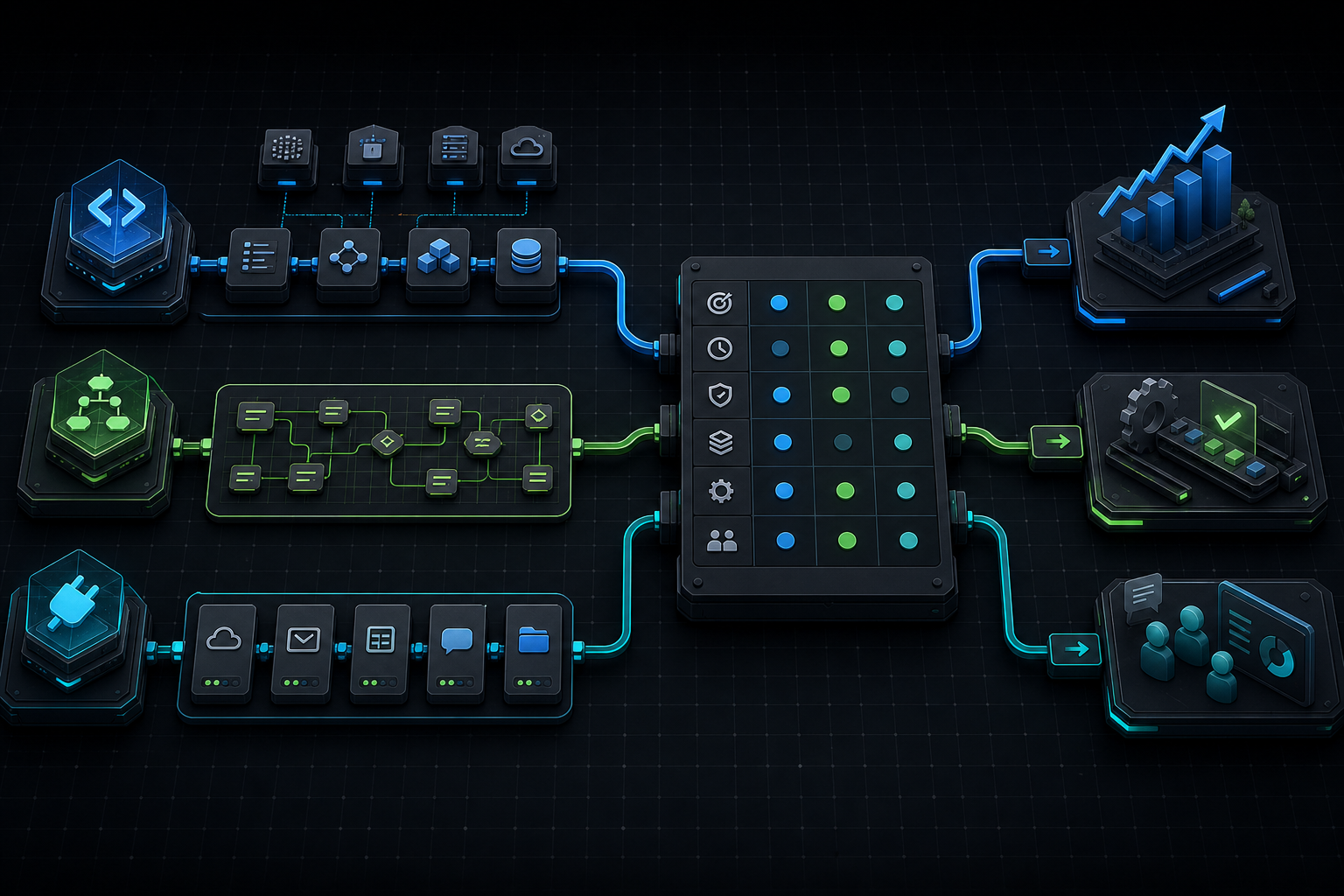
$ compare automation --matrix SELECT-6
> criteria: speed / control / lifecycle
> economics: executions / credits / tasks
> scenarios: technical / operations / SaaS
> decision: weighted evidence + bounded pilotWhat are we actually comparing?
The question “n8n, Make or Zapier?” sounds like a product ranking, but a useful answer starts with the operating model. All three platforms can connect applications, receive events, transform data and trigger actions. The important differences appear after the first successful demo: who can understand the workflow, how usage grows, where data and credentials live, how failures are repaired, and whether the team can hand the automation over without losing control.
This article answers a narrow commercial-investigation query: how should a company choose among n8n, Make and Zapier for a specific automation portfolio? It supports the broader AI automation service and AI specialist in Armenia pages without replacing their commercial intent.
The comparison was reviewed against official product documentation and pricing pages available in July 2026. Features, limits and billing can change, so confirm the current plan before procurement. The recommendation below avoids a universal winner and uses an original weighted matrix instead.
Before scoring tools, write one page that states:
- the events, monthly volume and peak concurrency;
- the applications, APIs and private systems involved;
- the number and technical level of workflow owners;
- the required development, review and production environments;
- data residency, credential and audit requirements;
- acceptable recovery time after a failed run;
- the expected life of the automation;
- the cost of one duplicate, missed or incorrect business action.
Without this baseline, a large integration catalog or an attractive canvas can dominate the decision while the real operating cost remains invisible.
SELECT-6: one set of criteria
SELECT-6 is the decision method created for this article. Score every platform from 1 to 5 against six criteria, multiply by scenario-specific weights, then run the same pilot on the two leading candidates.
| Criterion | What evidence to inspect | Procurement question |
|---|---|---|
| S — Speed to value | Native connector, mapping effort, first accepted run | Can the process owner build or review the first version? |
| E — Engineering control | Code, HTTP, data model, hosting and extensibility | Can the team express non-standard contracts without fragile workarounds? |
| L — Lifecycle operations | History, errors, replay, alerting, versioning | Can an operator diagnose and repair a partial failure? |
| E — Economics at volume | Billing unit, fan-out, polling and AI usage | What does one accepted business outcome cost at expected volume? |
| C — Compliance and control | Hosting, residency, roles, secrets and audit | Do data and access controls match policy? |
| T — Team fit | Builder skill, reviewer skill, handover and support | Who owns changes six months after launch? |
The score is not a market fact. It is a documented decision for one portfolio. A weight of 30 for lifecycle operations means a failed workflow is materially expensive; it does not mean that operations are universally “30% important.”
Use this calculation:
type Score = 1 | 2 | 3 | 4 | 5;

const weightedScore = (
  weights: Record<string, number>,
  scores: Record<string, Score>,
) =>
  Object.entries(weights).reduce(
    (total, [criterion, weight]) => total + weight * scores[criterion],
    0,
  ) / 5;
Weights must total 100. Keep the raw evidence beside every score. If two candidates finish within five points, treat the result as a tie and decide with a pilot, not with more spreadsheet precision.
Strengths and trade-offs
n8n
n8n is strongest when the automation is treated as an engineering system. Official materials describe cloud and self-hosted options, code steps, custom API requests, webhooks, API/CLI control and custom nodes in self-hosted deployments. Its cloud pricing is based on complete workflow executions rather than each step; the official pricing page also lists a self-hosted Community Edition.
This shape fits teams that need private-network access, custom data contracts, controlled hosting or complex workflows with many internal steps. The related production n8n architecture guide explains item semantics, idempotency, recovery and retention in detail.
The trade-off is ownership. Self-hosting creates infrastructure work: upgrades, database and queue operations, encryption keys, backups, security hardening and incident response. A flexible canvas also permits inconsistent workflow design unless the team enforces schemas, reusable boundaries, review and release discipline. Advanced governance features may belong to commercial plans, so “self-hosted” must not be interpreted as “every enterprise feature is free.”
Choose n8n because the team needs engineering control and accepts operational responsibility—not because a developer can build a clever demo.
Make
Make is strong when visually mapping bundles, routers, filters and multi-step data transformations helps an operations or automation team understand the process. Its documentation defines a scenario as the workflow and modules as its steps. Error routes, incomplete executions and handlers such as retry, resume and rollback provide explicit recovery concepts that can be inspected on the canvas.
Make’s current usage model is credit-based. Official documentation states that a non-AI module run generally maps to one operation and one credit, while AI and advanced modules can use different credit amounts. This makes bundle fan-out, polling and repeated modules important in TCO estimation.
The trade-off appears when scenarios grow into dense visual programs. Routers, iterators, aggregators, error branches and repeated mappings can be readable locally yet difficult to review as one system. Recovery semantics also depend on the target application: a platform rollback cannot undo an external side effect unless that integration supports the required transaction or compensation.
Choose Make when visual transformation and operator comprehension dominate, and prove the cost and repair path with realistic bundle counts.
Zapier
Zapier is strong when a business team needs to connect common SaaS applications quickly through familiar trigger-and-action patterns. Its official documentation describes a large integration catalog, Paths for conditional routing, webhooks, code steps, replay and Autoreplay on eligible plans. That can shorten time to value for standardized departmental automations.
Zapier measures usage in tasks. Current official material explains that successful action steps generally consume tasks, while several built-in tools—including Filters and Paths—do not. AI model tiers and some programmatic actions can have different task rates. Therefore, count the actual action path per event rather than only the number of Zaps.
The trade-off is that a fast SaaS connection can become costly or constrained when each event fans out into many paid actions, requires deep custom protocol handling, or must reach private infrastructure. Replay improves recovery from failed steps, but idempotency still belongs to the workflow and target systems; repeating a step is unsafe if the previous result is ambiguous.
Choose Zapier when connector coverage, onboarding speed and business-user ownership are more valuable than infrastructure control.
TCO: calculate outcomes, not plan prices
Do not compare the smallest advertised monthly prices. Estimate the monthly cost of accepted outcomes:
monthly TCO =
  platform subscription and overage
  + external AI/API usage
  + hosting and backups
  + build and review time
  + monitoring and incident response
  + expected failure loss
  + migration and handover reserve
Use at least four workload fixtures:
- a normal event with the typical action path;
- a fan-out event with realistic bundle or item count;
- a temporary API failure that triggers retry or replay;
- an ambiguous write requiring read-back or operator reconciliation.
For n8n Cloud, model complete workflow executions; for Make, model credits generated by module runs and bundles; for Zapier, model the successful action tasks on the routes that actually run. For self-hosted n8n, add infrastructure and ownership even if the software edition has no subscription fee.
The correct denominator is not “runs.” Use cost / accepted business outcomes. A cheap run that creates duplicate CRM records or requires manual cleanup is not a cheap automation.
Official evidence reviewed
Use vendor documentation as a changeable input, not as a permanent promise. For this July 2026 review, the key primary sources were the n8n pricing and execution model, n8n source-control and environments guide, Make pricing, Make credit model, Make error handling, Zapier task rates, Zapier Paths and Zapier replay behavior.
Record the access date and the exact plan considered in the decision file. Do not copy a feature from an Enterprise column into a Community, Free or team-plan assumption. If a required control is unclear, validate it in a trial or obtain a written vendor answer before scoring.
Three selection scenarios
The following matrix is an original example, not a vendor benchmark. Scores show how the same products may rank differently when weights change.
Scenario A: technical team, private systems, complex workflow
Weights: speed 10, engineering control 30, lifecycle 20, economics 15, compliance 20, team fit 5.
| Platform | Weighted result / 100 | Why |
|---|---|---|
| n8n | 88 | Self-hosting and extensibility fit private APIs and custom contracts; operations must be owned. |
| Make | 66 | Strong visual orchestration, but private-system and code-heavy requirements need validation. |
| Zapier | 58 | Fast SaaS connectivity does not offset lower infrastructure control in this scenario. |
Route: pilot n8n first. Keep Make as the challenger if the operations team must own daily changes.
Scenario B: operations team, transformation-heavy workflows
Weights: speed 25, engineering control 10, lifecycle 20, economics 15, compliance 10, team fit 20.
| Platform | Weighted result / 100 | Why |
|---|---|---|
| Make | 84 | Visual bundle mapping and explicit error routes fit the owner profile. |
| Zapier | 76 | Faster for standard app actions, but complex transformations may become fragmented. |
| n8n | 70 | Capable, but engineering flexibility is not the leading requirement. |
Route: pilot Make and Zapier with the same fan-out fixture. Compare operator diagnosis time and credits/tasks per accepted outcome.
Scenario C: small SaaS team, standard departmental automation
Weights: speed 35, engineering control 5, lifecycle 15, economics 15, compliance 10, team fit 20.
| Platform | Weighted result / 100 | Why |
|---|---|---|
| Zapier | 87 | Connector coverage and trigger-action onboarding minimize delivery friction. |
| Make | 78 | Strong alternative when transformations and branching grow. |
| n8n | 64 | Additional control is valuable only if the team will use and operate it. |
Route: pilot Zapier first. Re-score if volume, private APIs or custom logic become material.
Failure modes in the selection process
Choosing by connector count
A connector does not prove that the required object, field, trigger or permission is supported. Test the exact action and rate-limit behavior.
Comparing list prices
Execution, credit and task units are different. Convert all candidates to the same event fixtures and accepted outcomes.
Ignoring repair work
A green “success” state may still leave a partial business outcome. Test duplicate delivery, timeout after write, revoked credentials and malformed input.
Treating self-hosting as free control
Self-hosting transfers runtime responsibility. Name the owner for patching, backups, observability and restore tests before giving it a high compliance score.
Letting one builder decide for every operator
The person who creates the workflow may not be the person who handles incidents. Run the pilot with both roles.
Locking the portfolio to one tool
One company can use different tools for different risk classes. Standard SaaS notifications, transformation-heavy operations and private-system workflows do not need one universal runtime. Keep shared conventions for identity, secrets, alerts and ownership across platforms.
Decision matrix and pilot gate
Use this sequence:
- Define three representative workflows and four failure fixtures.
- Set SELECT-6 weights before product demos.
- Score evidence, not feature names.
- Pilot the two leading candidates with production-like volume and non-production targets.
- Measure build time, accepted outcomes, usage units, diagnosis time and repair steps.
- Review security, data handling, credentials, handover and exit path.
- Approve one bounded portfolio slice, not an unlimited platform mandate.
The decision record should contain assumptions, official plan links, raw scores, pilot evidence, rejected options and the date for re-evaluation. Revisit it every six months or after a material pricing, governance or architecture change.
The best result is not “n8n wins,” “Make wins” or “Zapier wins.” It is a tool boundary that the team can explain, operate and replace. The case studies show the kind of production evidence to request. If the weights remain unclear, request an independent architecture review before committing the automation portfolio.
require(weightsTotal === 100 && evidenceByCriterion);
require(twoCandidatesPiloted && failureFixturesTested);
decision = scoreGap > 5 ? leader : compareAcceptedOutcomes();