RAG for Sales: Products, Case Studies and Objections
Prepare inspectable sales answers from approved current evidence
Product sources, case studies, objection boundaries, review gates and CRM evidence receipts
Original SALES-RAG-8 workflow with an input/output example and acceptance criteria
RAG for sales, sales knowledge base, product evidence, case study retrieval, objection handling and SALES-RAG-8
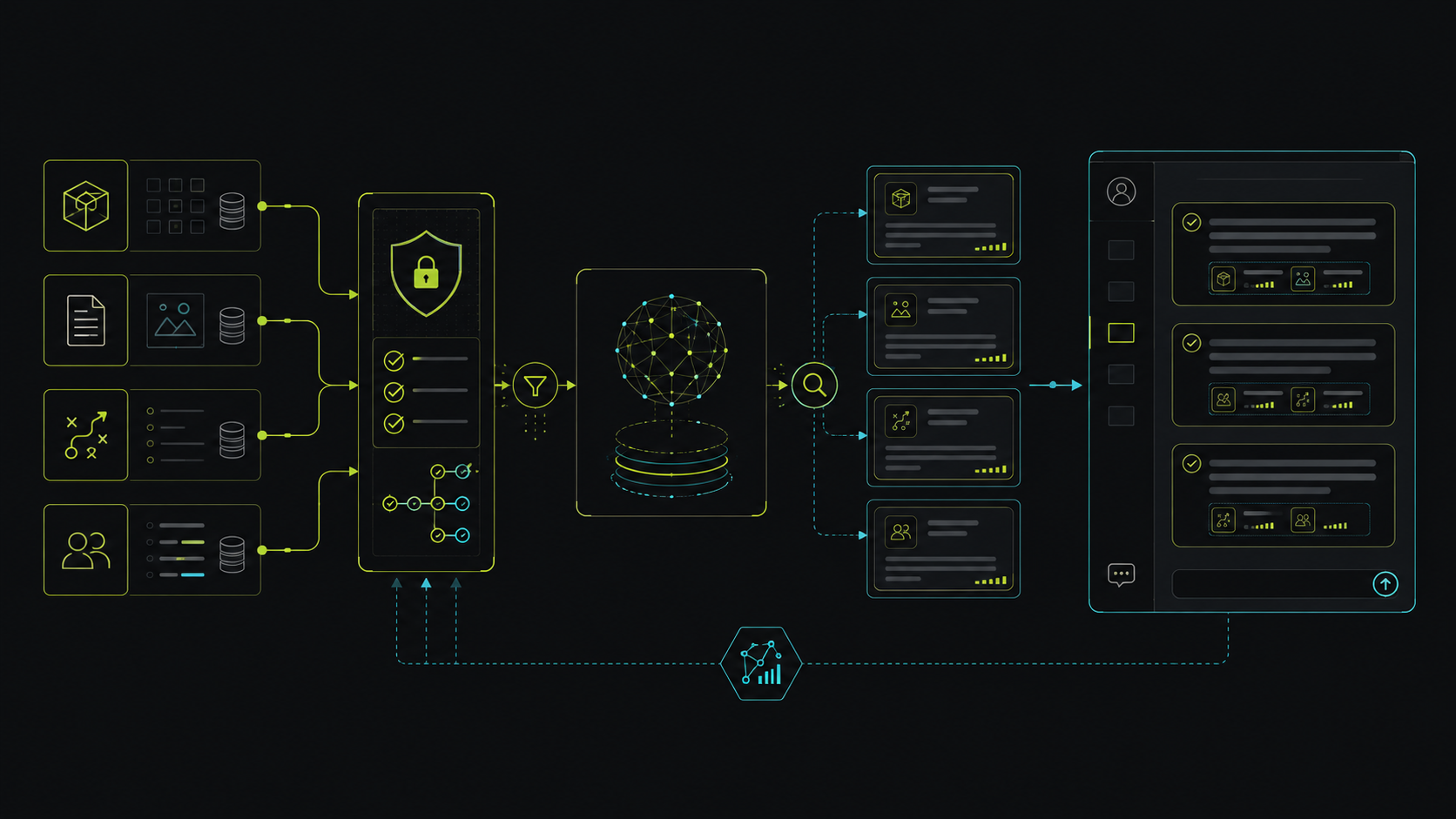
$ sales-rag --contract SALES-RAG-8
> receive: account / product / locale / deal-stage
> filter: approved source / version / entitlement
> retrieve: product / case / objection evidence
> verify: claim coverage / policy / lifecycle
> route: draft / review / no-answer / escalationA sales RAG assistant is useful when it helps a representative find the current approved product detail, relevant case evidence and permitted response to an objection. It is not a system for improvising promises, changing prices, or sending messages on its own. The reliable unit is a cited proposal that a person can inspect, correct and use.
This guide describes SALES-RAG-8: a narrow source-to-answer contract for product questions, case-study lookup and objection preparation. For the broader architecture of a retrieval system, see the RAG systems service. For delivery evidence and project boundaries, see case studies.
Start with the sales decision, not the model
The first question is not “which vector database should we choose?” It is: what decision should become easier and what must remain with the seller? A practical first scope is a draft answer for a named account and product, with source links and an explicit no-answer route.
| Request | Allowed output | Must not be inferred |
|---|---|---|
| Product capability | cited capability and product version | roadmap or unapproved feature |
| Customer proof | approved case excerpt and its scope | performance result for another customer |
| Objection | evidence-backed talking points and open questions | legal, commercial or security commitments |
| Pricing or discount | link to current approved policy | price, discount or contract term |
This boundary avoids a common failure mode: a fluent answer is treated as commercial truth even when the source is stale, out of scope or absent.
SALES-RAG-8: the workflow
The contract has eight stages:
- Receive a request with account, product, locale, deal stage and permitted CRM context.
- Classify whether it is product lookup, proof lookup, objection preparation, commercial question or an escalation.
- Filter the source registry by product, version, market, audience, approval state and entitlement.
- Retrieve passages with source ID, revision, owner and stable locator.
- Compose a short proposal that separates evidence, uncertain points and questions for the owner.
- Verify each material claim, prohibited claim, source lifecycle and citation link.
- Review commercial, legal, security or account-specific statements with an authorised owner.
- Record the approved answer or escalation outcome without automatically sending it to the prospect.
request(account, product, locale, deal_stage)
  -> permitted_context
  -> approved_source_filter
  -> cited_retrieval
  -> bounded_draft
  -> claim_and_policy_gate
  -> reviewer_or_escalation
  -> CRM evidence receipt
The final receipt should store which sources were used, which reviewer approved any exception and which questions remained unresolved. It should not store the model’s text as if it were a source of truth.
Build a source registry before indexing files
Sales materials are often spread across product pages, presentations, call notes, security documents, price lists and case studies. Indexing all of them without ownership creates an attractive but unreliable search layer. Every eligible source needs at least:
- source ID, title, owner and review date;
- product, version, language, market and audience;
- approval state and whether sales reuse is permitted;
- access scope and retention boundary;
- revision, effective dates and replacement relationship;
- stable URL or document locator.
The registry is what lets retrieval exclude an old deck after a product change or keep an internal security note out of a prospect-facing answer. For general version and removal behavior, read RAG index updates, ingestion and removal.
Product answers need evidence packets
A useful answer packet is compact. It contains the customer’s question, the allowed account context, two to five evidence snippets, citations, a drafted answer, uncertainty and a route. The assistant may say “the approved documentation supports X” and link to it. It must say “I could not verify this from approved sources” when evidence is missing.
Example:
INPUT
Account: existing retail customer
Question: Does the product support a Russian-language knowledge base?
Context: evaluation stage; no approved implementation scope

OUTPUT PROPOSAL
Evidence: DOC-144 rev.12, section 4; CASE-019 rev.3, scope note
Draft: “The current product documentation describes Russian-language content
as an indexed source. A multilingual evaluation set is still needed for your
documents and acceptance criteria.”
Route: owner review before any delivery commitment
The proposal does not convert one documented capability into a commitment about quality, timeline or fit for every corpus. A multilingual deployment needs its own evaluation; the multilingual RAG guide explains why language handling is not a checkbox.
Objections should become inspectable questions
An objection is not a prompt to “win the deal.” It is a request to identify the concern, retrieve permitted evidence, name the gap and route the next owner. A security objection may require a security owner. A procurement objection may need current commercial policy. A feature comparison may need a product manager to validate scope.
Use an objection card with four fields:
- Concern: the buyer’s words, without changing their meaning.
- Evidence: current approved facts with locators.
- Boundary: what the evidence does not prove.
- Next action: a named owner, question or permitted follow-up.
This format prevents the assistant from making a competitor comparison, warranty or contractual representation that the source material does not support.
Integration contracts: CRM is context, not proof
CRM data can provide account identity, segment, stage, owner and prior approved activity. It should not silently expand what the retrieval system can reveal or claim. Keep three contracts separate:
- Identity contract: server-trusted account, user role and tenant boundary.
- Knowledge contract: approved source eligibility, revision and citations.
- CRM contract: a draft or reviewed evidence receipt, not an autonomous outbound action.
For a sales-email workflow with human approval and delivery read-back, see AI sales email assistant: personalization without mass spam. That workflow is intentionally separate from retrieval.
Acceptance checks before a pilot
Run a small, representative test set rather than reporting a generic accuracy number. Include known-answer questions, no-answer questions, superseded documents, denied sources, mixed-language queries, wrong-account contexts and objections that require escalation.
| Check | Passing condition |
|---|---|
| Evidence coverage | every material claim has a permitted current locator |
| Product fit | retrieved source matches product and version |
| Access control | denied sources never appear in answer or trace |
| No-answer behavior | missing evidence produces a usable escalation route |
| Objection boundary | commercial, legal and security commitments are routed |
| Review trail | exception reviewer and decision are retained |
Measure failures by type: wrong source, outdated source, missing source, wrong entitlement, unsupported claim or bad route. This makes repairs actionable: fix metadata, remove a source, change a policy gate or add an evaluation case.
What a controlled first pilot looks like
Choose one product line, one sales team and a bounded set of approved documents. Start with draft preparation inside a seller workspace. Do not connect automatic email sending, price calculation or CRM stage changes until source, policy and review evidence are stable.
The pilot deliverables are ordinary engineering artifacts: source registry, access map, retrieval contract, test set, reviewer matrix, failure log, monitoring signals and a rollback path. The desired result is not “AI closes more deals”; it is a reviewable evidence workflow that shows where it helps and where it must stop.
If your team needs to map one sales process into that kind of controlled pilot, prepare a project brief or review the RAG systems service.
require(request.account && request.product && request.locale);
require(evidence.every(isApprovedCurrentAndPermitted));
require(answer.claims.every(hasMatchingLocator));
require(testSet.knownAnswer && testSet.noAnswer && testSet.denied && testSet.superseded);

if (!evidence.supportsAnswer) route = "no-answer-or-escalation";
if (request.isCommercial || request.isLegal || request.isSecurity) route = "authorised-review";
if (request.isOutboundAction) route = "separate-approved-workflow";