When Does a Business Actually Need an AI Agent?
Choose autonomy only when the task requires it
Business outcome, alternatives, risk gates and pilot sequence
Original TASK-GATE-7 decision tree and pilot priority matrix
When a business needs an AI agent, workflow or answer assistant
$ decide --contract TASK-GATE-7
> bind: task / owner / acceptance
> compare: answer / workflow / adaptive investigation
> gate: scope / budget / review / recovery
> route: simple solution / bounded pilot / holdAn AI agent is justified when a business process needs an adaptive sequence of permitted actions: the next step depends on an observation, and the result can be checked. A request for “an agent” is not yet a problem statement. Write down the user, trigger, current process, accepted outcome, decision owner and cost of a wrong action first.
If the task is to answer from approved documents, a searchable assistant may be enough. If the steps and approvals are stable, a deterministic workflow is usually easier to inspect. If neither can handle meaningful variation without a forest of brittle branches, a bounded agent pilot may be appropriate. For the broader choice between formats, see AI agent versus chatbot. For implementation scope in Armenia, see AI specialist Armenia.
Define the outcome before the architecture
Consider an operations team receiving supplier requests. “Automate supplier work” is too broad. A testable task is: read an authorized incoming request, identify missing fields, inspect current permitted catalogue and policy, draft a recommendation with source links, then hand the decision to an owner. A completed outcome is an accepted draft or an explicit exception. A model response alone is not proof that a supplier record was changed or approved.
Record the baseline process before a pilot: where requests arrive, how many decision types exist, which sources are authoritative, which systems may be read or written, and who resolves ambiguous cases. These are discovery inputs, not claimed customer measurements. The acceptance set should contain normal, missing-data, contradictory-source, denied-access and timeout cases.
Available solution shapes
| Shape | Suitable task | Completion evidence | Typical limit |
|---|---|---|---|
| Search or assistant | Find and explain current policy | Answer with permitted source and revision | Does not execute the process |
| Deterministic workflow | Follow known steps and approval rules | State transition and destination read-back | New exceptions require designed branches |
| Bounded agent | Select the next permitted investigation step from observations | Trace of tools, state, decision and checked outcome | Needs stronger gates, budgets and recovery |
| Human-led process | High consequence or poorly defined decision | Named reviewer and decision record | More manual effort, often appropriate initially |
The interface does not decide the category. An agent may appear as a chat window, while a workflow may use a model to classify a field. Prompt engineering helps shape model outputs; AI automation covers integration and process control. Neither removes the need for application-side authorization.
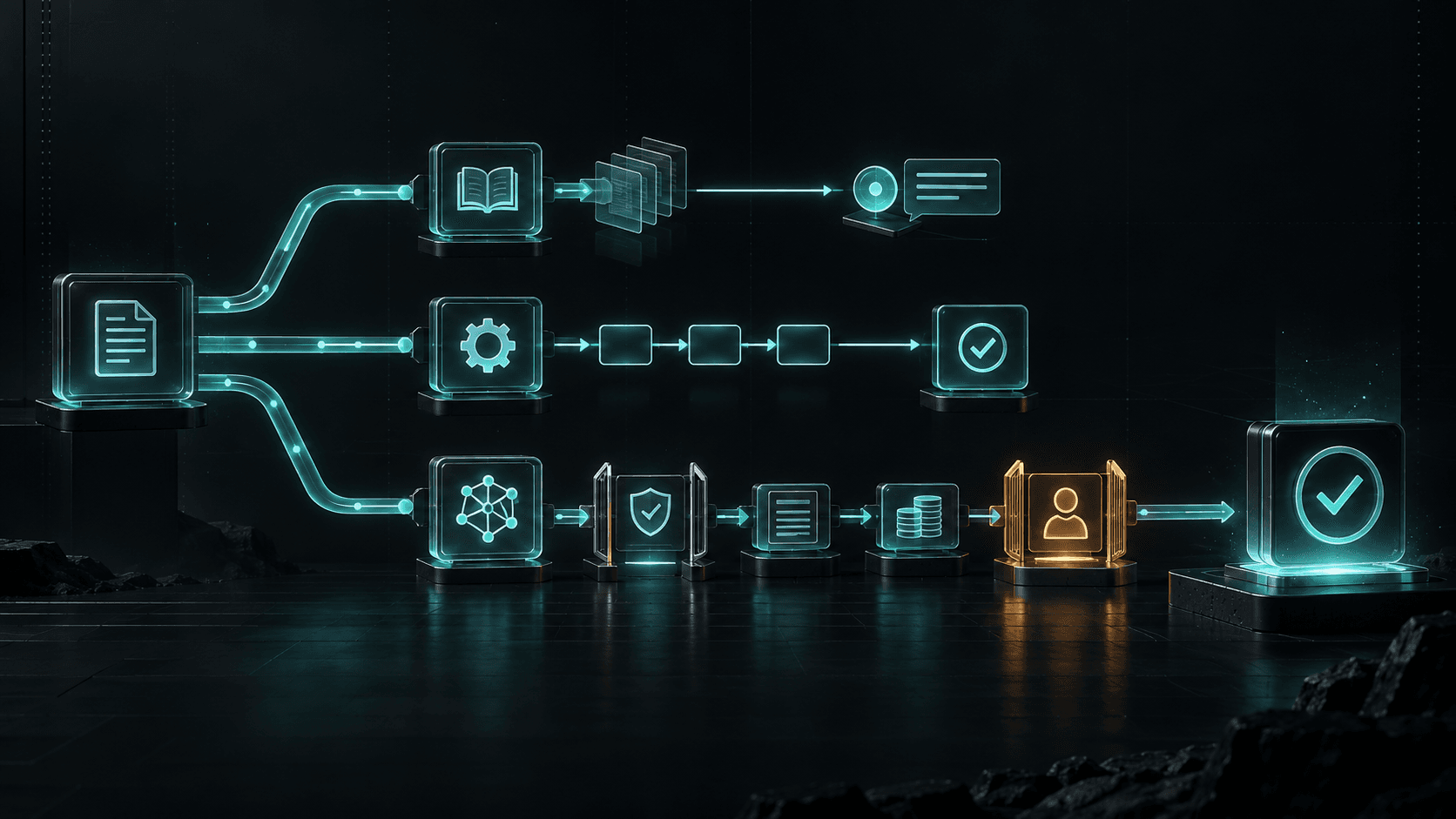
Original decision tree: TASK-GATE-7
This is an editorial decision procedure for discovery, not a benchmark or a claim of customer performance. Apply the gates in order. A failed hard gate means redesign or human handling before any scoring.
1. Is the accepted outcome defined with an owner and evidence?
   no  -> map the process and collect representative cases.
2. Does the task require a change outside the conversation?
   no  -> test a search or answer assistant.
3. Are transitions, validation and approvals known in advance?
   yes -> build a deterministic workflow; add a model only for bounded extraction.
4. Does the next investigation step depend on changing observations?
   no  -> simplify the workflow or keep a human decision.
5. Can tools be scoped, state persisted, cost bounded and actions recovered?
   no  -> human-led pilot or redesign; do not grant open tool access.
6. Can a reviewer inspect receipts and stop consequential actions?
   no  -> add review and recovery gates before piloting.
7. Pilot a bounded agent on representative cases; expand only after acceptance.
The tree intentionally stops before tool access if an outcome or owner is missing. It also permits a human-led answer. The useful question is whether adaptive tool selection adds enough value over a simpler process to justify its extra control surface.
Priority matrix for a pilot
Use the matrix to plan work, not to award points to an architecture. Each row is a discovery question. “Required” blocks deployment until evidenced; “measure in pilot” needs a declared baseline and sample; “later” can wait without hiding a safety dependency.
| Workstream | Priority | Evidence to collect | Decision if absent |
|---|---|---|---|
| Outcome and owner | Required | Accepted-result definition, reviewer, exception path | Hold architecture choice |
| Access and policy | Required | Tool scope, data rights, approval boundaries | No external actions |
| Source quality | Required | Current versions, provenance, conflicting-source cases | Clarify or return no answer |
| Adaptive benefit | Measure in pilot | Cases a fixed workflow cannot handle cleanly | Prefer workflow if benefit is absent |
| Ownership cost | Measure in pilot | Model and tool usage, human review, incidents, maintenance | Compare cost per accepted result |
| Interface polish | Later | User feedback after safe process works | Do not make it a release gate |
For each representative case, record expected route, permitted tools, actual tool receipt, reviewer decision and verified outcome. Compare the agent with the current process and a workflow baseline on the same cases. Do not infer a return on investment from a synthetic matrix.
Risk and limits
An agent can compound small errors across steps. A wrong source may lead to a wrong tool choice; an ambiguous API timeout may lead to a duplicate write. Keep read tools distinct from draft and write tools. Validate typed arguments server-side, use least privilege and idempotency keys where writes are permitted, check destination state after uncertain responses, and keep a human approval boundary for consequential actions.
Set a maximum number of steps, time budget and explicit stop reasons. Store a minimal receipt with task ID, relevant versions, tool calls, reason codes and result; avoid copying secrets or entire private documents into logs. Test denied access, stale source, unavailable tool and budget exhaustion. A safe partial report is an acceptable outcome when the system cannot establish the answer.
Recommended rollout
- Discovery: select one process, name its owner, define accepted results and failure cases.
- Baseline: test manual handling and the simplest search or workflow alternative on the same examples.
- Contract: specify allowed tools, data scope, state, approval and recovery.
- Read-only pilot: let the agent investigate and draft, then have a reviewer compare evidence with the baseline.
- Controlled action: permit one narrow reversible action only after the read-only route is accepted; verify destination read-back.
- Operate: review exceptions, cost per accepted result, source changes and rollback procedures before expanding scope.
If the process is still unclear, a short discovery audit is the useful next purchase. Ask for a bounded recommendation with task examples, decision tree, tool inventory, risk owner and pilot acceptance criteria. The article supports that discussion; it does not replace the service scope on AI specialist Armenia.
require(task.owner && task.acceptedOutcome);
if (!task.externalAction) route = "assistant";
else if (task.stepsKnown) route = "workflow";
else if (tools.scoped && state.durable && budget.bounded && reviewer.assigned) route = "agent-pilot";
else route = "hold-for-discovery";
// Writes require separate permission and verified read-back.