AI Complaint Escalation: Detect Risk Without Letting AI Make the Final Decision
AI prepares inspectable risk evidence while policy and people retain escalation authority
Source contracts, deterministic review gates, recovery paths and verified case read-back
Original ESCALATE-7 workflow with production acceptance criteria
AI complaint escalation, customer complaint risk detection, human review, support policy, CRM case workflow, evidence packet and controlled AI automation
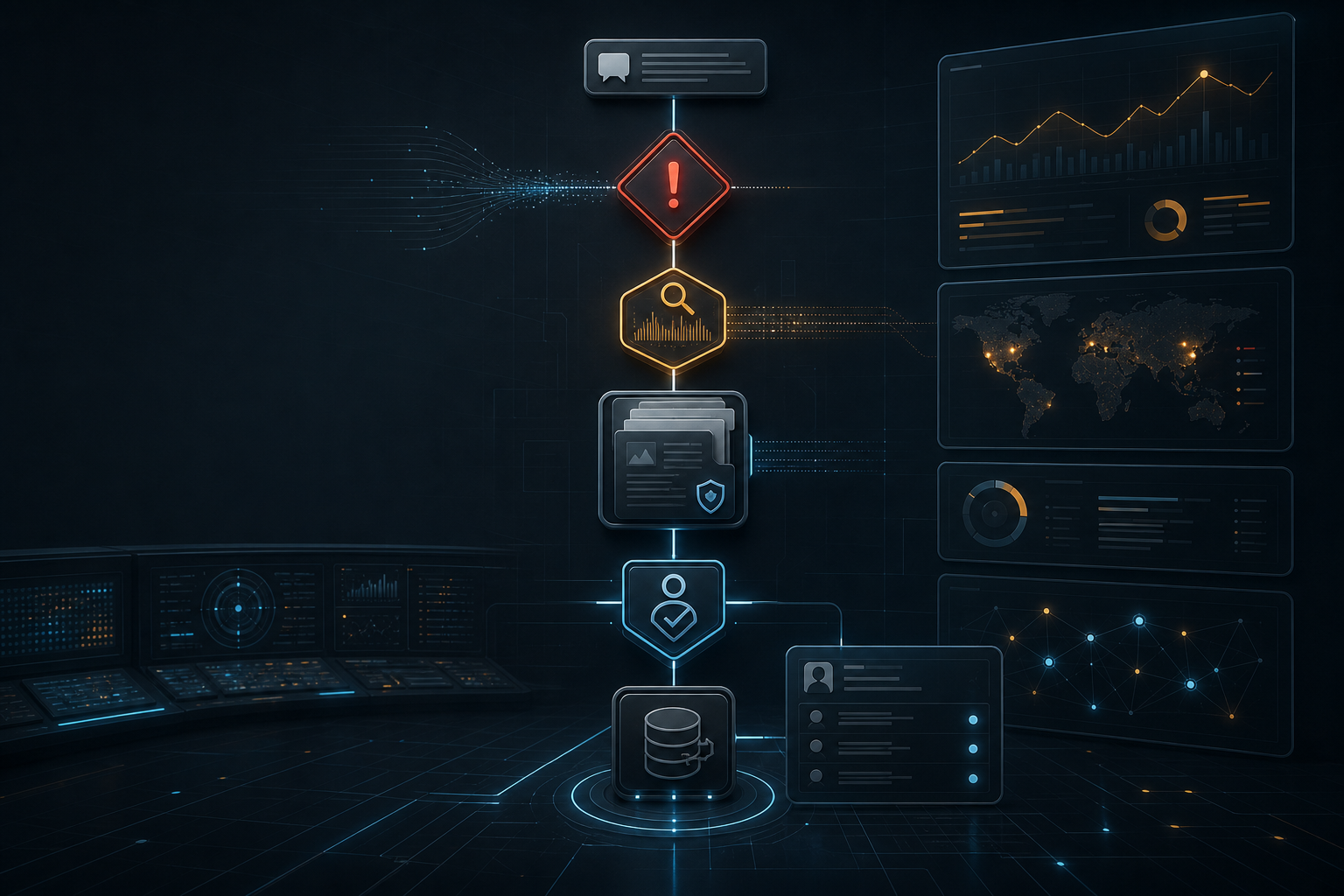
$ escalate complaint --contract ESCALATE-7
> receive: event / receipt / source version
> extract: indicators / evidence / uncertainty
> gate: policy / reviewer / deadline
> decide: authority / rationale / expiry
> commit: idempotent case / read-back / recoveryCustomer complaints are a high-value support signal, but they are also a poor place for autonomous action. A message can express frustration, a legal allegation, a safety concern, a refund request, a threat to leave, or simply a request that is missing context. AI can help find patterns and assemble evidence; it cannot establish the organisation's obligation, promise a remedy, or decide the final escalation on its own.
This guide answers the narrow technical question of AI complaint escalation. It does not replace the broad AI specialist Armenia landing page. For an implementation scope, see AI automation; public delivery evidence belongs in the case-studies hub.
1. Define escalation as a controlled decision, not a sentiment score
The unsafe shortcut is negative sentiment -> urgent ticket. Complaints vary in severity, evidence and consequence. A customer may use strong language about a minor delivery delay, while a calm message may contain a credible safety, privacy or payment problem. A useful system therefore separates three questions:
- what the source message actually says and which records support that reading;
- which risk indicators are present under a versioned taxonomy;
- which authorised person or deterministic policy chooses the next action.
Start with an immutable intake record: tenant, channel receipt, source message reference, event time, conversation version and applicable policy version. Preserve the original language and attachment references. A summarised prompt is not the source of truth, and a later edited CRM note must not silently replace it.
{
  "eventId": "evt-2026-08-10-0049",
  "tenantId": "workspace-42",
  "conversationVersion": 18,
  "sourceRef": "sealed://message/9914",
  "riskPolicyVersion": "ESCALATE-7",
  "delivery": "received",
  "decisionState": "evidence_pending"
}
The classification model should return a bounded proposal, not an instruction. It can name detected signals, quote or point to small evidence spans, identify missing context and choose a review band. It must not emit a final legal, financial, safety or customer-facing decision.
2. Build the ESCALATE-7 path around explicit authority
ESCALATE-7 is a reference workflow for turning a complaint into an inspectable review packet. It is provider-neutral: email, chat, voice transcription and social messages need adapters, but the decision contract should stay stable.
- Receive a signed or otherwise verified source event and retain its receipt.
- Deduplicate by tenant, external event ID and operation so retries do not create parallel escalations.
- Resolve context only from allow-listed conversation, order, account and prior-case fields.
- Extract evidence into a typed proposal: topic, indicators, quotations or source offsets, uncertainty and blocked data.
- Apply policy for category, account state, timing, customer request, contractual rule and required reviewer role.
- Route review to the named owner with a deadline and a non-AI fallback path.
- Record the decision with rationale, authority, current source version and resulting command.
The model has authority only over its declared output shape. The policy service determines whether a complaint must be reviewed and which queue is eligible. The reviewer determines the final disposition when rules require judgment. The destination system remains authoritative for whether an escalation, case, refund hold or customer response actually exists.
| Boundary | Must be retained | Must not be inferred as fact |
|---|---|---|
| Source adapter | provider receipt, channel ID, timestamp | that delivery means the complaint is valid |
| Context builder | allow-listed references and redaction state | missing order, customer or contract details |
| AI proposal | indicators, evidence, uncertainty, schema version | a final remedy or binding priority |
| Policy gate | rule version, route, reviewer requirement | an exception to a mandatory rule |
| Reviewer | decision, reason, authority, expiry | that stale evidence still applies |
| Destination | idempotency key and read-back | that a requested write completed after timeout |
For initial intake routing, pair this with AI support ticket routing. When a complaint touches CRM records, AI CRM enrichment explains why source hierarchy and read-back matter.
3. Give the model a bounded evidence task
Pass only the information needed to prepare a review packet: the permitted message text or redacted transcription, language state, current open-case flag, order or service reference where allowed, and the policy taxonomy. Do not provide credentials, unrelated account history, hidden notes, or a broad customer profile just to make the response sound confident.
type EscalationProposal = {
  eventId: string;
  indicators: Array<"safety" | "privacy" | "payment" | "service_failure" | "threat" | "unknown">;
  evidence: Array<{ sourceRef: string; excerpt: string }>;
  uncertainty: Array<"identity" | "missing_context" | "language" | "policy">;
  reviewBand: "mandatory" | "priority_review" | "standard_review";
  policyVersion: "ESCALATE-7";
};
Schema validity is a transport check, not proof that the classification is correct. A policy can require mandatory review when the customer requests a human, an allegation concerns safety or privacy, the identity is uncertain, the source is old, evidence is absent, the message language is outside the evaluated set, or the next command could change money, access or legal position.
Keep original text and detected language as separate fields. If Armenian, Russian or English messages are in production scope, test the complete path per language. A good result on a few English samples does not establish equivalent performance elsewhere. Do not present a language as an autonomous support capability without a human-reviewed operational workflow.
4. Design the failure modes before a live rollout
Complaint escalation is mainly an integration and governance problem. Test the situations a dashboard can hide:
- the same message arrives twice or out of order;
- a model finds a risk label but cannot cite an allowed source span;
- a CRM account is ambiguous or belongs to another tenant;
- policy changes after the proposal but before review;
- the customer replies while the case is waiting for a reviewer;
- a reviewer opens an old packet after a human agent already resolved the case;
- a destination write times out after possibly succeeding;
- an attachment is unavailable, unsafe to process or retained too long;
- an operator pauses the AI path during an incident;
- a queue is unavailable or a deadline expires.
Every failure needs a safe state and owner. An ambiguous destination write becomes reconcile_required, not a blind retry. An evidence-free proposal becomes review_required, not a high-priority escalation. A policy mismatch invalidates the packet and rebuilds it from the current source. A paused model path still accepts the source event and routes it through ordinary human intake.
5. Test the whole contract, then run a narrow pilot
Unit tests should cover normalisation, tenant isolation, policy predicates, idempotency keys and stale-version rejection. Contract tests should replay channel fixtures. Integration tests should exercise the real or sandbox case destination and read the record back. End-to-end tests should include a reviewer correction, an expired decision and an ambiguous write recovery.
Create an acceptance set from representative complaint topics, lengths, channel formats, languages and known edge cases. Store the minimum test data necessary and retain fixture provenance. Review severe failures separately from ordinary routing quality: a missed urgent signal, cross-tenant disclosure, unreviewed customer promise and duplicate external action have different containment requirements.
Useful operational signals are inspectable rather than promotional: duplicate blocks, evidence-missing proposals, mandatory-review queue age, overrides, stale-packet rejections, policy-version mismatches, destination read-back failures and reconciliation duration. They identify where the workflow needs attention; they do not prove customer satisfaction, compliance or business results.
ESCALATE-7 production acceptance gate
require(event.id && tenant.id && source.receipt && policy.version);
require(proposal.schemaValid && proposal.evidence.length && proposal.sourceVersion === conversation.version);
escalate = policy.permits && reviewer.authorized && destination.readBack && recovery.owner;
A controlled first rollout
Begin with one channel, a small versioned taxonomy, review-first routing, a named owner and a reversible destination action. Run historical or sandbox fixtures before a small live cohort. Keep the ordinary support queue working if the model, adapter or policy service is paused. Expand only after evidence quality, human correction, delivery ordering and recovery behaviour are understood.
AI can make complaint intake more legible; it should not turn a probabilistic label into a final decision. For a bounded architecture review and pilot design, request an AI automation architecture review.
require(event.id && tenant.id && source.receipt && policy.version);
require(proposal.schemaValid && proposal.evidence.length && proposal.sourceVersion === conversation.version);
escalate = policy.permits && reviewer.authorized && destination.readBack && recovery.owner;