CRM Call Summaries: From Transcript to a Controlled Next Action
Turn a call into inspectable operational context, not an unreviewed customer record
Source contracts, evidence spans, policy gates, human review and verified CRM read-back
Original CALL-6 workflow with acceptance criteria for a controlled rollout
AI CRM call summaries, call transcription workflow, CRM next action, sales call summary, human review CRM, source evidence and verified CRM update
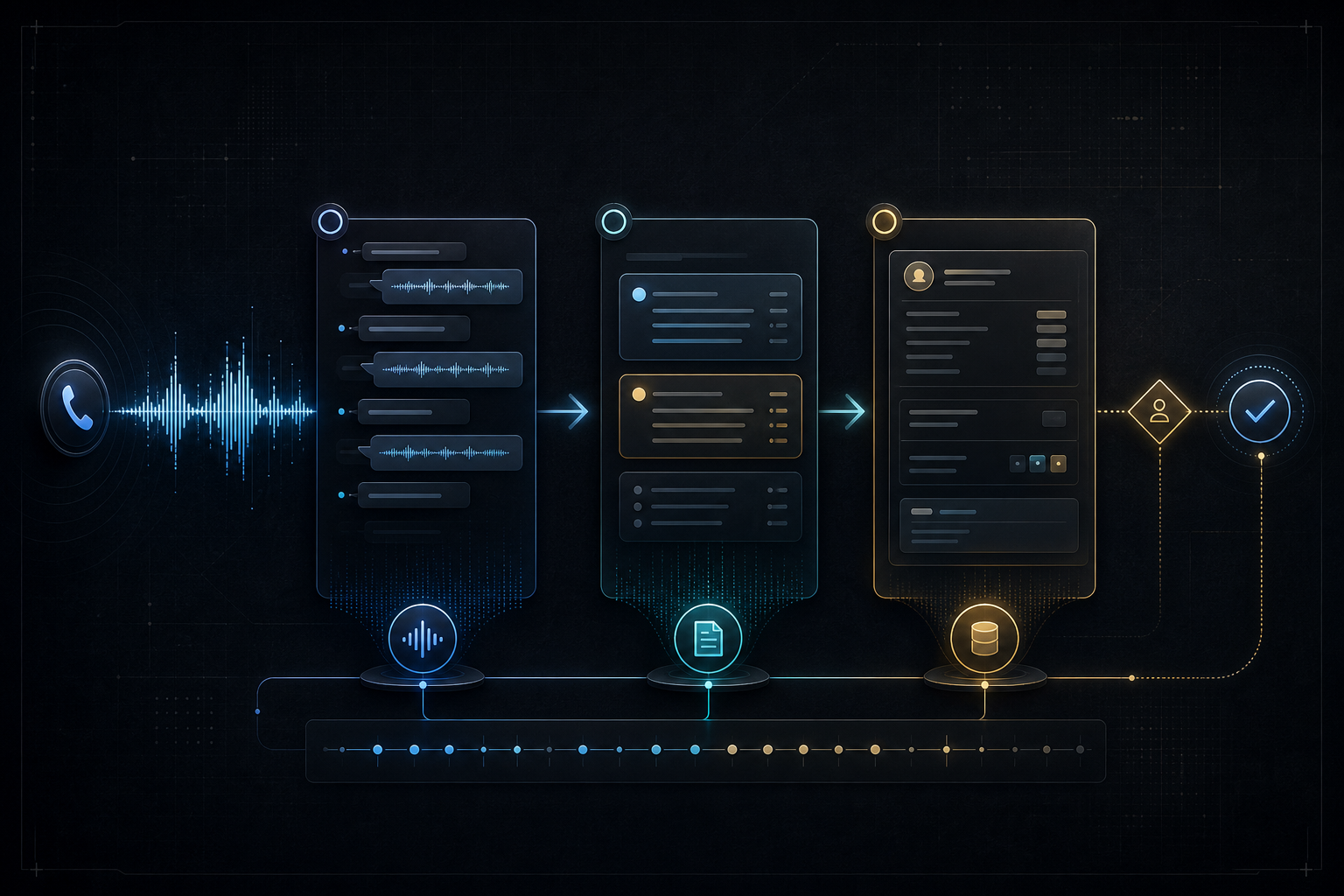
$ summarize call --contract CALL-6
> capture: call / tenant / source receipt
> prepare: transcript / redaction / context
> propose: summary / evidence / uncertainty
> validate: schema / action / policy
> gate: reviewer / authority / expiry
> commit: CRM task / read-back / recoveryAn AI call summary is useful when it makes the next operational step easier to inspect. It is unsafe when a fluent paragraph silently becomes the customer record, a sales commitment, or a task assigned to the wrong person. The practical scope is narrower: preserve the call source, build a permitted transcript packet, return a structured summary with evidence and uncertainty, apply CRM rules, and verify the saved record.
This is a long-tail implementation guide, not a claim that a model replaces a sales or support team. Broad local AI delivery remains on the AI specialist Armenia page. For implementation scope, see AI automation; public proof remains separate in the case-studies hub.
1. Start with the call record and its data boundary
A reliable workflow starts before transcription. A call event needs a stable identifier, tenant boundary, recording or transcript reference, speaker labels when available, source timestamps, consent or retention state, and the CRM object that may receive a result. A model does not need unrestricted recordings, every historical note, unrelated contacts, or credentials.
Define the permitted question first:
- Is the output an internal summary, a follow-up draft, a review task, or a proposed CRM field update?
- Which parts of the transcript can be used, retained, or shown to an operator?
- Which statements are evidence from the call and which are interpretation?
- Which topics must always route to a human: pricing commitments, contract changes, payment disputes, legal requests, security incidents, deletion requests, or an explicit request for a person?
- Who owns an ambiguous contact match, a poor transcript, and a rejected next action?
Keep source and proposal separate. A source envelope might look like this:
{
  "callId": "call-2026-08-09-041",
  "tenantId": "workspace-42",
  "recordingRef": "sealed://calls/041",
  "transcriptVersion": "asr-v3",
  "crmContactId": "contact-884",
  "policyVersion": "CALL-6",
  "retentionState": "permitted_internal_review"
}
The source envelope records what entered the workflow. It is not a model prompt. The model receives a smaller, approved packet: selected transcript spans, allowed CRM context, a fixed output schema, and the action taxonomy. If speaker attribution is uncertain, preserve that uncertainty rather than turning it into a confident customer statement.
2. Use a CALL-6 workflow: source, summary, policy, owner, read-back
The model may help turn a long conversation into an operator-ready brief. It must not turn an uncertain sentence into an authoritative CRM update. One controlled sequence is CALL-6:
- Capture an identifiable call receipt, source references, tenant boundary, and applicable retention/consent state.
- Prepare a bounded transcript packet: normalize timestamps, redact excluded data, mark speaker uncertainty, and preserve transcript version.
- Propose a typed summary with evidence spans, unresolved questions, declared next actions, and an uncertainty band.
- Validate schema, CRM object identity, action taxonomy, required fields, and policy constraints without asking the model to decide them.
- Review or gate commitments, sensitive topics, ambiguous identity, weak transcript evidence, and consequential updates to a named owner.
- Commit and reconcile one idempotent internal write or approved task, then read it back from the CRM and record correction/recovery.
The CRM needs separate fields for the source call, proposal, deterministic policy decision, final human-edited outcome, and destination receipt. A green job status proves only that code ran; it does not prove that the intended contact, task, or follow-up exists in the CRM.
For example, a model proposal can be deliberately constrained:
{
  "callId": "call-2026-08-09-041",
  "summary": "Customer asked for an internal review of the current onboarding workflow.",
  "evidence": [{ "start": "00:08:14", "end": "00:08:29", "text": "Could your team review our onboarding flow?" }],
  "nextAction": "create_review_task",
  "owner": "account_team",
  "confidenceBand": "review_required",
  "policyVersion": "CALL-6"
}
The proposal is not permission to promise a delivery date, change a contract, update a lifecycle stage, or message the customer. Those are separate decisions with their own authority.
3. Make CRM and transcript contracts explicit
Call summaries cross a telephony or meeting provider, speech-to-text, a context service, an AI step, CRM, task system, and operations. Give each layer a narrow responsibility.
| Component | Owns | Must make inspectable |
|---|---|---|
| Call intake | provider receipt and source reference | call ID, tenant, timestamps, retention state |
| Transcript processor | versioned transcription | speaker/segment provenance and uncertainty |
| Context builder | allow-listed CRM packet | fields, redaction, expiry, source links |
| AI summarizer | bounded proposal | schema, evidence, open questions, uncertainty |
| Policy gate | deterministic action eligibility | permit, review, reject reason, expiry |
| CRM/task destination | authoritative state | idempotency key, saved IDs, read-back |
| Operations | correction and recovery | named owner and reconciliation record |
Use an idempotency key derived from the tenant, call ID, transcript version, action type, and policy version. A provider retry or a regenerated transcript must not create duplicate tasks or overwrite a human correction. Before an action is committed, compare the expected CRM record version with the current version; if the record changed since the proposal, pause for review.
The policy gate should route to review when the call source is missing, transcript quality is insufficient, identity is ambiguous, evidence does not support the proposed action, the action is outside the allowed taxonomy, the contact has a newer human note, or the CRM write cannot be read back. For adjacent boundaries, see AI CRM enrichment and AI sales email personalization.
4. Test the uncomfortable cases before launch
Do not validate this workflow only with clean calls and perfect transcripts. Build a representative acceptance set with the languages, audio quality, interruptions, accents, product terminology, and call types the team actually handles. Preserve the minimum data needed for evaluation and keep fixtures under the applicable retention rules.
Include cases such as:
- a caller changes their mind or makes two unrelated requests;
- speakers overlap, a name is misheard, or a transcript segment is missing;
- a call has a weak contact match or multiple possible CRM records;
- a customer asks for a human, deletion, contract change, refund, or security help;
- the call mentions a date or price that should not become a commitment;
- transcription is regenerated after an operator already corrected the summary;
- the CRM accepts a write but the read-back is unavailable;
- a provider retries the same call event;
- a model returns valid JSON with an unsupported action;
- a policy changes between proposal and commit.
Acceptance criteria should be observable:
- Every summary references a stable source and transcript version.
- Each important conclusion has permitted evidence or is marked unresolved.
- A human can edit or reject a summary without changing hidden model state.
- Sensitive, commercial, and ambiguous actions reach the configured review path.
- Retries cannot create duplicate tasks or overwrite newer human changes.
- The destination read-back either confirms the write or creates a visible reconciliation task.
- The non-AI process remains usable if transcription, model, or CRM integration is paused.
Evaluate failure classes separately. A missing nonessential detail is not the same as assigning a follow-up to the wrong contact or turning a tentative discussion into a promise. This distinction determines whether the fix belongs in transcription, context selection, schema design, policy, CRM integration, or operational training.
5. Operate on signals that reveal weak contracts
Useful operational signals include source-receipt failures, transcript-version changes, summaries sent to review, unsupported action proposals, evidence gaps, operator correction reasons, duplicate-action blocks, stale CRM-version blocks, read-back failures, reconciliation age, and pause-switch use. They show where the workflow needs attention; they do not prove call quality, conversion, customer satisfaction, or revenue.
Assign an owner for call taxonomy and review rules, plus an owner for integration incidents. Version prompts, schemas, transcript providers, policies, and destination mappings so that an operator can explain why a particular proposal was produced. Keep a normal manual note and task path so the team can continue work while the AI step is investigated.
CALL-6 production acceptance gate
require(call.id && call.tenantId && transcript.version && policy.version);
require(proposal.schemaValid && proposal.evidence.length && action.isAllowed);
commit = reviewer.approved && destination.readBack && recovery.owner;
This gate does not promise cleaner calls or better sales outcomes. It checks that a proposed next action has an identifiable source, bounded context, valid structure, permitted authority, destination evidence, and a recovery owner.
A controlled first rollout
Start with one internal use case such as an operator-reviewed summary and one reversible task type. Use a small set of representative calls, including messy and uncomfortable cases. Compare the proposal with the final human record, keep the source reference, and verify the CRM read-back. Expand only when the team understands the correction patterns, identity boundary, retention rules, and recovery path.
That is the useful role of AI call summaries: they make the handoff from conversation to work easier to inspect while people, policies, and CRM records retain authority. To scope a controlled implementation, discuss an AI automation pilot.
require(call.id && call.tenantId && transcript.version && policy.version);
require(proposal.schemaValid && proposal.evidence.length && action.isAllowed);
commit = reviewer.approved && destination.readBack && recovery.owner;