Omnichannel AI Support: One Controlled Layer Across Messengers
Unify support context without making one model the authority over every channel
Conversation contracts, policy gates, recovery paths and explicit human ownership
Original CHANNEL-8 reference architecture with production acceptance criteria
omnichannel AI support, AI customer support automation, messenger support layer, conversation state, human review, support integration and controlled AI workflow
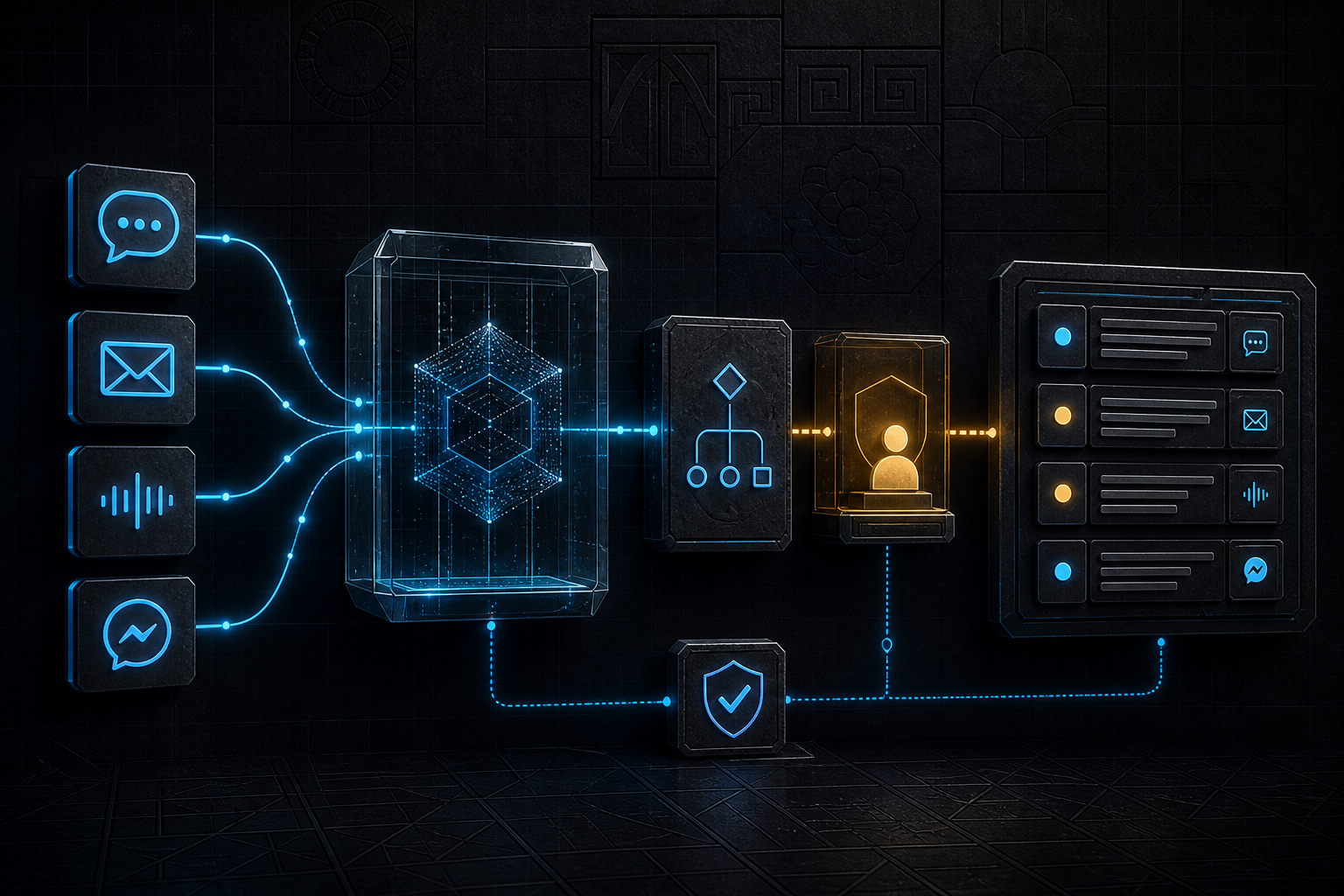
$ support layer --contract CHANNEL-8
> receive: channel / external-id / timestamp
> resolve: tenant / contact / conversation
> normalize: message / attachment / consent
> propose: intent / evidence / uncertainty
> gate: policy / owner / escalation
> commit: idempotent action / read-back
Omnichannel AI support is not one chatbot copied into every messenger. It is a controlled layer that receives events from several channels, retains the source record, resolves the right customer conversation, and proposes a bounded next step. The channel is an input boundary; it should not decide what the system knows, who may act, or whether an answer is authoritative.
This guide focuses on the long-tail architectural question: how to put one AI-assisted support layer above chat, email, voice, and messenger channels without losing identity, policy, recovery, or ownership. It does not replace the broad AI specialist Armenia landing page. For implementation scope, see AI automation; public delivery evidence belongs separately in the case-studies hub.
1. Start with the support problem and its non-negotiable requirements
Customers experience one company, while a support team may receive web chat, email, phone transcripts, WhatsApp-style messages, social DMs, and forms through different providers. A shared AI layer can reduce repeated triage and give an operator coherent context. It becomes unsafe when it assumes that a matching display name is the same person, treats an incomplete webhook as a complete conversation, or performs a customer-facing action without the channel's actual policy and delivery receipt.
State the narrow job before choosing a model:
- normalize an incoming event into a durable internal envelope;
- find or create a conversation only under tenant and identity rules;
- propose intent, language, summary, routing, or draft assistance from permitted context;
- apply deterministic policies for consent, retention, queues, escalation, and authority;
- preserve the original source and make correction, recovery, and read-back observable.
The system is not entitled to merge every message from every channel. An email address, provider contact ID, phone number, and social profile may refer to the same person, different people, or an ambiguous case. Identity resolution needs confidence boundaries, evidence, and a manual path. Similarly, a message that looks like a request for an account change, refund, or deletion must not become an automated operation merely because an AI classifier labels it confidently.
An initial event envelope should have a stable internal ID, a provider receipt, tenant boundary, channel-specific external ID, timestamp, content reference, and policy version. It should record whether the message is original content, a provider-generated summary, a retry, or an update. The normalized envelope is a contract for downstream components, not a model prompt.
{
  "eventId": "evt-2026-08-09-0184",
  "tenantId": "workspace-42",
  "channel": "web_chat",
  "externalMessageId": "provider-msg-8841",
  "conversationKey": "pending-resolution",
  "sourceTimestamp": "2026-08-09T10:15:00Z",
  "contentRef": "sealed://message/8841",
  "policyVersion": "CHANNEL-8",
  "delivery": "received"
}
The AI packet can be smaller: approved message text or a redacted summary, available queues, language policy, and a request for a fixed schema. It does not need unbounded CRM history, unrelated private notes, credentials, or every past conversation. Keeping the source envelope and the model packet distinct helps a reviewer discover whether a bad proposal came from bad identity resolution, missing policy, incomplete context, or a model error.
2. Design the shared architecture around contracts, not providers
CHANNEL-8 is a reference sequence for one controlled cross-channel support path. It is deliberately provider-neutral: a vendor adapter may change, but the internal contracts should remain inspectable.
- Receive the webhook, poll result, or import with its provider receipt and raw-content retention boundary.
- Authenticate and deduplicate the source before interpretation. Retried delivery must not create two conversations or two customer replies.
- Resolve identity inside the correct tenant. Return a match, an ambiguity state, or a new-contact candidate; do not silently merge uncertain records.
- Normalize message type, language state, attachment references, timestamps, and reply/thread relations into a canonical event.
- Build bounded context from allow-listed conversation and account fields, with redaction and expiry.
- Propose a typed AI result: intent, summary, evidence snippets, uncertainty, and a proposed route or draft. A proposal is not an instruction to send.
- Gate with deterministic policy: allowed queues, restricted categories, human-request handling, ownership, consent, and authority for the next action.
- Commit and reconcile an idempotent destination write or approved reply; record the read-back, failure state, and recovery owner.
This separation keeps each component honest. The adapter owns provider authentication and receipts. The identity service owns tenant-scoped matching. The conversation store owns ordering and durable thread state. The model can interpret only the supplied packet. The policy service decides what may happen. The queue, CRM, or messaging provider owns the final external state. Operations owns correction and incident recovery.
| Component | Input | Output that must be inspectable |
|---|---|---|
| Channel adapter | provider event | receipt, external IDs, delivery state |
| Identity resolver | tenant + source identifiers | match, ambiguity, evidence, owner path |
| Conversation store | canonical event | ordered thread, dedupe result, version |
| Context builder | allow-listed records | redacted packet, expiry, source references |
| AI layer | bounded packet | schema-valid proposal, evidence, uncertainty |
| Policy gate | proposal + policy | permit, review, escalate, or reject reason |
| Destination | approved command | idempotency key, read-back, correction path |
For routing inside the support operation, pair this architecture with AI support ticket routing. For data that returns to a CRM, the separate AI CRM enrichment guide explains why a successful write is not enough without source and read-back evidence.
3. Keep one conversation model without pretending channels are identical
“Unified inbox” should mean a shared operational view, not loss of channel facts. Email has headers and thread references; chat has delivery/read states; voice creates transcription and recording-retention questions; social platforms have provider-specific permissions and reply constraints. The canonical model should retain these distinctions while exposing a stable minimum interface.
At minimum, model a tenant, contact, channel account, conversation, message, attachment reference, event receipt, policy decision, action command, and audit record. A conversation is scoped by tenant. A message has one source channel and provider identifier even when it appears in a unified thread. A contact link may be verified, asserted by a user, probabilistic, or unresolved. These states are meaningful; they should not collapse into a single contactId just to make a demo convenient.
Use an idempotency key based on the tenant, source event, operation, and policy/action version. A retry after a timeout must not create duplicate assignments, duplicate replies, or overwrite a newer human correction. Compare the current conversation version before executing a proposal created from older context. When the write is ambiguous—for example, a provider timed out after accepting a reply—reconcile by querying the authoritative destination before retrying.
The state machine needs ordinary failure states too: received, duplicate, identity_review, context_blocked, proposal_ready, policy_review, committed, reconcile_required, and failed_with_owner. These are better than a single green “completed” status because they tell an operator what the system knows and who must act next.
4. Treat AI output as assistive evidence, not channel authority
AI is useful for tasks with bounded observable outputs: classify a support theme, detect language, summarize a long thread for an agent, extract explicit product names, propose a queue, or prepare a draft that an authorized person can edit. Require a typed result with source evidence and uncertainty. If the result does not validate, it should not reach an external system.
type SupportProposal = {
  eventId: string;
  intent: "access" | "billing" | "general" | "unknown";
  language: "en" | "ru" | "hy" | "undetermined";
  summary: string;
  evidence: string[];
  confidenceBand: "proceed" | "review_required";
  proposedRoute: "access" | "billing" | "general" | "human_review";
  policyVersion: "CHANNEL-8";
};
Do not rely on a raw confidence number as permission. A deterministic policy can require review whenever identity is unresolved, the message asks for a human, a restricted subject appears, evidence is missing, the channel is outside an approved rollout, or the requested action is customer-facing. Keep model and prompt versions in the audit record, but never make an operator reproduce hidden context before they can correct a proposal.
The same boundary matters for multilingual support. Preserve original text and detected language separately. Evaluation needs representative Armenian, Russian, and English cases if those are in actual scope; a system that performs acceptably on English fragments cannot be assumed safe in another language. Do not publish Armenian copy or route it as a supported production capability until the content and workflow have a human-reviewed path.
5. Design for failure modes before the first production channel
An omnichannel layer fails at integrations and state boundaries as often as it fails at classification. Test the uncomfortable cases before the rollout:
- the same webhook arrives twice or out of order;
- a source signature is invalid or a provider retries after a long delay;
- a contact match points to two records in the same tenant;
- the same phone number appears in separate tenants;
- an attachment is unavailable, unsafe to process, or has expired;
- a model returns valid JSON with an unknown queue or unsupported language;
- a policy changes after the proposal but before the command;
- a human corrects the conversation while a worker is retrying;
- the queue assignment succeeds but its read-back is unavailable;
- a customer asks to stop automation or to speak to a person;
- the provider rate-limits or returns an ambiguous send outcome;
- an operational pause needs to disable AI proposals without losing intake.
Each one needs an explicit safe state. For example, unresolved identity routes to an owner instead of merging records; an unknown label routes to review; an ambiguous send becomes reconcile_required, not a retry loop; and a paused model path still accepts and records the source event. A dead-letter queue is useful only if each entry has a reason, a source reference, a retry rule, and an accountable owner.
6. Test contracts, not a polished demo
Use layered tests. Unit tests validate normalizers, tenant scoping, idempotency key generation, schema checks, policy predicates, and action builders. Contract tests replay provider fixtures against each adapter. Integration tests exercise a real or sandbox destination and assert read-back. End-to-end tests cover a full event through the review queue, including an operator correction. Operational drills simulate a provider outage, duplicate delivery, and model-path pause.
Build an acceptance set from representative channels, languages, message lengths, attachments, and known edge cases. Store only the least sensitive test data necessary, and retain fixture provenance. Review results by failure class rather than a single “AI accuracy” number. An imperfect category suggestion can be harmless if it always reaches review; a mistaken customer reply or a cross-tenant merge is a separate severity class and should tighten the release gate.
Useful operational signals are inspectable: duplicate-event blocks, unresolved identity rate, policy-block reasons, model schema failures, review queue age, human corrections, destination read-back failures, reconciliation duration, and channel-specific provider errors. They reveal weakness in the system but do not prove resolution quality, customer satisfaction, or business impact.
CHANNEL-8 production acceptance gate
require(event.id && event.channel && tenant.id && policy.version);
require(context.allowed && proposal.schemaValid && action.isPermitted);
commit = owner.approved && destination.readBack && recovery.recorded;
The gate does not promise that support will be faster or that an AI system can replace a team. It verifies that an intended action has identifiable input, a permitted context, a valid decision boundary, accountable approval, destination evidence, and a way to recover.
A controlled first rollout
Begin with one low-risk channel, a narrow taxonomy, review-first routing, one named operational owner, and a reversible destination action. Run it against representative historic or sandbox fixtures, then a small live cohort only after adapter, policy, and recovery checks pass. Keep a clear pause switch and a normal non-AI intake path. Expand to a second channel only when identity, ordering, and correction behavior are understood—not because the first dashboard appears green.
That is the practical value of omnichannel AI support: a single inspectable layer for support work while providers, policies, people, and verified downstream systems keep their own authority. To review a bounded architecture and rollout plan, request an AI automation architecture review.
require(event.id && event.channel && tenant.id && policy.version);
require(context.allowed && proposal.schemaValid && action.isPermitted);
commit = owner.approved && destination.readBack && recovery.recorded;